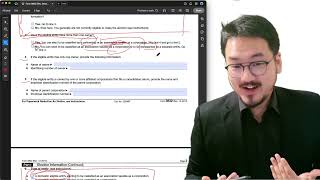
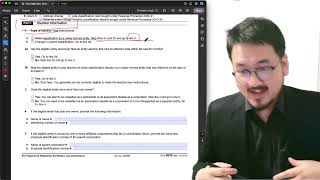
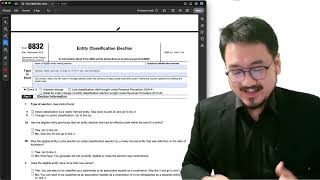
Form 8832 Entity Classification: Advanced Scenarios
Late-election relief, the 60-month revocation limit, electing C-corp for treaty access, the no-S-corp trap, the 75-day / 12-month effective-date rules, retained earnings, and state non-conformity — for foreign-owned US LLCs.
 Lipai WangIRS-registered tax professionalResearch Report
Disclaimer: This is independent research and educational analysis, compiled from the IRS “About Form 8832” page, Treas. Reg. section 301.7701-3, Rev. Procs. 2009-41, 2010-32, and 2013-30, Publication 515, and IRS CP277/CP278 notice guidance current to mid-2026. It is not legal or tax advice, and entity-classification outcomes turn on intensely fact-specific timing, ownership, and treaty questions. Anyone weighing a Form 8832 election — especially a late election, a C-corp election for treaty access, or anything touching a foreign treaty position — should consult a qualified attorney or tax adviser before filing.
Key Takeaways
- A foreign owner does not change the domestic default classification: a US LLC with one member is disregarded and one with two or more members is a partnership unless it elects otherwise on Form 8832.
- The effective date can reach only 75 days back or 12 months forward of the filing date. Do not rely on the regulation's clipping rule to rescue a January 1 election filed in April — the IRS may instead deny it with notice CP278.
- Past the 75-day window, Rev. Proc. 2009-41 is the simplified late-election path while you are still within 3 years and 75 days of the requested date — it needs reasonable cause, consistent filing, and the right magic-words statement.
- Once an entity changes classification by election, the 60-month limitation generally blocks another election for five years — and swapping one foreign owner for another rarely cures it unless the more-than-50% ownership-change exception is genuinely met.
- A nonresident-alien owner cannot have a valid S corporation, so Form 2553 does not work for a foreign individual; electing C-corp can preserve dividend-article treaty benefits but usually defeats the transparent-entity treaty position on the operating income.
1. The framework that drives every edge case
Form 8832 is the check-the-box election. For a domestic eligible entity the default federal classification is mechanical: a domestic LLC with two or more members is a partnership, and one with a single owner is a disregarded entity. A foreign owner does not alter those domestic default rules — so the form is only needed when the entity wants a classification other than its default, or later wants to change.
The election must be filed with the IRS service center designated on the form, must include all required information including the EIN, and must normally be attached to the entity's federal return for the year of the election — or, if the entity itself has no filing obligation that year, to a direct or indirect owner's return.
Classification changes run through a strict deemed-transaction regime. If a disregarded entity elects corporate status, the owner is deemed to contribute all assets and liabilities to a corporation for stock; if an association elects out of corporate status, the regulations deem a liquidation, followed where applicable by a contribution to a new partnership. The classification change is treated as occurring at the start of the effective date, while the deemed transfers occur immediately before the close of the prior day. That ordering can materially change downstream federal tax results, which is why Form 8832 is better understood as a transaction-ordering election than a routine form.
2. The effective-date trap — 75 days back, 12 months forward
Under Treas. Reg. section 301.7701-3(c)(1)(iii), an election may be effective no more than 75 days before the filing date and no more than 12 months after it. The regulation says an overreaching date is clipped to the maximum period allowed — but in real service-center processing the IRS may instead issue a denial rather than silently salvaging the intended year-start, especially where the filer clearly reached for a date more than 75 days back and did not request late-election relief.
CP278 is the IRS's published denial notice for exactly this situation: it states the requested effective date could not be accepted because the form was not filed within 75 days of that date. The practical lesson for foreign-owned LLCs is blunt — do not count on the clipping rule to preserve a January 1 effective date on a form mailed in April or later.
The flip side is CP277, the IRS's public acceptance notice, which confirms the election was accepted and tells the entity to file the return that matches it. If a client says they received an 8832 acceptance, ask for the actual notice and confirm whether it is CP277; if it is a timing denial, the CP278 guidance is the better map.
3. Late-election relief — Rev. Proc. 2009-41 (and the 2010-32 trap)
The simplified path, and the foreign procedure that is constantly mis-cited
Rev. Proc. 2009-41 is the main simplified late-election relief route, and it is broader than many remember: it covers both late initial classification elections and late changes. It is the exclusive simplified route while the entity is within 3 years and 75 days of the requested effective date, and an entity that fits the procedure pays no ruling user fee.
To qualify, the failure must be solely that Form 8832 was not filed on time; the entity must either have no return due yet for the first intended year or have timely filed all required returns consistent with the requested classification (a return filed within six months of its due date, excluding extensions, is treated as timely); affected persons must have filed consistently where the entity had no filing requirement; there must be reasonable cause; and the 3-year-and-75-day window must still be open.
The statement requirements are exacting, and defective filings usually fail on them rather than on the substance. Within the window, the entity files a completed, properly signed Form 8832, indicates it is filed pursuant to the revenue procedure, includes a declaration that the eligibility elements are met, and attaches a reasonable-cause statement. Because the public form still reflects paper-era mechanics, the procedure also instructs filers to write “Filed Pursuant to Rev. Proc. 2009-41” at the top and attach a dated penalties-of-perjury declaration signed by an authorized representative and any affected persons with personal knowledge.
Rev. Proc. 2010-32 is narrower and frequently mis-cited in foreign-owned LLC work. It is not a general late-election procedure for domestic foreign-owned LLCs. It corrects a foreign owner-count mismatch: a qualified foreign eligible entity that filed an otherwise valid Form 8832 based on a reasonable but mistaken assumption about whether it had one owner or more than one. If the conditions are met, the IRS treats an election to partnership as an election to disregarded status (or vice versa), and the filer submits a corrected form marked “FILED PURSUANT TO REVENUE PROCEDURE 2010-32.”
If the entity is outside Rev. Proc. 2009-41 or fails its consistency or reasonable-cause conditions, the taxpayer is back in section 301.9100 relief territory, requesting a discretionary time extension by private letter ruling — relief the IRS still grants where the taxpayer acted reasonably and in good faith and the government is not prejudiced.
4. The 60-month revocation limit and its exceptions
There is no special “revocation statement” regime for Form 8832. In practice you revoke a prior choice by filing a new classification election — and that runs straight into the 60-month limitation of Treas. Reg. section 301.7701-3(c)(1)(iv): once an eligible entity changes classification by election, it generally cannot change again by election for sixty months.
Two exceptions matter. First, an election by a newly formed eligible entity that is effective on its date of formation is not treated as a “change,” so it does not start the 60-month clock. Second, the Commissioner may permit a new election inside the sixty months if more than 50% of the ownership interests on the effective date of the later election are held by persons who held no interest on the filing date or effective date of the prior election.
For foreign owners, two consequences follow. Once an LLC has elected association status, merely adding or removing members does not undo it, because an association's classification is not affected by changes in the number of members. And swapping one foreign owner for another does not automatically solve the 60-month problem — the test cares about who owned the interests, not whether the same owner moved to a new country of residence or a better treaty profile.
5. Electing C-corp for treaty access — when it helps, when it defeats
For a foreign owner, electing C corporation status can either preserve or destroy a treaty position, depending on which position is being protected. Where a foreign-owned US LLC stays fiscally transparent, treaty analysis typically runs under the fiscally transparent entity rules: IRS Publication 515 explains that treaty benefits may be available on income derived through a disregarded or flow-through entity if the relevant treaty and residence rules treat the item as derived by a treaty resident.
Once the LLC elects to be a corporation, the foreign owner usually loses any treaty position that depends on directly deriving the operating income through a transparent US entity — the classic “defeats treaty” outcome. The corporation becomes the taxpayer on the business income, and the owner's treaty analysis shifts to the treatment of later payments out of the corporation (dividends, interest, royalties), where reduced withholding generally requires the right documentation, commonly Form W-8BEN or W-8BEN-E, and may implicate Form 8833 disclosure on positions the owner takes directly.
The same election can preserve a different treaty benefit. If the owner wants the US business behind a domestic corporate blocker and expects value to leave as dividends rather than directly allocated profit, the treaty question becomes whether the shareholder qualifies under the dividend article and any limitation-on-benefits rules. In that fact pattern corporate status can improve administrability and preserve shareholder-level treaty withholding on outbound payments — even as it sacrifices the transparent-entity analysis on the underlying operating income. These are two different treaty positions, and owners routinely conflate them.
Timing is not optional. The service center generally notifies the entity whether the election is accepted, and a determination usually arrives in roughly 60 days. A corporation's Form 1120 is generally due on the 15th day of the fourth month after its year-end, so an LLC that elects corporate status midyear usually files a short-period first corporate return beginning on the effective date.
6. Why a foreign owner cannot elect S-corp — traps and “workarounds”
S corporation status is off the table in the typical foreign-owner fact pattern. Section 1361(b)(1)(C) says a small business corporation cannot have a nonresident-alien shareholder, and the regulations repeat that a corporation with a nonresident-alien shareholder is not a small business corporation. So a foreign owner cannot solve this by filing Form 2553 directly, and filing Form 8832 first does not cure the shareholder-eligibility defect.
There is a deeming rule — a timely, valid Form 2553 by an eligible entity is treated as including the association election under Treas. Reg. section 301.7701-3(c)(1)(v)(C) — but it only works if the entity already satisfies every S-corporation eligibility requirement. A nonresident-alien shareholder on the effective date can invalidate or terminate the election, and late S-election relief under Rev. Proc. 2013-30 does not forgive substantive ineligibility.
The “workaround” talk is therefore narrower than marketers suggest. There is no clean structure that lets a foreign individual stay the shareholder and keep a valid S corporation, because S corporations also cannot have a corporate shareholder outside narrow exceptions that do not help here. The realistic options are to keep pass-through treatment, interpose a domestic C-corporation blocker (after which the operating company is no longer an S corporation owned by the foreign person), or wait until the interests are held by persons who are genuinely eligible S shareholders on the election's effective date.
7. Effective dates, Form 2553, and retained earnings
Because the deemed-transaction rules treat a disregarded entity's election to corporate status as a section 351-style contribution of assets and liabilities for stock, the pre-election earnings question is widely misunderstood. Corporation basis is generally determined under section 362, shareholder stock basis under section 358, and gain can arise under section 357(c) if liabilities exceed basis.
As an inferential matter, pre-election income of a disregarded entity was already the owner's income before the corporation existed; it does not become the corporation's historical earnings and profits merely because the owner later checked the corporate box. What carries over economically is asset basis, liability structure, and stock-basis consequences — not a free block of legacy corporate E&P. A later corporate distribution is tested against the corporation's own E&P, while pre-election cash in the business may have to be analyzed as contributed capital, a shareholder receivable or payable, or part of the deemed-incorporation balance sheet.
On the Form 2553 interaction: a valid S election by an eligible entity is deemed to include the association election, so a qualifying entity need not file Form 8832 separately to be treated as a corporation for an S election. But, as above, that path is closed to a foreign individual because the shareholder-eligibility test must still be met. The practical point is to treat sloppy owner-draw accounts and undocumented intercompany balances as a real risk — they frequently become the hardest part of the opening corporate return, especially when the first corporate year begins midyear.
8. State non-conformity — California, New Jersey, Texas
Federal classification does not automatically govern the states. California is the most nuanced of the three: it generally conforms to the federal check-the-box election, treats the federal election as the California election (no separate California classification election), and instructs filers to attach a copy of the federal Form 8832 to the California return for the year the election is effective; an LLC treated as a corporation files California corporate returns such as Form 100 or 100S. California can still produce different economic results through its own fees and filing regimes, but it is not a broad nonconformity state on classification itself.
New Jersey is the classic divergence point, but mainly for S corporation status: federal S status does not automatically flow through, and a corporation must separately apply for New Jersey S treatment, generally within 3 1/2 months after the start of the fiscal year. Fail to do that and New Jersey taxes the entity as a C corporation on income allocated to the state — a trap for taxpayers who assume a federal election works everywhere.
Texas is a different kind of nonconformity. Texas franchise-tax responsibility follows the entity's legal formation, not its federal tax classification: a single-member LLC that is disregarded for federal income tax is still a taxable entity for Texas franchise tax. So a federal Form 8832 election can change the federal income-tax posture while leaving Texas franchise-tax exposure fundamentally unchanged.
9. The reverse-flow problem — foreign entities owned by US persons
Form 8832 also governs the reverse-flow case, where the electing entity is not a domestic LLC but a foreign eligible entity owned by US persons — and the foreign default rules are different. Under Treas. Reg. section 301.7701-3(b)(2), a foreign eligible entity defaults to a partnership if it has two or more members and at least one lacks limited liability, to an association if all members have limited liability, and to a disregarded entity only if it has a single owner that lacks limited liability.
Classification of a foreign eligible entity becomes “relevant” when an event creates a US return, information-return, or statement obligation for which classification matters — the regulations use a US person acquiring an interest that triggers a Form 5471 obligation as the example. If classification was never relevant, the default is set when relevance first arises; if it is not relevant for 60 consecutive months, the default can effectively reset when relevance later resumes. A dormant or non-US-relevant foreign entity can therefore spring to life under an unexpected default the moment a US person acquires an interest or an information return comes due.
In reverse-flow planning, then, Form 8832 is often used less to “opt into corporation” and more to avoid landing in the wrong US international-reporting regime — because the wrong default can turn an expected branch or partnership outcome into a foreign-corporation result with very different substantive rules and information returns.
10. Processing failures and the Spanish “Formulario 8832” pitfalls
The most common processing errors are unglamorous but expensive. The election is not accepted unless the form carries all required information, including the entity's identifying number, and unless it is properly signed — by all current owners, or by a duly authorized officer, manager, or member representing under penalties of perjury that they have authority. Retroactive elections add traps: a person who was an owner during the retroactive period but is no longer an owner when the form is filed must also sign, and a classification-change filing may need signatures from those who were owners on the date the deemed transactions occur. Many “mysterious” rejections are really signature or owner-consent failures.
For Spanish-speaking owners, the problem is not only language but a mismatch between the IRS's multilingual support and its English-only business forms. The IRS maintains a large Spanish-language site and Spanish pages for many individual forms, but it states that the English version is the official version of federal guidance — and the public materials for Form 8832 consist of an English “About Form 8832” page and the English PDF. So when an owner or preparer references a “Formulario 8832,” they are usually working from an unofficial translation, a bilingual checklist, or a preparer intake sheet, not an official IRS filing document.
That creates predictable pitfalls: mistranslating the effective date, misunderstanding who must sign, assuming the IRS automatically treats a late request as retroactive to formation, and confusing a request for corporate classification on Form 8832 with an S election on Form 2553. A bilingual cover memo can help, but the filed document still has to be the official English Form 8832 and should track the exact language the revenue procedures require — especially when invoking Rev. Proc. 2009-41.
- Confirm every required signer — including former owners for the retroactive period and owners on the deemed-transaction date.
- Include the EIN; an election missing required information is not accepted.
- When relying on Rev. Proc. 2009-41, write the magic-words line at the top and attach the dated penalties-of-perjury declaration.
- Treat any “Formulario 8832” as a study aid only — file the official English Form 8832.
Form 8832 elections at a glance
| Scenario | Available to a foreign individual owner? | Key timing / rule |
|---|---|---|
| Single-member LLC elects C-corp | Yes (deemed section 351 incorporation) | 75 days back / 12 months forward; short-period 1120 if midyear |
| Multi-member LLC elects C-corp | Yes (loses partner-level transparency) | Same effective-date window; deemed liquidation/contribution rules |
| Elect S-corp (via Form 2553) | No — NRA shareholder barred by section 1361(b)(1)(C) | Form 8832-first does not cure ineligibility |
| Late initial / change election | Yes, if it fits Rev. Proc. 2009-41 | Within 3 years + 75 days; reasonable cause + consistent filing |
| Re-elect / revoke after a prior election | Generally blocked for 60 months | Exceptions: new entity on formation; >50% ownership change |
Related on ForeignLLCTax
Primary sources
- IRS — About Form 8832, Entity Classification Election
- Treas. Reg. § 301.7701-3 — Classification of certain business entities (Cornell LII)
- Treas. Reg. § 301.7701-2 — Business entities; definitions (Cornell LII)
- IRS — About Form 2553, Election by a Small Business Corporation
- IRS — Understanding your CP277 notice (Form 8832 accepted)
- IRS — Notices and letters
- 26 U.S.C. § 1361 — S corporation defined (Cornell LII)
- IRS — Publication 515 (withholding on payments to foreign persons / treaty benefits)
- IRS — About Form 8833, Treaty-Based Return Position Disclosure
- IRS — About Form 3115, Application for Change in Accounting Method
- California FTB — Limited liability company filing information
- Texas Comptroller — Franchise tax overview