Disregarded Entity Explained: How Single-Member LLCs Are Taxed by the IRS

Key Takeaways
- A disregarded entity is an LLC the IRS treats as not separate from its single owner
- Single-member LLCs are automatically classified as disregarded entities — no election needed
- The LLC does not file its own income tax return; income flows to the owner
- Wholly foreign-owned disregarded entities file Form 5472 + pro forma 1120 for years with reportable transactions; zero income is not the test
What Is a Disregarded Entity?
A disregarded entity is a business entity that the IRS does not recognize as separate from its owner for federal tax purposes. The most common example is a single-member LLC — an LLC with only one owner. From the IRS's perspective, the LLC "does not exist" as a separate taxpayer; instead, all income and expenses flow directly to the single owner.
How Single-Member LLCs Are Taxed
When you form a single-member LLC in the United States, the IRS automatically classifies it as a disregarded entity by default. You do not need to file any special election for this classification — it happens automatically.
This means the LLC itself does not file a separate income tax return. Instead, the owner reports the LLC's income on their personal tax return (or, for foreign owners, through the applicable international reporting mechanisms).
The Form 5472 Exception
While the disregarded entity classification means your LLC does not file its own income tax return, there is an important exception for foreign-owned LLCs. The IRS requires foreign-owned disregarded entities to file Form 5472 with a pro forma Form 1120 to report transactions between the LLC and its foreign owner. For this purpose only, the disregarded entity is treated as if it were a corporation.
Frequently Asked Questions
Do I need to file Form 8832 for my single-member LLC to be a disregarded entity?
No. Single-member LLCs are automatically treated as disregarded entities by default. You only need to file Form 8832 if you want to change this default classification (e.g., elect to be taxed as a corporation).
If my LLC is disregarded, why do I still have IRS filing requirements?
While the LLC is disregarded for income tax purposes, the IRS has a separate reporting requirement under IRC Section 6038A for foreign-owned entities. Form 5472 is an information return, not an income tax return.
IRS Form 5472 Instructions
Official IRS source on irs.gov
Listen on Spotify
Money & Tax Talk with Rippa — 5/5 rating
Never miss an IRS deadline
Get free email reminders for Form 5472, state annual reports, quarterly estimated tax, and OBBBA rule changes — built for foreign-owned LLC owners. No spam. Unsubscribe anytime.
We respect your privacy. No spam, ever.
Need to file your foreign-owned LLC return?
Skip the CPA bill. Our guided wizard builds your IRS-ready filing package, step by step.
Includes its walkthrough video pack
Start filing →
Ask the AI tools, free
Tax Return Drafter, Catch-Up Planner, Form Reviewer, IRS Notice Decoder — purpose-built AI tools, no signup needed.
Free tier · BYOK Anthropic/OpenAI for power use
Browse tools →
Starting your foreign-owned LLC?
Vetted partners we use ourselves: doola & Firstbase for formation, Mercury for banking, Alohi for IRS faxing.
No-fluff recommendations, no Northwest
See partners →
More on Form 5472 & Foreign-Owned LLCs
 0:37
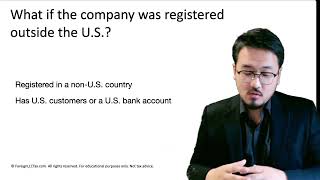
0:37U.S. Bank Account Does Not Make a U.S. LLC: Foreign Company IRS Filing Rules
 1:41
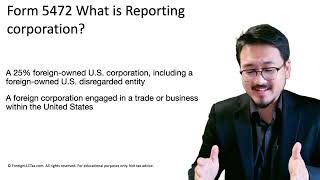
1:41What Is a Reporting Corporation? IRS Form 5472 Key Concept Explained
 1:16
1:16Do You Need to Complete All Sections of Form 5472? Common Misconceptions
 1:04
1:04Why the IRS Requires Form 5472 for Foreign-Owned LLCs: Pro Forma 1120 Explained
 0:57
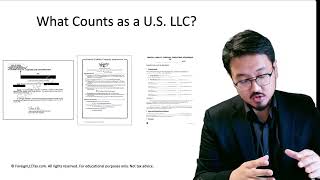
0:57What Counts as a U.S. LLC? IRS Rules for Foreign Owners (Form 5472)
 1:17
1:17