Crypto in a Foreign-Owned U.S. LLC: Form 1099-DA, the W-8 Chain, and What's Still Unsettled
The 2025-2027 broker-reporting phase-in, why the owner's W-8 — not a W-9 — controls whether a 1099-DA ever issues, whether offshore trading is a U.S. trade or business, staking and NFT income, FBAR and Form 8938, and the Form 5472 statement a crypto capital contribution requires.
 Lipai WangIRS-registered tax professionalResearch Report
Disclaimer: This is independent research and educational analysis, compiled from the 2024 final section 6045 broker regulations, the Form 1099-DA and Form 5472 instructions, Rev. Rul. 2023-14, Rev. Proc. 2024-28, and FinCEN Notice 2020-2, current to mid-2026. It is not legal or tax advice. Several core questions here — the section 864(b)(2) treatment of spot crypto, the character and source of staking rewards, Form 8938 for crypto-only accounts — are genuinely unsettled, and the phase-in rules continue to move. Anyone running digital-asset activity through a U.S. entity should confirm the current state of the law with a qualified cross-border tax adviser before filing.
Key Takeaways
- 2025 is the first gross-proceeds year for Form 1099-DA. Customer copies were due February 17, 2026, and most show proceeds with no basis. Basis reporting starts with 2026 sales, and only for lots acquired from and held at the same broker on or after January 1, 2026.
- A foreign-owned disregarded LLC documents broker accounts through the owner's Form W-8BEN or W-8BEN-E — never a W-9. A broker that can rely on that documentation treats the account as an exempt foreign person and should issue no 1099-DA at all.
- Whether spot crypto fits the section 864(b)(2) trading safe harbors is unsettled — a CFTC commodity is not automatically a tax-code commodity. The working protection in an own-account, no-U.S.-office pattern is the section 865 foreign-source default for nonresident property gains.
- Staking timing is settled (Rev. Rul. 2023-14 — income at dominion and control), but character and source are not. Plain lending interest from a U.S. payor is the riskiest profile; protocol incentives are the least mapped.
- Capitalizing the LLC with crypto is a Form 5472-reportable contribution (nonmonetary — Parts V and VI plus a fair-market-value statement) with $25,000 penalty stakes. FinCEN currently says a crypto-only foreign account is not FBAR-reportable, but the LLC is a U.S. person and mixed fiat accounts are.
1. Form 1099-DA: the 2025-2027 phase-in
Treasury's July 2024 final regulations under section 6045 put digital-asset brokers into the information-reporting system in stages. The first live stage is gross-proceeds reporting for sales effected on or after January 1, 2025. For those 2025 sales, brokers had to furnish the customer copy of Form 1099-DA by February 17, 2026 — and the IRS warned in advance that most of those first-year forms would show proceeds without basis, leaving the taxpayer to compute gain or loss from its own records.
Basis reporting begins with sales on or after January 1, 2026, and only for a narrow class of lots: digital assets the customer acquired from, and kept at, the same broker on or after January 1, 2026. Coins bought elsewhere, transferred in from a self-custody wallet, or acquired before 2026 stay uncovered — the broker reports proceeds and the basis burden stays on the books.
The rules are also phased by broker type. Custodial platforms came first. A separate December 2024 rulemaking treats certain DeFi trading front-end service providers as brokers, but only for sales on or after January 1, 2027 — so on that timetable a pure front-end interface is generally not in the live 1099-DA window for 2025-2026, while custodial exchanges are. The broker definition is broad (anyone who in the ordinary course stands ready to effect sales for others), but for sales effected at an office outside the United States it narrows to U.S. digital asset brokers — which is why the practical burden lands on U.S. custodial platforms holding the KYC file.
Two optional methods blunt the detail. Under the Form 1099-DA instructions, brokers may aggregate qualifying stablecoin sales (with a $10,000 de minimis) and specified NFT sales (with a $600 de minimis), and under those methods need not report acquisition dates or basis even for otherwise covered assets. Stablecoin-heavy and NFT-heavy activity can therefore produce coarser reporting than the headline rules suggest.
- 2025 sales — gross proceeds reported; customer copies due February 17, 2026; mostly no basis.
- 2026 sales — basis added, but only for same-broker lots acquired on or after January 1, 2026.
- 2027 sales — certain DeFi front-end providers join the broker regime on the current timetable.
2. The W-8 chain: why a correctly documented LLC gets no 1099-DA
The W-9 instructions are explicit: a U.S. disregarded entity with a foreign owner does not use Form W-9. It documents itself with the appropriate Form W-8 — and because the single owner is treated as the beneficial owner of income the disregarded LLC receives, the form is the owner's: W-8BEN for a foreign individual, W-8BEN-E for a foreign entity owner. Handing a broker a W-9 in the LLC's name is the classic mistake, and it puts the account on the U.S.-person reporting track.
That documentation is what switches the reporting machine off. The W-8BEN and W-8BEN-E instructions let a foreign beneficial owner claim an exception from Form 1099 reporting and backup withholding for items that include broker proceeds, and the digital-asset broker regulations carry an exempt foreign person concept built on the same documentation. A broker holding valid owner-level W-8 documentation it can rely on should issue no Form 1099-DA for the account.
Three failure modes produce a 1099-DA anyway. First, the broker never collected valid W-8 documentation — or it lapsed, since W-8s expire and must be refreshed. Second, the broker cannot reliably associate the form with the account, a common outcome when the account was opened in the LLC's name and the W-8 names the owner without linking the two. Third, the broker has reason to know the foreign claim is wrong — a U.S. address, U.S. phone number, or U.S. login pattern that contradicts the certification. In each case the broker reports, and for 2025 that usually means gross proceeds with no basis.
An unexpected 1099-DA is not itself a tax bill — but it is an IRS-matched document, and a foreign owner who believes the income is not U.S.-taxable still has a reconciliation problem to manage rather than ignore.
3. Is trading from abroad a U.S. trade or business?
Section 864(b)(2) contains the two statutory trading safe harbors. Trading in stocks or securities through a resident broker, or for the taxpayer's own account, is not a U.S. trade or business for a nonresident or foreign corporation. Trading in commodities gets a parallel safe harbor — but the commodity prong is textually narrower: the commodities must be of a kind customarily dealt in on an organized commodity exchange, and the transaction must be of a kind customarily consummated at such a place. Treasury regulation 1.864-2 confirms that giving a U.S. broker discretionary authority does not by itself break either covered safe harbor.
Spot crypto's fit is unsettled. Notice 2014-21 treats virtual currency as property for tax purposes, and the CFTC treats bitcoin and other virtual currencies as commodities under the Commodity Exchange Act — but the CEA label does not answer the tax question, because section 864(b)(2)(B) uses its own exchange-tied commodity definition and no published tax authority has extended it to spot crypto. The resulting ranking: assets that are genuinely securities within the tax text have the strongest safe-harbor claim; major spot crypto assets have a plausible but unconfirmed commodity argument; NFTs are weakest, fitting neither stocks-or-securities nor exchange-traded commodities comfortably.
The real protection is source, not the safe harbor. Section 865 sources a nonresident's gain from selling personal property outside the United States by default — and since crypto is property and a disregarded LLC takes its owner's tax identity, the analysis runs through the foreign owner. Own-account trading from abroad, with no U.S. footprint, generally produces foreign-source capital gains that sit outside U.S. net-basis taxation even while the section 864(b)(2) question stays open.
What flips it is the U.S. office rule. Under section 865(e)(2)(A), gain attributable to a U.S. office or other fixed place of business the nonresident maintains is U.S.-source, and section 864(c)(4)(B) supplies the bridge that can turn attributable foreign-source items into ECI. The dangerous fact pattern is not trading crypto — it is trading from a U.S. office, with U.S. personnel, dependent agents, market-making functions, or dealer-style operations. For the full framework on where that line sits, see our U.S. trade or business risk guide.
4. Staking, yield, and NFT income: timing is settled, character is not
Rev. Rul. 2023-14 settles exactly one question. A cash-method taxpayer who stakes proof-of-stake crypto — directly or through an exchange — includes the fair market value of the reward units in gross income in the year it obtains dominion and control over them. The ruling deliberately stops there: it does not classify the rewards as FDAP, services income, interest, royalties, or ECI, and there is still no published authority on the source or character of a nonresident's staking rewards.
On-chain revenue is not a tax category — each receipt has to be decomposed. A receipt that is really sale proceeds from disposing of crypto or NFTs held for investment runs through the property and source rules above. A receipt that is compensation for services (validator operations, development work) is sourced where the services are performed, and section 862(a)(3) puts work performed outside the United States on the foreign-source side. A receipt that looks like interest or a royalty pulls in the FDAP machinery of sections 871(a) and 881(a) plus the section 864(c) ECI rules.
That decomposition produces a risk ladder. Economically plain lending interest from a U.S. payor fits the statutory FDAP framework reasonably well — which makes centralized lending and yield products the riskiest profile for a foreign owner. Many DeFi yield arrangements are mixtures of swap economics, liquidity incentives, token emissions, and fee sharing, with no clean published character-and-source map: the farther a cash flow sits from ordinary interest and the closer to protocol incentives or token-based compensation, the less settled the analysis.
NFTs split into three profiles. A buy-and-sell investor looks like property trading. A creator who mints and sells looks like a business or inventory fact pattern — materially less favorable than capital trading, and the profile where U.S.-facing operations most easily create ECI exposure. Secondary-sale royalties are their own puzzle: a true royalty is sourced under sections 861(a)(4) and 862(a)(4) by where the intangible is used, but many smart-contract payment streams do not map cleanly onto the traditional royalty model.
The high-confidence summary: trading gains are the easiest category to keep outside U.S. tax. Staking, lending yield, creator revenue, and NFT-operating revenue raise progressively harder character, source, and ECI questions under current guidance.
5. FBAR and Form 8938: one clear answer, one murky one
FinCEN Notice 2020-2 is unusually direct: the current FBAR regulations do not define a foreign account holding virtual currency as a reportable account type, so a crypto-only foreign account is — at this time — not FBAR-reportable, unless it is reportable for some other reason. FinCEN's FBAR page still pointed to that notice as of mid-2026, though the notice itself signals an intent to amend the rules.
The twist for this structure is who the filer would be. The LLC itself is a U.S. person for FBAR purposes — FinCEN's definition reaches entities created or organized in the United States, so the analysis does not stop at the owner being foreign. A U.S.-organized LLC with a foreign exchange account holding only crypto is currently outside FBAR. The moment that same account also holds fiat, securities, or other reportable financial assets, it can be reportable — and many offshore exchange accounts carry fiat balances in practice.
Form 8938 has no equivalent crypto notice. For a disregarded LLC the assets are looked through to the foreign owner, who is not a specified individual — so the structure alone usually creates no 8938 filing. An LLC taxed as a domestic corporation or partnership can instead be a specified domestic entity with its own filing duty once thresholds are met. And whether a crypto-only foreign exchange account is even a financial account maintained by a foreign financial institution is open: the FATCA regulation defines financial assets by reference to securities, partnership interests, commodities, notional principal contracts, and insurance contracts — digital assets are not named.
The practical reading: FBAR currently has a direct answer and Form 8938 is a facts-and-definitions exercise. Mixed fiat accounts at custodial platforms carry the strongest reporting risk on both fronts; crypto-only accounts the weakest. In every sentence above, currently is load-bearing.
6. Funding the LLC with crypto: a Form 5472 event
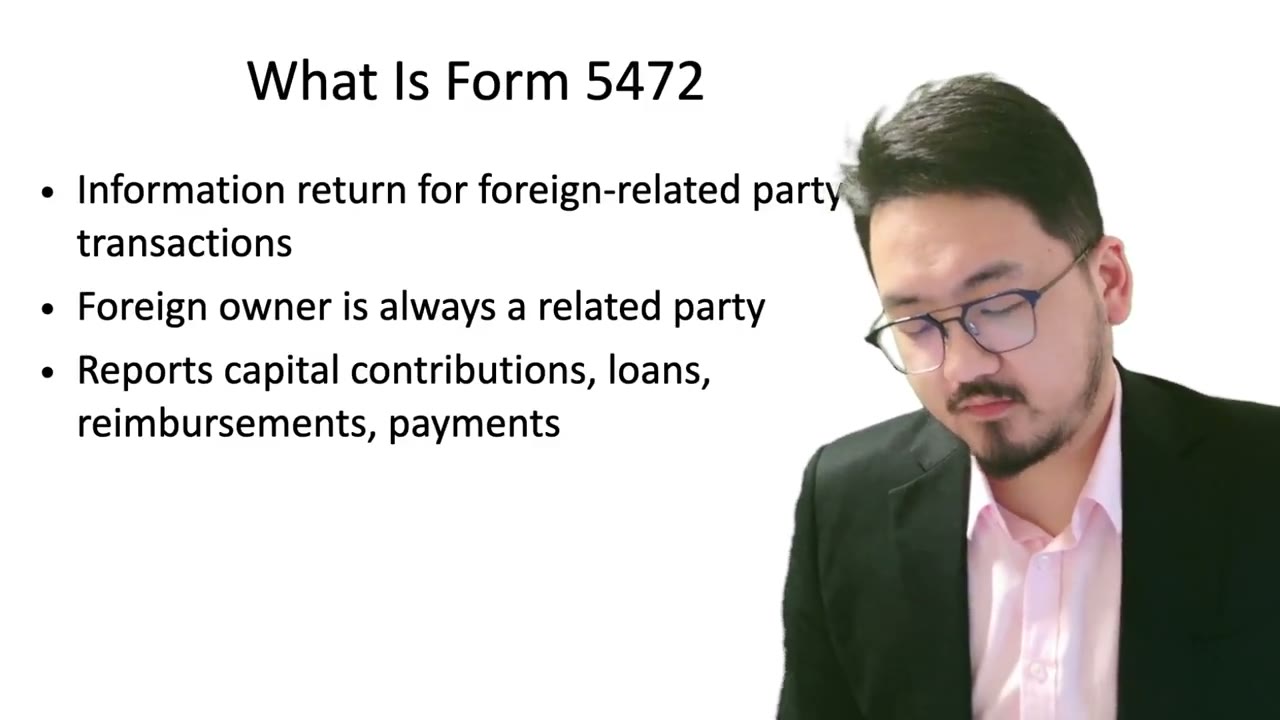
Here the law is comparatively settled. The section 6038A regulations treat a foreign-owned U.S. disregarded entity as a corporation for this limited purpose: it files a pro forma Form 1120 with Form 5472 attached, reporting its transactions with the foreign related party, by the 1120 due date including extensions.
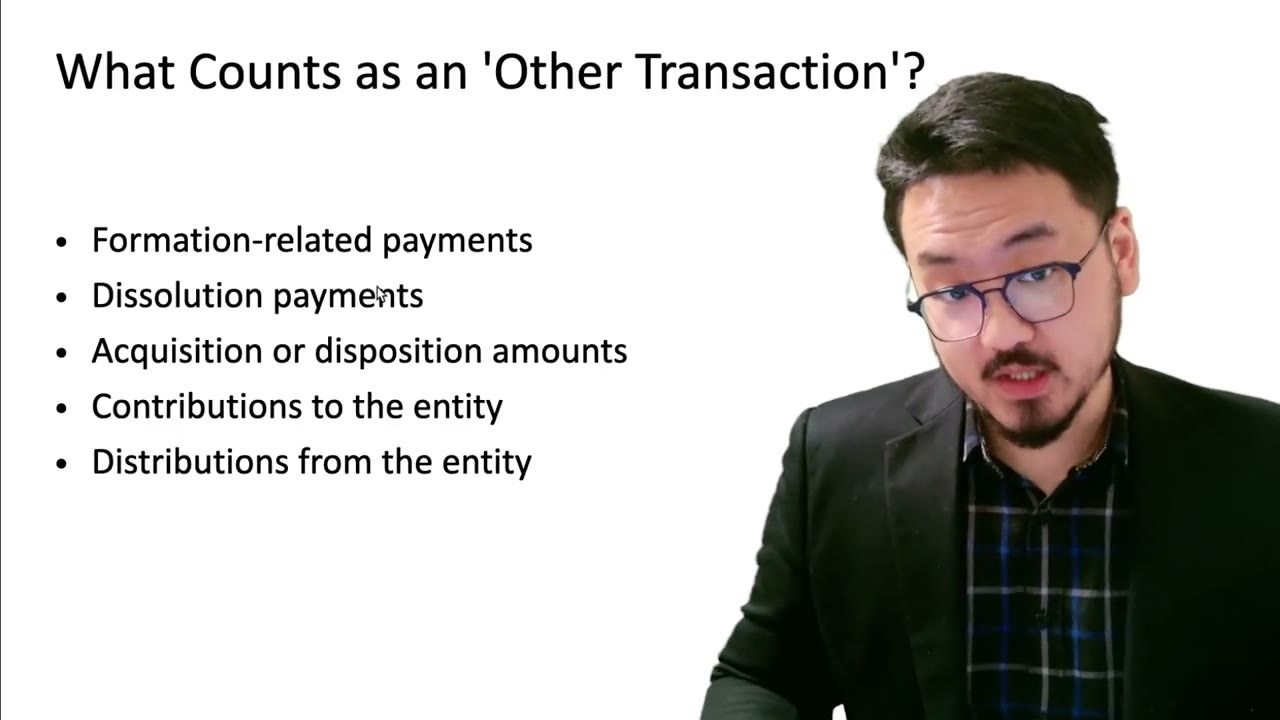
For entities that are reporting corporations only because they are foreign-owned disregarded entities, the reportable set expands to any other transaction as defined in the section 482 regulations — and the rules say expressly that this includes amounts paid or received in connection with formation, plus contributions to and distributions from the entity. The 482 definition of a transaction itself lists contributions and other transfers of property or money.
Crypto is property under Notice 2014-21, so transferring BTC, ETH, or any other digital asset into the LLC to capitalize it is best read as a reportable contribution of property — and because it is noncash, a nonmonetary transaction. The Form 5472 instructions point foreign-owned disregarded entities to Part V for these other transactions and to Part VI for nonmonetary and less-than-full-consideration items: describe the asset, the transfer date, and attach a reasonable estimate of U.S.-dollar fair market value. If the transfer moved for less than full consideration or carried obligations with it, those facts belong in the description too.
The stakes are the usual 5472 stakes: a $25,000 base penalty for failing to file timely and properly, additional $25,000 increments if the failure continues after IRS notice, and a substantially incomplete form treated as not filed at all. Pair the filing with basis discipline: Rev. Proc. 2024-28 gave a transition window to allocate unused pre-2025 basis across remaining units on a wallet-by-wallet or account-by-account basis — the allocation that determines what gain the books show when contributed coins are later sold. Our Form 5472 record-keeping guide covers the supporting-document side.
7. The honest unsettled map — and what to document meanwhile
Three open questions frame everything above, and none has a published answer as of mid-2026. There is no direct authority on whether spot crypto is a section 864(b)(2)(B) commodity. There is no direct authority on the source and FDAP character of native staking rewards. And there is no crypto-specific Form 8938 guidance comparable to FinCEN Notice 2020-2 for FBAR. Phase-in dates and broker-scope rules have also been moving targets — verify the current state before relying on any of them for a filing position.
While the law is open, documentation is the defense. A taxpayer with clean records gets to choose and support its position; one without inherits whatever the broker reported. The stack worth maintaining:
- The W-8 chain — the owner's W-8BEN or W-8BEN-E on file with every broker, renewed before expiry, with the account association confirmed in writing.
- Wallet-by-wallet basis books under Rev. Proc. 2024-28 — acquisition dates, lot allocations, and disposals that will reconcile against same-broker covered-lot reporting when it arrives.
- A contribution file — which digital assets funded the LLC, transfer dates, and the fair-market-value support behind each Form 5472 Part V / Part VI entry.
- Location evidence — where trading decisions are made and services performed: no U.S. office, no U.S. personnel, no dealer-style operations, and proof of it.
- Staking timestamps — when dominion and control over each reward arose, since that is the Rev. Rul. 2023-14 inclusion trigger.
- Account composition records — whether each foreign exchange account ever held fiat or securities alongside crypto, since that is what flips the FBAR answer.
Four fact patterns at a glance
| Fact pattern | 1099-DA in 2025-26 | Substantive exposure |
|---|---|---|
| Own-account spot trading from abroad, valid owner W-8 | None, if the broker can rely on the W-8 (exempt foreign person) | Lowest — section 865 foreign-source default; 864(b)(2) fit unresolved |
| Same trading, but a documentation gap at a U.S. exchange | Likely issued; 2025 forms show proceeds without basis | A matching and reconciliation problem more than new tax |
| Staking, lending, or DeFi yield | Depends on the platform and receipt type | Timing settled; character and source open — U.S.-payor interest is the strongest FDAP fit |
| NFT minting with U.S.-facing operations | Optional NFT method — aggregated, $600 de minimis, no basis | Highest — creator/inventory profile plus U.S. office facts drive ECI risk |
Related on ForeignLLCTax
Primary sources
- IRS — About Form 1099-DA (Digital Asset Proceeds From Broker Transactions)
- IRS — Instructions for Form 1099-DA
- IRS — Digital assets (taxpayer overview)
- IRS — Rev. Rul. 2023-14 (staking rewards: timing of inclusion)
- IRS — Rev. Proc. 2024-28 (digital-asset basis allocation safe harbor)
- IRS — Notice 2014-21 (virtual currency treated as property)
- FinCEN — Report of Foreign Bank and Financial Accounts (FBAR; links Notice 2020-2)
- IRS — Instructions for Form 5472
- IRS — About Form W-8BEN
- IRS — About Form W-8BEN-E
- Cornell LII — 26 U.S.C. § 864 (trade or business; ECI; trading safe harbors)
- Cornell LII — 26 U.S.C. § 865 (source rules for personal property sales)
- Cornell LII — 26 U.S.C. § 6045 (broker information returns)
- Cornell LII — 26 U.S.C. § 6038A (foreign-owned reporting corporations)