Pass-Through Entity Basics: Understanding QBI Deduction

Key Takeaways
- Pass-through entities (sole proprietorships, partnerships, S-Corps) don't pay entity-level income tax
- Income passes through to owners' personal returns via Schedule C or K-1 forms
- QBI deduction allows up to 20% deduction on qualified business income from pass-throughs
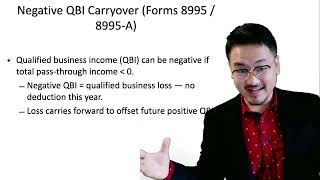
- Negative QBI carries forward and reduces future QBI deductions — it does not disappear
- The QBI deduction was designed to give pass-through owners parity with the corporate tax rate
Understanding Pass-Through Entities
A pass-through entity is a business structure where income is not taxed at the business level. Instead, the income, deductions, and credits pass through to the individual owners' personal tax returns. Common pass-through entities include sole proprietorships (Schedule C), partnerships (Form 1065, with K-1 to partners), and S-Corporations (Form 1120-S, with K-1 to shareholders).
The QBI Deduction: 20% Deduction on Business Income
The Qualified Business Income (QBI) deduction allows eligible taxpayers to deduct up to 20% of their qualified business income from pass-through entities. This deduction was created to provide pass-through business owners with a benefit comparable to the lower corporate tax rate.
QBI includes the net income from a qualified trade or business operated through a pass-through entity. It does not include capital gains or losses, interest income not properly allocable to the business, or employee compensation.
Negative QBI and Carryovers
When your total qualified business income is less than zero — meaning your pass-through businesses had net losses — you have negative QBI. In this situation, you cannot claim the 20% QBI deduction for that year. However, the negative QBI amount carries forward to future years.
In future years when you have positive QBI, the carried-forward negative amount will offset that positive QBI before the 20% deduction is calculated. This reduces the benefit of the QBI deduction in future years but does not eliminate it entirely.
Frequently Asked Questions
Does the QBI deduction apply to all business income?
No. QBI includes net income from qualified trades or businesses but excludes capital gains/losses, investment interest, employee compensation, and income from specified service trades or businesses above certain income thresholds.
How long does negative QBI carry forward?
Negative QBI carries forward indefinitely until it is fully absorbed by positive QBI in future years.
Never miss an IRS deadline
Get free email reminders for Form 5472, state annual reports, quarterly estimated tax, and OBBBA rule changes — built for foreign-owned LLC owners. No spam. Unsubscribe anytime.
We respect your privacy. No spam, ever.
Need to file your foreign-owned LLC return?
Skip the CPA bill. Our guided wizard builds your IRS-ready filing package, step by step.
Includes its walkthrough video pack
Start filing →
Ask the AI tools, free
Tax Return Drafter, Catch-Up Planner, Form Reviewer, IRS Notice Decoder — purpose-built AI tools, no signup needed.
Free tier · BYOK Anthropic/OpenAI for power use
Browse tools →
Starting your foreign-owned LLC?
Vetted partners we use ourselves: doola & Firstbase for formation, Mercury for banking, Alohi for IRS faxing.
No-fluff recommendations, no Northwest
See partners →
More on QBI & Pass-Through Entities
 5:15
5:15Negative QBI Carryover: What It Means for Your Tax Return
 4:55
4:55QBI for REIT and PTP: Carryover Rules and Calculation
QBI on Form 1040-NR and ECI Guide
QBI on Form 1040-NR and ECI Guide for Foreign Founders (2025-2026)
Form 8995 vs Form 8995-A Guide
Form 8995 vs Form 8995-A Guide for Section 199A Filers (2025-2026)
QBI Loss Carryforward Guide
QBI Loss Carryforward Guide for Foreign-Owned Businesses (2025-2026)
QBI SSTB and Consulting Founder Guide