QBI Loss Carryforward Guide for Foreign-Owned Businesses (2025-2026)

QBI deduction eligibility path
How qualified business income is tested for the Section 199A deduction.
Identify qualified business income
Income from a qualifying US trade or business, within the rules.
Check the limitations
Taxable-income thresholds, wage, and property limits can apply.
Apply the service-business rules
Specified service businesses face additional limits above the thresholds.
Compute and claim
Calculate the deduction and carry it to the return.
Key Takeaways
- A negative QBI year generally creates a QBI carryforward to the next year.
- The QBI carryforward rule is separate from ordinary loss deductibility rules.
- The carryforward can still matter even after the original business ends.
- Suspended losses must be tracked separately until they are actually allowed for taxable income purposes.
A negative QBI year does not disappear just because the business survives
The 2025 Instructions for Form 8995 say that if a taxpayer has a qualified business net loss for the year, the loss is carried forward to the next year. The instructions are clear that this carryforward does not change the deductibility of the loss for other parts of the Code. It is a section 199A tracking rule, not a replacement for the ordinary loss rules.
That distinction matters because some founders assume a deductible business loss and a QBI loss are the same thing. They are related, but they are not the same calculation.
The carryforward can survive even if the business later closes
The Form 8995 instructions also say the amount carried forward offsets QBI in later years regardless of whether the trade or business that generated the loss is still in existence. That is a surprisingly important detail for founders who have wound down one venture and started another.
The practical effect is that an old QBI loss can still suppress a later-year section 199A deduction even after the original business is gone.
Suspended losses require an extra layer of tracking
The instructions explain that losses or deductions suspended by other Code provisions are not treated as qualified losses in the year they are suspended. Instead, the qualified portion is taken into account later when the suspended amount becomes deductible for taxable income purposes. That means a clean QBI file has to track both current-year loss carryforwards and delayed-suspension mechanics.
Without that tracking, later-year QBI calculations are often wrong even when the main tax return looks fine.
Frequently Asked Questions
Does a QBI loss carryforward vanish if I shut down the business that created it?
No. The Form 8995 instructions say the carryforward offsets later QBI regardless of whether the original trade or business is still in existence.
Are suspended losses automatically part of QBI in the year they arise?
No. The instructions say suspended losses are taken into account for QBI only when the allowed portion becomes deductible in computing taxable income.
If I have a net QBI loss, can I still have a QBI deduction?
Generally no, unless qualified REIT dividends or qualified PTP income change the result under the section 199A rules.
Listen on Spotify
Money & Tax Talk with Rippa — 5/5 rating
Need Help Filing?
Contact us with your situation and we'll point you to the right path
Never miss an IRS deadline
Get free email reminders for Form 5472, state annual reports, quarterly estimated tax, and OBBBA rule changes — built for foreign-owned LLC owners. No spam. Unsubscribe anytime.
We respect your privacy. No spam, ever.
Need to file your foreign-owned LLC return?
Skip the CPA bill. Our guided wizard builds your IRS-ready filing package, step by step.
Includes its walkthrough video pack
Start filing →
Ask the AI tools, free
Tax Return Drafter, Catch-Up Planner, Form Reviewer, IRS Notice Decoder — purpose-built AI tools, no signup needed.
Free tier · BYOK Anthropic/OpenAI for power use
Browse tools →
Starting your foreign-owned LLC?
Vetted partners we use ourselves: doola & Firstbase for formation, Mercury for banking, Alohi for IRS faxing.
No-fluff recommendations, no Northwest
See partners →
More on QBI & Pass-Through Entities
QBI on Form 1040-NR and ECI Guide
QBI on Form 1040-NR and ECI Guide for Foreign Founders (2025-2026)
Form 8995 vs Form 8995-A Guide
Form 8995 vs Form 8995-A Guide for Section 199A Filers (2025-2026)
QBI SSTB and Consulting Founder Guide
QBI SSTB and Consulting Founder Guide (2025-2026)
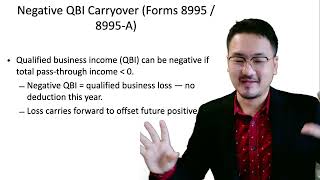 4:42
4:42Pass-Through Entity Basics: Understanding QBI Deduction
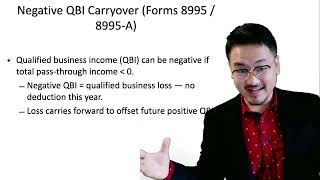 5:15
5:15Negative QBI Carryover: What It Means for Your Tax Return
 4:55
4:55