Due Dates for Decedent and Estate Tax Returns

Key Takeaways
- Final Form 1040 covers income from January 1 through date of death — due April 15
- Estate income tax return (Form 1041) covers income earned by the estate after death
- Estate tax return (Form 706) required if estate exceeds the federal estate tax exemption
- Form 706 is due 9 months after the date of death
- Extensions are available for all decedent-related returns
Filing for Someone Who Has Passed Away
Even in death, the IRS expects punctuality. When someone dies, two types of returns may be required. First, a final individual return (Form 1040) covering income earned from January 1 through the date of death. Second, if the deceased person's estate continues to earn income after death (such as from rental properties, investments, or business interests), an estate income tax return (Form 1041) may be required.
Due Dates for Decedent Returns
The final Form 1040 follows the normal individual due date — April 15 of the year following death. The estate income tax return (Form 1041) is due on the 15th day of the 4th month after the end of the estate's tax year. The estate may choose either a calendar year or a fiscal year.
Additionally, if the estate's gross value exceeds certain thresholds (currently $12.92 million for 2023), an estate tax return (Form 706) must be filed within 9 months of death.
Frequently Asked Questions
Who is responsible for filing the decedent's final tax return?
The executor or administrator of the estate is responsible for filing the final Form 1040. If there is no executor, the surviving spouse or another responsible person typically handles the filing.
Can a surviving spouse file jointly in the year of death?
Yes. In the year your spouse died, you can still file a joint return for that year. This often produces the most favorable tax result.
Never miss an IRS deadline
Get free email reminders for Form 5472, state annual reports, quarterly estimated tax, and OBBBA rule changes — built for foreign-owned LLC owners. No spam. Unsubscribe anytime.
We respect your privacy. No spam, ever.
Need to file your foreign-owned LLC return?
Skip the CPA bill. Our guided wizard builds your IRS-ready filing package, step by step.
Includes its walkthrough video pack
Start filing →
Ask the AI tools, free
Tax Return Drafter, Catch-Up Planner, Form Reviewer, IRS Notice Decoder — purpose-built AI tools, no signup needed.
Free tier · BYOK Anthropic/OpenAI for power use
Browse tools →
Starting your foreign-owned LLC?
Vetted partners we use ourselves: doola & Firstbase for formation, Mercury for banking, Alohi for IRS faxing.
No-fluff recommendations, no Northwest
See partners →
More on Tax Return Due Dates
 3:44
3:44Tax Return Due Dates: General Filing Deadline Rules
 3:28
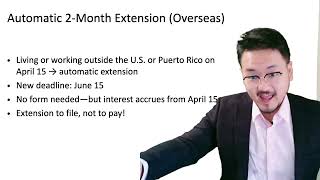
3:28Automatic 2-Month Tax Extension: Who Qualifies?
 4:55
4:55When to Hire a Tax Professional Before the Deadline
Timely Filing Proof Guide for International Business Returns
How to Prove Form 5472 and Business Returns Were Filed on Time (2026-2027)
When Will the IRS Release 2026 Tax Forms? (Timeline for Form 5472 and Form 1120)
When Will the IRS Release 2026 Tax Forms? Form 5472 and 1120 Release Timeline
Form 7004 Extension Guide for Foreign-Owned LLCs