Tax Return Due Dates: General Filing Deadline Rules

Key Takeaways
- Individual returns (Form 1040): due April 15 for calendar-year taxpayers
- Partnerships (1065) and S-Corps (1120-S): due March 15
- Automatic 6-month extension available by filing Form 4868 (extends to October 15)
- Extension extends time to file only — taxes owed must still be paid by April 15
- If the due date falls on a weekend or holiday, the deadline moves to the next business day
The General Due Date Rule
The IRS defines the tax return due date as the 15th day of the 4th month after the end of your tax year. Since 99% of individual taxpayers use the calendar year (ending December 31), this translates to April 15 of the following year. This is the date by which you must either file your return or request an extension.
For partnerships and S-Corporations, the deadline is earlier: March 15 (the 15th day of the 3rd month). This is because these entities need to issue K-1 forms to their partners/shareholders in time for those individuals to prepare their own returns.
Extensions: More Time to File, Not to Pay
Filing Form 4868 grants an automatic 6-month extension for individuals, pushing the deadline to October 15. However, this is an extension of time to file, not an extension of time to pay. If you owe taxes, you must estimate and pay them by April 15 to avoid interest and late payment penalties.
Many taxpayers misunderstand this distinction and wait until October to both file and pay. The result is interest charges dating back to April 15, plus potential late payment penalties.
Frequently Asked Questions
What is the penalty for filing late?
The failure-to-file penalty is 5% of unpaid taxes per month (or partial month), up to 25%. If you are owed a refund, there is no penalty for filing late, but you should still file within 3 years to claim it.
Do I need to file an extension if I'm going to get a refund?
Technically no — the late filing penalty is based on unpaid taxes, so if you're owed a refund there's no penalty. However, filing on time or requesting an extension is still good practice.
Never miss an IRS deadline
Get free email reminders for Form 5472, state annual reports, quarterly estimated tax, and OBBBA rule changes — built for foreign-owned LLC owners. No spam. Unsubscribe anytime.
We respect your privacy. No spam, ever.
Need to file your foreign-owned LLC return?
Skip the CPA bill. Our guided wizard builds your IRS-ready filing package, step by step.
Includes its walkthrough video pack
Start filing →
Ask the AI tools, free
Tax Return Drafter, Catch-Up Planner, Form Reviewer, IRS Notice Decoder — purpose-built AI tools, no signup needed.
Free tier · BYOK Anthropic/OpenAI for power use
Browse tools →
Starting your foreign-owned LLC?
Vetted partners we use ourselves: doola & Firstbase for formation, Mercury for banking, Alohi for IRS faxing.
No-fluff recommendations, no Northwest
See partners →
More on Tax Return Due Dates
 4:55
4:55When to Hire a Tax Professional Before the Deadline
 4:12
4:12Due Dates for Decedent and Estate Tax Returns
 3:28
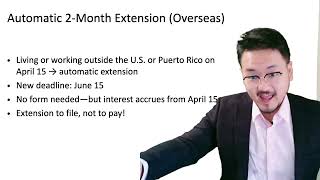
3:28Automatic 2-Month Tax Extension: Who Qualifies?
When Will the IRS Release 2026 Tax Forms? (Timeline for Form 5472 and Form 1120)
When Will the IRS Release 2026 Tax Forms? Form 5472 and 1120 Release Timeline
Form 7004 Extension Guide for Foreign-Owned LLCs
Form 7004 Extension Guide for Foreign-Owned LLCs (2025-2026)
Timely Filing Proof Guide for International Business Returns