LLC Taxes Explained: How LLCs Are Taxed by the IRS (Complete Guide)

Key Takeaways
- LLCs are hybrid structures offering liability protection with tax flexibility
- The IRS classifies single-member LLCs as disregarded entities by default
- Multi-member LLCs are treated as partnerships; either type can elect corporate status
- Foreign-owned single-member LLCs generally file Form 5472 for years with reportable related-party transactions, even when the wrapper calculates no income tax
The LLC: A Hybrid Business Structure
The LLC (Limited Liability Company) is often called a hybrid business structure because it combines features of different entity types. It provides the liability protection of a corporation while offering the tax flexibility of a partnership or sole proprietorship.
How the IRS Classifies LLCs
The IRS does not have a specific tax classification called "LLC." Instead, the IRS classifies LLCs based on their structure. A single-member LLC is treated as a disregarded entity (essentially a sole proprietorship for tax purposes). A multi-member LLC is treated as a partnership. Either type can elect to be taxed as a corporation by filing Form 8832.
This flexibility is one of the LLC's greatest advantages — you can choose the tax treatment that best fits your business situation.
Tax Implications for Foreign Owners
For foreign owners of single-member LLCs, the disregarded entity classification means the LLC itself does not pay U.S. income tax. However, the foreign owner still has an obligation to file Form 5472 with a pro forma Form 1120 to report transactions between the owner and the LLC. This is an information reporting requirement, not a tax payment.
Frequently Asked Questions
Does an LLC pay its own taxes?
It depends on the classification. A single-member LLC (disregarded entity) does not pay its own taxes — income passes to the owner. A multi-member LLC is taxed as a partnership. Either can elect corporate taxation via Form 8832.
Is an LLC better than a corporation for foreign owners?
For most foreign owners with a single-member entity, an LLC classified as a disregarded entity is simpler. It requires only Form 5472 + pro forma 1120, rather than a full corporate tax return.
Never miss an IRS deadline
Get free email reminders for Form 5472, state annual reports, quarterly estimated tax, and OBBBA rule changes — built for foreign-owned LLC owners. No spam. Unsubscribe anytime.
We respect your privacy. No spam, ever.
Need to file your foreign-owned LLC return?
Skip the CPA bill. Our guided wizard builds your IRS-ready filing package, step by step.
Includes its walkthrough video pack
Start filing →
Ask the AI tools, free
Tax Return Drafter, Catch-Up Planner, Form Reviewer, IRS Notice Decoder — purpose-built AI tools, no signup needed.
Free tier · BYOK Anthropic/OpenAI for power use
Browse tools →
Starting your foreign-owned LLC?
Vetted partners we use ourselves: doola & Firstbase for formation, Mercury for banking, Alohi for IRS faxing.
No-fluff recommendations, no Northwest
See partners →
More on Business Entity Types
 4:45
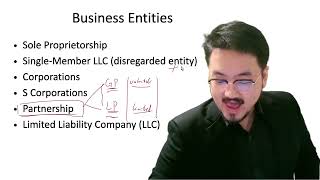
4:45Partnership Taxation Explained: How the IRS Taxes Partnerships
 3:38
3:38Introduction to LLCs: What Is a Limited Liability Company? US Tax Explained
 8:10
8:10C Corp vs S Corp Tax Basics: Corporation Taxation Explained
 8:39
8:39Sole Proprietorship Explained: Taxes, Pros and Cons You Must Know
 7:35
7:35Form 8832 Entity Classification Election Complete Guide Part 5
 8:10
8:10