What Is the Alternative Minimum Tax? AMT for Foreign Founders & 1040-NR Filers
The parallel tax system in IRC §§55-59, the 2025-vs-2026 numbers OBBBA rewrote, when a Form 1040-NR filer must run Form 6251 — and why a foreign-owned LLC's Form 5472 filing, by itself, never creates AMT.
 Lipai WangIRS-registered tax professionalResearch Report
Disclaimer: This is independent research and educational analysis, compiled from IRC §§55-59, Rev. Proc. 2024-40 and 2025-32, the Form 6251, 1040-NR, 1116, and 8960 instructions, and Public Law 119-21, current to June 2026. It is not legal or tax advice. AMT outcomes turn on filing status, residency, sourcing, and credit facts that interact in non-obvious ways — anyone with an ISO exercise, a treaty position, or cross-border foreign tax credit exposure should have the computation run by a qualified adviser. The 2026 dollar amounts are final, but 2026 form line references may shift when the IRS publishes the 2026 Form 6251 package.
Key Takeaways
- AMT is a parallel computation, not a surtax: IRC §§55-59 rebuild the year's income under stricter rules (AMTI), apply a 26%/28% schedule, and tax you only to the extent tentative minimum tax exceeds regular tax.
- AMT can reach Form 1040-NR filers — Form 6251 attaches to the 1040-NR. But the base is the graduated-rate (ECI) side of the return; flat-rate Schedule NEC income taxed by withholding stays outside it.
- An owner whose only US filing is Form 5472 + a pro forma 1120 for a disregarded LLC has no personal AMT exposure — that is a §6038A information regime, with no individual return for Form 6251 to attach to.
- 2026 treats very high earners worse than 2025: OBBBA (P.L. 119-21) made the post-TCJA regime permanent but cut the phaseout thresholds ($626,350 → $500,000 single; $1,252,700 → $1,000,000 joint) and set a 50% phaseout rate.
- The AMT foreign tax credit is a separate §59(a) computation — often a separate AMT Form 1116 — and §906 keeps the underlying credit narrow for nonresidents. Paying tax at home does not switch AMT off.
1. What the alternative minimum tax actually is
The alternative minimum tax is a second, parallel computation of the same year's income tax, codified at IRC §§55-59. Section 55 imposes the tax itself: you owe AMT only to the extent tentative minimum tax (TMT) exceeds your regular tax. Section 56 supplies the adjustments that rebuild the base — depreciation timing, incentive stock options, deduction addbacks. Section 57 lists tax preference items, §58 polices certain losses, and §59 carries the special rules, including the separately computed AMT foreign tax credit.
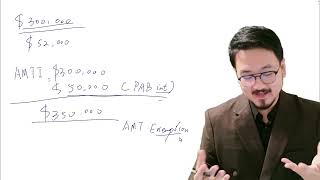
Mechanically, Form 6251 starts from regular taxable income, layers the adjustments and preferences on top to produce alternative minimum taxable income (AMTI), subtracts an exemption that phases out at high incomes, and runs a two-bracket schedule — 26% up to a breakpoint, 28% above it, with the breakpoint halved for married filing separately. The result is TMT. If TMT beats the regular tax on the comparison line, the excess is AMT and lands on Schedule 2.
The design target is taxpayers whose deductions, exclusions, or timing benefits pushed regular tax too low relative to economic income — classically large state-tax deductions, ISO exercise spreads, and accelerated depreciation. The 2017 tax act shrank the AMT's reach dramatically, but as the next section shows, the 2026 parameter reset pulls high earners back in.
2. The 2025 vs 2026 numbers — and the OBBBA surprise
The statutory dollar amounts are inflation-indexed under §55(d)(3); the operative figures come from Rev. Proc. 2024-40 for 2025 and Rev. Proc. 2025-32 for 2026. The full comparison is in the at-a-glance table at the end of this report.
The 2026 column looks routine at first: exemptions tick up with inflation ($88,100 → $90,100 single; $137,000 → $140,200 joint). The surprise is in the phaseouts. P.L. 119-21 (OBBBA) made the larger post-TCJA exemption regime permanent — but it reset the phaseout thresholds down to $500,000 (single and separate filers) and $1,000,000 (joint), froze indexing of the joint floor until years beginning after 2026, and set the exemption to erode at a 50% rate above the threshold (50 cents per excess dollar, double the prior 25-cent pace).
The combined effect is counterintuitive: 2026 hits high earners harder than 2025 even though the nominal exemption is larger. The single-filer exemption is fully gone at $978,750 of AMTI in 2025 but at just $680,200 in 2026; the joint complete-phaseout point falls from $1,800,700 to $1,280,400, and married-filing-separately from $900,350 to $640,200. A founder who kept the full exemption in 2025 can lose all of it in 2026 on identical income — the most consequential individual-AMT change of the OBBBA era.
3. Does AMT apply to Form 1040-NR filers? Yes — on the graduated-rate side
Nonresident aliens are squarely inside the AMT system. Form 6251 attaches to Form 1040-NR, the 1040-NR instructions direct filers to it, and owing AMT is itself one of the listed reasons a nonresident must file a return at all.
What changes for an NRA is the base. A 1040-NR splits income into two regimes: effectively connected income (ECI) taxed at graduated rates on the face of the return, and FDAP income taxed at a flat rate on Schedule NEC. The Form 6251 comparison runs entirely off the graduated-rate side — line 10 builds from Form 1040-NR line 16 plus Schedule 2 line 1z — while the Schedule NEC tax sits on line 23a, outside the computation. Flat-rate withholding income cannot generate AMT.
There is no special NRA exemption table: line 5 uses the same filing-status grid as Form 1040 filers. But one genuinely NRA-specific rule hides in the instructions: the line 6 'RPI' computation. If a nonresident disposed of US real property interests at a gain, and both the net real-property gain and the line 4 AMTI amount exceed the tentative line 6 figure, line 6 is replaced with the smaller of the net gain or line 4, annotated 'RPI'. Generic AMT explainers never mention it.
Scenario test: a founder who files a 1040-NR only because a US payer underwithheld on Schedule NEC dividends has no AMT base to recompute. Give the same founder ECI consulting income, or a FIRPTA gain taxed on the graduated-rate side, and Form 6251 is in scope.
4. When a foreign-owned LLC owner can ignore AMT entirely
A foreign-owned US disregarded entity's annual filing — Form 5472 attached to a pro forma Form 1120 — is an information regime under §6038A, not an income-tax regime. The 5472 instructions treat the LLC as a corporation only for that limited reporting purpose, and the entity itself owes no income-tax return. With no personal return in the picture, there is nothing for Form 6251 to attach to.
The clean ignore-AMT fact pattern: no effectively connected income, no US real property gain taxed at graduated rates, no underwithheld Schedule NEC item forcing a personal return, and no other special tax that requires a 1040-NR. A remote SaaS founder with a Delaware LLC who never set foot in the US and only contributed capital or made intercompany loans fits it — 5472 compliance yes, personal AMT no.
Each of these facts flips the answer: US-source consulting ECI, US wages, a §871(d) net-rental election that moves real-estate income to the graduated side, or a FIRPTA gain. Any of them puts the owner into 1040-NR territory, and once a 1040-NR with graduated-rate income exists, AMT must be tested like any other filer's. Whether you need a 1040-NR in the first place is its own decision tree — see when Form 1040-NR is required; this page picks up where that one ends.
5. The foreign tax credit trap — §59(a) and the narrow §906 lane
§59(a) requires a separate AMT foreign tax credit computation. It borrows the §904 limitation architecture but runs it on AMT numbers — AMTI as the income base, pre-credit tentative minimum tax as the limiting tax — which usually means preparing a separate AMT Form 1116 alongside the regular one. The regular-tax framework (sourcing, baskets, carryovers) lives in our foreign tax credit and Form 1116 guide; this section covers only what AMT changes.
For nonresidents the credit is narrow before AMT even enters. An NRA generally reaches the FTC only through §906: foreign tax is creditable, broadly, when imposed on foreign-source income that is effectively connected with a US trade or business. Foreign tax your home country levies on your US-source income merely because you live — or stay tax-resident — there is generally not creditable on a 1040-NR. That is the structural reason 'I already paid tax at home' so often fails.
Even a fully creditable tax may not kill AMT. Because the AMT Form 1116 limitation is computed on AMT-side numbers, a filer with an ISO spread, a depreciation difference, or a large line 2a addback can offset regular tax completely and still owe AMT — the AMT limitation simply comes out lower than the regular one. The Form 6251 instructions contemplate AMT versions of Form 1116, Schedule D, the capital-gain worksheets, and the line 18 limitation worksheet.
Two quieter traps. First, deducting foreign income taxes on Schedule A instead of crediting them is not safe: line 2a adds back Schedule A taxes including foreign income taxes you chose to deduct, so the benefit evaporates under AMT. Second, the small-FTC election (claiming the regular credit without Form 1116) makes the AMT FTC equal the regular credit at line 8 — but unused AMT FTC from an election year cannot be carried back or forward, and carryovers from other years cannot be used in it. The ordinary computation, by contrast, generally preserves §904(c) carryovers.
The classic founder version: tax-resident at home, working in the US on a treaty-nonresident 1040-NR posture, with the home country taxing overlapping business income. The §906 lane is already narrow; add an ISO exercise or a large state-tax addback and regular tax looks manageable while AMT survives the recomputed line 8 credit.
6. Founder fact patterns that trigger AMT
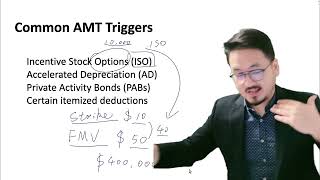
The most founder-specific trigger is the incentive stock option exercise. §56(a)(3) switches off §421 nonrecognition for AMT purposes, so line 2i picks up the spread — fair market value over strike price at exercise, net of anything already in regular income. An exercise-and-hold founder can owe a substantial AMT bill in a year with no cash proceeds at all. A same-year disqualifying disposition rewrites the line 2i and line 2k math, so the exercise-and-sale calendar matters.
Depreciation adjustments under §56(a)(1) are real but narrower than the folklore: property placed in service after 2015 generally produces no line 2l adjustment. The live exposure sits in older asset pools, special property classes, and depreciation passed through on K-1s — not in a typical modern startup's purchases.
State taxes are potent again. Post-OBBBA, Schedule A for the 1040-NR allows a state and local income tax deduction up to $40,000 ($20,000 separate, with an income-based reduction) — and line 2a adds all of it back. A founder paying serious California or New York tax takes the regular-tax benefit and watches AMT claw it back, a dynamic that barely existed under the old $10,000 cap.
Treaty positions are complexity markers more than triggers. A tie-breaker can move a founder onto a 1040-NR with Form 8833 disclosure; a treaty resourcing rule can force a separate 're-sourced by treaty' Form 1116 basket. None of it creates AMT automatically — but each piece reshapes the base or the AMT FTC baskets that decide whether AMT survives.
- Line 2i — ISO exercise spread: AMT income with no cash event.
- Line 2a — every Schedule A tax added back, including the post-OBBBA $40,000 SALT deduction and foreign taxes deducted instead of credited.
- Line 2l — depreciation: mostly pre-2016 property, ADS mismatches, and K-1 pass-through items.
- Form 8833 — treaty tie-breakers and resourcing reshape the base and FTC baskets without creating AMT by themselves.
7. Form 6251 for a 1040-NR filer — and the NIIT non-issue
Order of operations, using the finalized 2025 form
First, the attach test. The 2025 instructions require Form 6251 when line 7 exceeds line 10, when certain credits are claimed (the general business credit, the prior-year minimum tax credit, certain clean-vehicle and refueling-property credits), or when negative adjustments on lines 2c through 3 would otherwise mask an AMT exposure.
Then build AMTI. Line 1a starts from Form 1040-NR line 14 reduced by Schedule 1-A line 37, checked against line 11b at line 1b. Line 2a is where 1040-NR founders usually first diverge — Schedule A taxes plus deducted foreign taxes come back. Then the founder lines: the ISO spread at 2i, disposition differences at 2k, depreciation at 2l, passive and loss-limitation items, and residual adjustments at line 3, producing AMTI at line 4.
Apply the line 5 exemption and the 26%/28% schedule at line 7. A 1040-NR filer with qualified dividends or Schedule D gains in play must run Part III with its NRA-specific inputs; otherwise line 7 comes straight off line 6. A nonresident with US real property gains checks the line 6 RPI override before computing the tax.
If a foreign tax credit is involved, figure the regular FTC and Schedule 3 line 1 before touching line 8: when line 10 already meets or beats line 7, line 8 stays blank and line 11 is zero. Otherwise the separate AMT Form 1116 — plus, where needed, AMT capital-gain and line 18 limitation worksheets — feeds line 8. Finally, line 10: Form 1040-NR line 16, plus Schedule 2 line 1z, minus Schedule 3 line 1 and any negative Form 8978 amount treated as positive. Line 9 over line 10 is AMT at line 11, carried to Schedule 2 line 2.
The net investment income tax is the non-issue here: the Form 8960 instructions exclude nonresident alien individuals, and a dual-status taxpayer faces NIIT only for the resident portion of the year. AMT (Schedule 2 line 2) and NIIT (Schedule 2 line 12) are separate computations that never offset each other — a year-end NRA may owe AMT but does not owe NIIT.
Timing caveat: the 2026 dollar amounts are final under Rev. Proc. 2025-32 and the statute is current through P.L. 119-21, but the IRS had not finalized the 2026 Form 6251 package when this report was prepared, so the walkthrough uses finalized 2025 line references. The mechanics should carry over; minor 2026 line renumbering is possible.
AMT numbers at a glance: 2025 vs 2026
| AMT item | 2025 | 2026 |
|---|---|---|
| Exemption, single | $88,100 | $90,100 |
| Exemption, married filing separately | $68,500 | $70,100 |
| Exemption, joint / qualifying surviving spouse | $137,000 | $140,200 |
| 28% breakpoint, single and most others | $239,100 | $244,500 |
| 28% breakpoint, married filing separately | $119,550 | $122,250 |
| Phaseout threshold, single | $626,350 | $500,000 |
| Phaseout threshold, married filing separately | $626,350 | $500,000 |
| Phaseout threshold, joint / qualifying surviving spouse | $1,252,700 | $1,000,000 |
Related on ForeignLLCTax
Primary sources
- 26 U.S.C. §55 — Alternative minimum tax imposed (gateway to §§56-59)
- IRS — Rev. Proc. 2024-40 (2025 inflation adjustments, AMT exemption and phaseout)
- IRS — Rev. Proc. 2025-32 (2026 inflation adjustments, AMT exemption and phaseout)
- IRS — About Form 6251, Alternative Minimum Tax — Individuals
- IRS — Instructions for Form 6251
- IRS — Instructions for Form 1040-NR
- IRS — Instructions for Form 1116 (foreign tax credit)
- IRS — Instructions for Form 8960 (net investment income tax)
- IRS — Instructions for Form 5472 (foreign-owned disregarded entities)
- Congress.gov — Public Law 119-21 (One Big Beautiful Bill Act)