FBAR for U.S. LLCs and Foreign Owners
Separate the domestic LLC's entity-level filing from the foreign owner, U.S.-person signatory, attributed owner, agent, and nominee rules.
 Lipai WangIRS-registered tax professionalResearch report · Updated
Key Facts
What Is FBAR (FinCEN 114)?
The Report of Foreign Bank and Financial Accounts (FBAR), officially known as FinCEN Form 114, is a report filed with the Financial Crimes Enforcement Network (FinCEN). It requires U.S. persons to disclose their financial interest in, or signature authority over, foreign financial accounts if the aggregate value exceeds $10,000 at any time during the calendar year.
The FBAR is not a tax form — it is filed separately from your tax return. It is a reporting requirement under the Bank Secrecy Act (BSA) and is used to detect and prevent financial crimes such as money laundering and tax evasion.
Foreign financial accounts include bank accounts, securities accounts, mutual funds, and other types of financial accounts maintained with a foreign financial institution.
Who Must File an FBAR?
A United States person must file an FBAR if they have a financial interest in, or signature authority over, one or more foreign financial accounts with an aggregate value exceeding $10,000 at any time during the calendar year.
"United States person" includes:
- U.S. citizens (including those living abroad)
- U.S. residents (green card holders and those meeting the substantial presence test)
- Domestic entities — corporations, partnerships, LLCs, trusts, and estates formed in the U.S.
Important distinction: The $10,000 threshold is based on the aggregate value of all foreign accounts combined — not per account. If you have three accounts holding $4,000 each, the total ($12,000) exceeds the threshold and you must file.
FBAR and Foreign-Owned LLCs
FBAR uses its own U.S.-person, financial-interest, signature-authority, account-location, and attribution definitions. Federal income-tax disregarded status does not control them.
Your U.S. LLC's Bank Account
An account maintained in the United States is not a foreign account merely because the owner lives abroad. For a multi-currency or fintech relationship, however, do not classify location from the brand name alone—identify the actual institution, branch, product, and account for each facility.
The Foreign Owner's Obligations
A nonresident foreign individual does not become an FBAR filer solely by owning a domestic LLC. If that owner independently becomes a U.S. person, then personal financial interests, signature authority, attribution, and all foreign accounts must be tested under the individual rules.
The LLC as a U.S. Entity
Your LLC is a domestic entity and is technically a "United States person." If the LLC itself holds any foreign financial accounts (e.g., a business account in your home country) with an aggregate value over $10,000, the LLC must file an FBAR. Tax classification does not change this result: a disregarded domestic LLC, partnership, or elected domestic corporation can each be a U.S. person for FBAR.
U.S.-Person Signatories and Attributed Owners
A U.S.-person manager or CFO with direct authority to control disposition from a foreign account can have a separate signature-authority filing unless an exception applies. A U.S. person owning more than 50% of a corporation's vote/value or a partnership's capital/profits can have attributed financial interest. Test the LLC, each U.S.-person actor, and any >50% U.S.-person owner separately.
Agents, Nominees, and Foreign-Formed Registrants
An account titled to an agent, nominee, or attorney acting for a U.S. person can be treated as that U.S. person's financial interest. Conversely, merely registering a foreign-created entity in a U.S. state does not by itself make that entity domestically created for FBAR; BOI and bank CDD can reach the same entity under different definitions.
Bottom line: Most foreign-owned single-member LLCs with only a U.S. bank account do not have an FBAR filing requirement. But always check your specific situation — especially if your LLC holds accounts outside the U.S. or if you have U.S. tax residency.
FBAR vs. FATCA (Form 8938)
FBAR and Form 8938 are separate requirements that sometimes overlap. Here's how they differ:
| Feature | FBAR (FinCEN 114) | FATCA (Form 8938) |
|---|---|---|
| Filed with | FinCEN (Treasury) | IRS (with tax return) |
| Threshold | $10,000 aggregate | Varies by specified filer, filing status, residence, and asset value |
| Who files | U.S. persons | Specified individuals and qualifying specified domestic entities |
| Filing method | BSA E-Filing (online) | Attached to tax return |
| Covers | Foreign bank/financial accounts | Broader — includes foreign assets |
If both thresholds are met, you may need to file both FBAR and Form 8938. They are not substitutes for each other. A disregarded entity is generally looked through for Form 8938, while the domestic LLC can still be an FBAR filer in its own right. A domestic partnership or corporation becomes a specified domestic entity only if it satisfies the applicable close-holding and passive-income/passive-asset tests; domestic status alone is not enough.
Filing Deadline
The FBAR is due on April 15 of the year following the calendar year being reported. If you miss the April 15 deadline, FinCEN provides an automatic extension to October 15 — no extension request is needed.
For the 2026 calendar year, the nominal dates are April 15, 2027 and the automatic extension to October 15, 2027, subject to current FinCEN relief and calendar rules.
How to File an FBAR
FBARs are ordinarily filed electronically through the BSA E-Filing system. Preserve the BSA acknowledgement separately from IRS e-file records.
- Go to the BSA E-Filing System
- Select "File FBAR" and create an account (or log in)
- Complete the form with your information and account details
- For each foreign account, provide: institution name, account number, account type, maximum value during the year, and country
- Submit electronically and save the confirmation
Tip:You'll need the maximum value of each account during the year, not the year-end balance. Check monthly statements to determine the highest balance.
Penalties for Non-Compliance
FBAR penalties are among the harshest in U.S. tax law:
Non-Willful Violation
For penalties assessed in 2026 the maximum remains $16,536 per (the January 2025 inflation adjustment; no 2026 adjustment was issued) non-willful violation. Under Bittner v. United States, a non-willful failure to file one compliant annual FBAR is measured per report, not once per unreported account. The actual assessment still depends on the statute, facts, and current guidance.
Willful Violation
For penalties assessed in 2026, the willful maximum uses the greater of the inflation-adjusted $165,353 amount or 50% of the balance in the account at the time of the violation. Willfulness, reasonable cause, mitigation, and criminal exposure require fact-specific legal analysis.
Inflation amounts change annually. If a filing is missing or inaccurate, do not select a delinquent, streamlined, or voluntary-disclosure path from a generic article; obtain advice before making a submission that fixes the facts or willfulness position.
Primary FBAR sources
Common Misconceptions for Foreign LLC Owners
Myth: "My LLC has a U.S. bank account, so I need to file an FBAR."
Reality: A U.S. bank account is not a foreign account. Your LLC only needs to file an FBAR if it holds accounts outside the U.S.
Myth: "As a foreign owner, I need to file an FBAR for my personal foreign accounts."
Reality: If you are not a U.S. person (not a citizen, green card holder, or tax resident), you generally do not have a personal FBAR requirement.
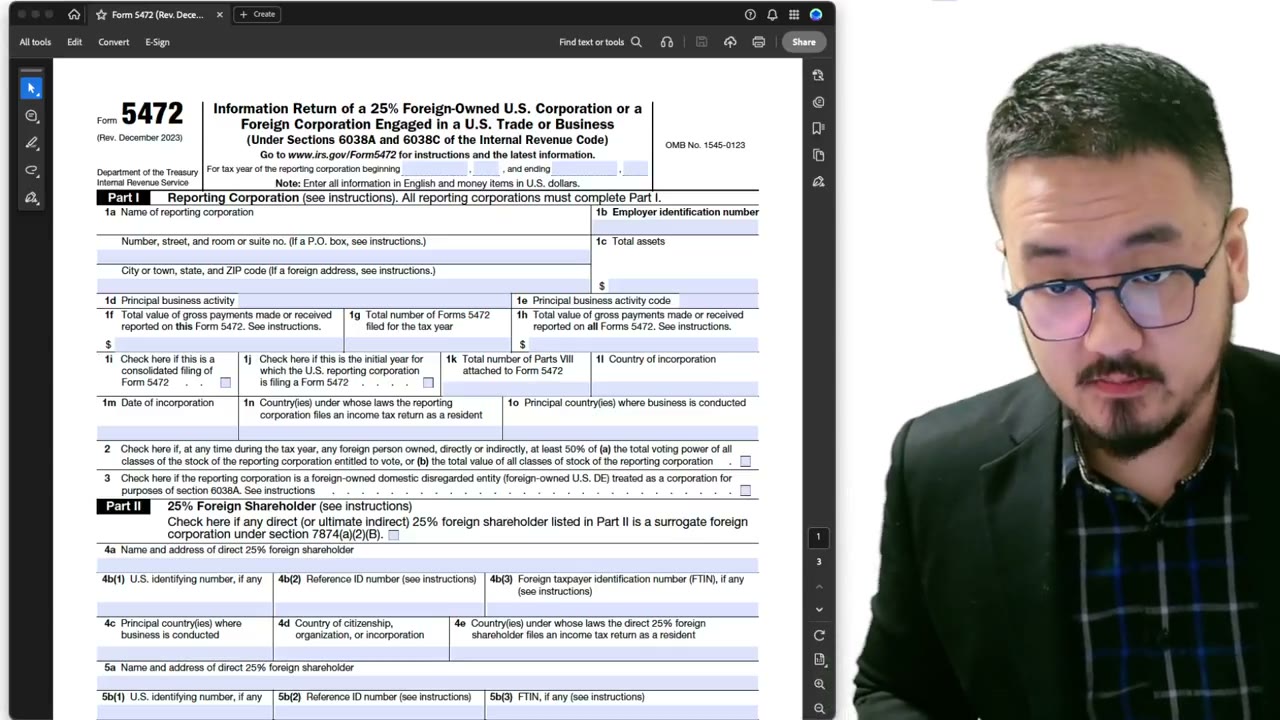
Myth: "FBAR replaces Form 5472."
Reality: They are completely separate requirements. FBAR is a FinCEN report about foreign accounts. Form 5472 is an IRS form about related-party transactions. Neither replaces the other.
Myth: "I don't owe taxes, so I don't need to file an FBAR."
Reality: FBAR is a reporting requirement, not a tax. It applies regardless of whether you owe any U.S. taxes.
Myth: "Small accounts don't count."
Reality: Every foreign account counts toward the $10,000 aggregate threshold, regardless of individual account size.
Next Steps
Stay Compliant with doola Bookkeeping
Proper bookkeeping makes all your filing obligations simpler — from Form 5472 to FBAR. doola provides dedicated bookkeeping, tax filing, and compliance management for foreign-owned LLCs.
Explore doola BookkeepingFile Your Form 5472 Online
FBAR is separate from your IRS obligations. Make sure your Form 5472 is filed on time to avoid the $25,000 penalty.
Start Filing