IRS Penalties & Enforcement for Foreign-Owned LLCs
The Form 5472 $25,000 penalty and its 30-day escalation, the Form 1120 late-filing rule, FBAR after Bittner, Form 8938, reasonable cause and First-Time Abatement, the statute of limitations, and how 2023-2026 enforcement actually reaches disregarded LLCs.
 Lipai WangIRS-registered tax professionalResearch report · Updated
Disclaimer: This is independent research and educational analysis, compiled from the IRS penalty and enforcement guidance, the Form 5472 and Form 8938 instructions, the Internal Revenue Manual, the FBAR penalty tables and current case law, and the statute-of- limitations rules reviewed August 30, 2026. It is not legal or tax advice. Penalty exposure and relief turn on intensely fact-specific questions, several figures are inflation- adjusted annually, and the reach of recent cases is still unsettled. Anyone facing a penalty notice or weighing a delinquent filing should consult a qualified attorney or tax adviser before acting.
Key Takeaways
- A foreign-owned U.S. disregarded LLC is treated as a domestic corporation solely for section 6038A purposes and generally files a pro forma Form 1120 with Form 5472 attached for a year with a reportable related-party transaction, even when it owes no income tax.
- The Form 5472 penalty is $25,000 per related party, per year for a late, incomplete, inaccurate, or unsupported filing — and a continuation penalty of another $25,000 for each 30-day period can begin after a 90-day post-notice window, with the IRM stating no maximum.
- The ordinary Form 1120 late-filing penalty under section 6651 is 5% of unpaid tax per month (max 25%), so a true pro forma wrapper with no tax due often carries little or no stand-alone amount — the real exposure is the linked 5472 information-return penalty.
- FBAR can reach the LLC itself because a U.S. LLC is a U.S. person for FBAR even while disregarded for income tax; after Bittner (2023) the non-willful penalty is counted per annual report, not per account, with a ceiling of $16,536 non-willful and $165,353 (or 50% of balance) willful — the January 2025 inflation-adjusted amounts, which carry into 2026 because no 2026 adjustment was issued (OMB M-26-11).
- First-Time Abatement does not generally apply to event-based Form 5472 penalties; the primary relief is a written, perjury-signed reasonable-cause statement filed only after every delinquent return is in — and a missing information return can keep the assessment statute open under section 6501(c)(8).
- FinCEN's August 11, 2026 final BOI rule exempts U.S.-created companies from BOI reporting, but that does not change Form 5472, partnership, withholding, owner-return, or FBAR duties. A registered foreign entity remains a separate BOI analysis.
1. The filing architecture that creates the trap
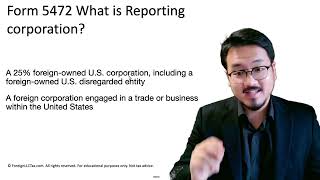
A foreign-owned U.S. single-member LLC that stays a disregarded entity for income-tax purposes is still treated as a domestic corporation solely for the limited reporting purposes of section 6038A. In practice that means the entity generally files a pro forma Form 1120 with Form 5472 attached by the Form 1120 due date, including extensions, when it has a transaction reportable in Part IV, V, or VI. The LLC may owe no regular U.S. corporate income tax, yet a required information return — and the penalty that backs it — is fully live.
This split is the core trap in the whole area. Owners reason that a disregarded entity with no U.S. tax due has nothing to file, when in fact the information-return obligation is what bites. The IRS Form 1120 instructions and the Internal Revenue Manual both treat the foreign-owned U.S. disregarded entity as a reporting corporation for section 6038A, so the wrapper return is mandatory whenever there are reportable related-party transactions.
Because the obligation is information-driven rather than tax-driven, the most common operational failures are mechanical: a missing wrapper return, a missing Form 5472, incomplete reporting of related-party transactions, and weak record retention or poor U.S. accessibility of the underlying books and records.
2. The Form 5472 penalty — $25,000 and the 30-day escalation
Initial penalty, continuation penalty, and how it stacks
Under section 6038A(d), the initial Form 5472 penalty is $25,000 per related party, per tax year for failing to timely file, for filing an incomplete or inaccurate form, or for failing to maintain the required records. The IRM frames the initial penalty as asserted once per related party per year, even when several distinct infractions involve the same related party.
The continuation penalty is what turns one bad year into a six-figure problem. If the failure continues more than 90 days after the IRS mails notice, an additional $25,000 applies for each 30-day period (or fraction of one) that the failure persists, and the IRM states there is no maximum. The manual also explains that a reporting failure and a record-maintenance failure for the same related party can carry separate continuation penalties — the IRS describes that combined accrual as reaching $50,000 per month.
Enforcement here is frequently administrative rather than auditor-driven. The IRM authorizes the IRS to systemically assess Form 5472 penalties during initial processing of a late-filed Form 5472 attached to a late-filed Form 1120, assigning penalty reference number PRN 711 to those systemic assessments. Manually or field-assessed penalties use PRN 625 (or 701) and generate a business notice after assessment. The practical lesson: a late package can trigger a $25,000 penalty by campus processing alone, with no exam ever opened.
- Initial penalty: $25,000 per related party, per year — assessed once per related party per year.
- Continuation penalty: +$25,000 per 30-day period after the 90-day post-notice window; the IRM states no stated cap.
- Reporting-failure and record-maintenance continuation penalties can stack for the same related party.
- Systemic assessments carry PRN 711; manual/field assessments carry PRN 625 or 701 — confirm which before responding.
3. Form 1120 late filing — the wrapper that usually does not bite
The ordinary corporate late-filing rule under section 6651(a)(1) is mechanically simple: 5% of the unpaid tax per month, capped at 25%, with a minimum penalty for a return more than 60 days late equal to the lesser of the tax due or $525 for a return required to be filed in 2026. The percentage is computed on unpaid tax.
On a true pro forma Form 1120 for a foreign-owned disregarded entity, there usually is no unpaid corporate income tax, so the section 6651 amount is often nil or modest. That does not make the wrapper harmless. The IRS uses the late-filed Form 1120 package as the trigger point for the section 6038A systemic assessment — the wrapper return may carry little stand-alone penalty value while acting as the gateway to a $25,000 information-return penalty.
There is a useful asymmetry in the relief analysis that follows from this. Because the section 6651 penalty is a listed First-Time Abatement penalty, the wrapper return can often qualify for FTA or ordinary reasonable cause — while the Form 5472 penalty riding on the same package generally cannot. That is why the two theories must be separated rather than argued as one.
4. FBAR — non-willful vs willful after Bittner
FBAR exposure is separate from the income-tax forms and can reach a foreign-owned single-member LLC directly. FinCEN and the IRS treat a U.S. LLC as a U.S. person for FBAR, and disregarded-entity status for federal income tax does not remove the FBAR obligation. So if the LLC itself holds foreign financial accounts above the threshold, the LLC can be the filer even though it is invisible for income tax.
The penalty structure splits on intent. For assessments on or after January 17, 2025, the inflation-adjusted maximums are $16,536 for a non-willful violation and $165,353 for a willful violation — although the willful statute also authorizes a maximum of 50% of the relevant account balance when that figure is higher. Willful cases can therefore remain balance-based and very large.
The single most important recent development for non-willful exposure is Bittner v. United States (2023), in which the Supreme Court held that the non-willful FBAR penalty applies per annual report, not per account. In Bittner the government had asserted roughly $2.72 million by counting per account; the per-report rule sharply limits the outer bound of many multi-account non-willful examinations. The earlier Ninth Circuit decision in United States v. Boyd (2021) had adopted the same per-report view that Bittner later embraced.
- A U.S. LLC is a U.S. person for FBAR; being disregarded for income tax does not end the FBAR duty.
- Ceilings (2025 adjustment, unchanged for 2026): $16,536 non-willful, $165,353 willful — willful can instead be 50% of the balance if higher.
- Bittner (2023): non-willful FBAR penalties are counted per report, not per account.
- The statute gives Treasury six years to assess FBAR penalties, and the non-willful reasonable-cause defense requires the balance to have been properly reported.
5. Form 8938 (FATCA) — narrower than owners fear
Form 8938 is easier to overstate than to apply. A foreign owner who is a nonresident alien usually is not the Form 8938 filer at all. A domestic corporation or partnership can be a specified domestic entity only when the statutory and regulatory conditions are met — chiefly that the entity is formed or availed of to hold specified foreign financial assets. A foreign-owned LLC is not automatically an 8938 filer merely because it is foreign-owned.
When Form 8938 does apply, the entity files if the total value of specified foreign financial assets exceeds $50,000 on the last day of the tax year or $75,000 at any time during the year. The baseline failure-to-file penalty is $10,000, with an additional $10,000 for each 30-day period after a 90-day post-notice window, up to an additional $50,000. A 40% accuracy-related penalty applies to any underpayment attributable to an undisclosed specified foreign financial asset.
Two cautions matter in this area. First, the section 6501(c)(8) statute-of-limitations consequence (discussed below) reaches Form 8938 omissions, so an unfiled 8938 can hold the year open. Second, the instructions expressly reject foreign secrecy or confidentiality law as reasonable cause — a foreign bank telling the owner it cannot share information is not, by itself, an excuse.
6. Reasonable cause — the primary defense for information-return penalties
The cross-cutting standard for IRS penalty relief is ordinary business care and prudence. The Penalty Handbook treats reasonable cause as case-specific: the taxpayer must show what happened and when, and relief usually fails once the obstacle has passed and the taxpayer still did not comply within a reasonable time. Forgetfulness or mere oversight is generally not enough, and ignorance of the law matters only in combination with other facts and circumstances.
For Form 5472 the IRM imposes extra discipline. It recommends that reasonable cause not be considered until every delinquent return has been filed, and it requires an affirmative written statement signed under penalties of perjury. For foreign-owned LLCs that usually means filing every missing pro forma Form 1120 and every missing Form 5472 for every open year before the substantive abatement request goes in.
There is also a strong pro-taxpayer passage to lean on where the facts fit. The IRM says reasonable cause is applied liberally for a small corporation (gross receipts of $20 million or less) that had no knowledge of the section 6038A requirements, had limited U.S. presence and contact, and promptly and fully complied with requests to file Form 5472 and produce the relevant books and records. Many genuinely-unaware foreign founders fit that profile.
- Standard: ordinary business care and prudence — specific facts, dates, and people, not a character reference.
- File all delinquent returns first; the IRM defers reasonable cause until the delinquency is cured.
- The Form 5472 statement must be written and signed under penalties of perjury, with documentary exhibits.
- Lean on the IRM small-corporation liberal-relief language when limited U.S. presence and prompt cure are provable.
7. First-Time Abatement — and why it usually misses Form 5472
First-Time Abatement is an administrative relief policy for taxpayers with a clean compliance history — broadly, all required returns filed (or extended), no penalties in the prior three years, and any tax paid or arranged. It is fast and does not require a reasonable-cause narrative.
The catch for foreign-owned LLCs is coverage. FTA is listed for failure-to-file (section 6651(a)(1)), failure-to-pay (section 6651(a)(2)), and failure-to-deposit (section 6656) penalties, plus partnership and S-corporation analogues. It is not listed for Form 5472 penalties, and the international-penalties manual states that FTA does not generally apply to event-based filing requirements such as Form 5472. So the headline FTA program on irs.gov simply does not reach the $25,000 information-return penalty.
Do not turn a PRN 711 label into an FTA promise. Some account-processing instructions have contained narrowly coded first-time administrative considerations for a systemic Form 5472 assessment tied to a late Form 1120, but that is not the same as saying section 6038A is covered by the ordinary FTA program. Confirm the current IRM, the notice, the penalty reference number, the entity's filing history, and the relief authority before relying on any such account-level treatment; the durable statutory defense remains reasonable cause.
8. Statute of limitations — section 6501(c)(8) keeps the year open
Under the general rule of section 6501(a), the IRS has three years from the filing of a return to assess tax and penalties, and if no return is filed the period never starts. For international information returns there is a more specific and more dangerous hook: section 6501(c)(8).
In broad terms, when a taxpayer fails to furnish required information under provisions including section 6038A, the assessment period for the relevant return can stay open until roughly three years after the missing information is finally provided. A practical, high-confidence reading is that a missing or incomplete Form 5472 — or a missing Form 8938 — can keep the assessment statute open well beyond the normal three-year rule. The IRS has separately taken the position that a Form 1120 missing its required Form 5472 attachment is not a complete return for starting the clock.
The exact reach of section 6501(c)(8) — whether the suspension applies to the whole return or only to items related to the missing information, and how any reasonable-cause carve-out applies — is fact-specific and should be confirmed against the current statute and case law before relying on it. The safe operating assumption for planning is the conservative one: file the missing information returns to start (or restart) the clock, because passively waiting for old years to fall off does not work here.
9. Enforcement trends and notice practice, 2023-2026
The dominant trend in this area is that enforcement is partly system design, not just classic audit selection. The IRM expressly authorizes systemic Form 5472 assessments from late-filed Form 1120 packages, and the National Taxpayer Advocate has repeatedly flagged systemic international-information-return assessments as a burden on both taxpayers and the IRS. For foreign-owned LLCs, many cases begin in campus processing, not in a bespoke international exam.
Traditional audit pressure still matters in the background. The IRS Data Book reported that in fiscal year 2024 the IRS closed 505,514 audits and recommended more than $29.0 billion in additional tax — substantial compliance activity even before automated or systemic information-return penalty programs are counted.
On the litigation side, use Farhy v. Commissioner precisely. The 2023 Tax Court held that the IRS lacked assessment authority for section 6038(b) penalties, but the D.C. Circuit reversed on May 3, 2024 and held those penalties assessable under section 6201. Farhy concerned section 6038(b), not Form 5472's section 6038A(d) penalty. It is therefore neither a current no-assessment rule nor a direct Form 5472 holding, and it should not be used as a generic promise that an international penalty is invalid.
10. The notice playbook and the abatement letter
CP215 vs CP15, what to pull, and what the letter must contain
Start by identifying the exact notice and penalty path. The retrieved IRS sources point to CP215 (a business civil-penalty notice) for an assessed Form 5472 penalty, not the individual CP15 that owners sometimes assume. The first defensive move is to confirm the actual notice series, the tax period, and the penalty reference number — whether it is the systemic PRN 711 or a manually assessed PRN 625 or 701 — because that determines which relief, including the narrow FTA piggyback, is even on the table.
Then build the administrative record before arguing. Pull transcripts, return copies, proof of mailing or private-delivery tracking, extension acknowledgments, any rejected e-file notices, and all filed Forms 5472 and pro forma Forms 1120. Cure every delinquency first, separate the section 6651 theory (for the wrapper) from the section 6038A theory (for the 5472), and move quickly on continuation-penalty cases because reasonable cause generally does not extend past the 90-day post-notice window.
An effective Form 5472 abatement request should, in order, identify the notice, period, and penalty reference; confirm that all delinquent Forms 5472 and pro forma Forms 1120 are filed; give a chronology of who was responsible and what happened; lay out the facts showing ordinary business care and prudence (including limited U.S. presence or a genuine compliance breakdown if applicable); describe prompt corrective action and current internal controls; attach documentary exhibits; and close with a declaration signed under penalties of perjury. If campus review denies relief, request the Independent Office of Appeals before deciding whether to pay and sue for refund.
- Confirm the notice series (likely CP215, not CP15), the tax year, and the PRN before responding.
- Pull transcripts, filings, extension proof, and delivery tracking to fix the record early.
- Cure all delinquencies, then argue section 6651 and section 6038A relief separately.
- Make the reasonable-cause statement litigation-quality and sign it under penalties of perjury.
11. One LLC can have several penalty lanes
Start every notice file with the entity's classification and transaction map. A one-owner disregarded LLC may have a pro forma Form 1120/Form 5472 information-return issue while its foreign owner separately has Form 1040-NR or Form 1120-F exposure. A two-owner partnership moves to Form 1065, K-1/K-2/K-3, and possibly section 1446 Forms 8804, 8805, and 8813. A valid corporate election creates a real Form 1120 filer and may still leave Form 5472, chapter 3/4 withholding, and owner-payment questions. One penalty theory cannot be copied across those lanes.
For a Form 1065 required to be filed during calendar 2026, section 6698 is generally $255 per partner for each month or fraction, up to 12 months. First-Time Abate can potentially cover section 6698 when its administrative requirements are met. The separate Rev. Proc. 84-35 small-partnership presumption ordinarily does not fit a partnership with a nonresident-alien partner, although ordinary statutory reasonable cause can still be argued on the facts.
Forms 1042-S, 8805, and many 1099 statements can create separate filing and recipient-statement penalties under sections 6721 and 6722. For returns or statements required during 2026, the general unreduced amount is $340 per failure, with lower timely-correction tiers and separate intentional-disregard rules. Those information-return penalties do not erase the underlying withholding, deposit, or tax liability—and the ordinary FTA program does not cover sections 6721/6722.
FBAR and BOI are Title 31 systems, not income-tax additions. Bittner limits non-willful FBAR counting to the deficient annual report rather than each account, but it does not change willful exposure or the six-year assessment period. FinCEN's August 11, 2026 final rule exempts U.S.-created entities from BOI reports; it does not exempt a domestic LLC from FBAR when the LLC itself has reportable foreign accounts.
12. Route the dispute before choosing the remedy
An income-tax deficiency, an assessable Code penalty, and an FBAR penalty do not follow the same path. A statutory notice of deficiency generally allows a timely prepayment Tax Court petition for the covered tax. A section 6038A, section 6698, or sections 6721/6722 assessment may proceed without a deficiency notice. An FBAR penalty is a Title 31 liability with its own examination, Appeals, and federal-court route. Identify the statute and notice before using words such as appeal, petition, refund, or CDP.
The letter controls every deadline, but recurring checkpoints include: cure a Form 5472 continuation failure within the 90-day post-notice window; answer Notice 972CG generally within 45 days, or 60 days for a foreign filer, before proposed information-return penalties are assessed; and request Appeals within the period stated in an abatement-denial or examination letter, often 30 days. A lien or final levy notice can create a separate statutory Collection Due Process window, generally 30 days, using Form 12153.
After assessment, possible routes can include administrative abatement and Appeals, a permitted underlying-liability challenge in CDP, or payment followed by a timely refund claim—often Form 843 where appropriate—and refund litigation. Prior opportunities, claim and suit limitation periods, full-payment rules, divisible-penalty questions, the correct taxpayer, and the correct forum can change the route. The page therefore provides a triage map, not a legal-letter template or a guaranteed path to Tax Court.
Use Form 2848 when an eligible representative will advocate for the taxpayer for specified matters and periods. Form 8821 generally authorizes access to tax information but not representation. Facts suggesting willfulness, fraud, concealment, criminal exposure, privilege issues, uncapped continuation penalties, or imminent litigation warrant counsel review before a factual narrative is submitted.
Penalty matrix at a glance
| Obligation | Baseline penalty | Escalation / ceiling | Main relief path |
|---|---|---|---|
| Form 5472 (with pro forma 1120) — § 6038A | $25,000 per related party, per year | +$25,000 per 30-day period after a 90-day post-notice window; IRM states no maximum | Reasonable cause (written, under penalties of perjury); FTA generally does not apply |
| Form 1120 late filing — § 6651 | 5% of unpaid tax per month, up to 25%; min. (lesser of tax due or $525) if >60 days late in 2026 | Often nil on a no-tax pro forma return; the linked 5472 assessment is the real risk | Reasonable cause or First-Time Abatement |
| FBAR (FinCEN Form 114) | 31 CFR 1010.821 table (January 2025 adjustment, no 2026 adjustment issued): non-willful maximum $16,536; willful greater of $165,353 or 50% of balance | Bittner: non-willful counted per report, not per account; 6-year assessment window | Statutory reasonable-cause defense (balance must have been properly reported) |
| Form 1065 — §6698 | $255 per partner per month or fraction for returns required during 2026 | Maximum 12 months; K-1/K-3 statement failures can be separate | Reasonable cause; FTA may apply; Rev. Proc. 84-35 usually fails with an NRA partner |
| 1042-S / 8805 / 1099 — §§6721/6722 | Generally $340 for each 2026 filing or statement failure before correction tiers | IRS filing and recipient-statement failures are separate; intentional disregard is higher | Reg. §301.6724-1 reasonable cause; ordinary FTA does not apply |
| Form 8938 (FATCA) | $10,000 failure-to-file | +$10,000 per 30-day period after notice, up to +$50,000; 40% accuracy penalty on related underpayment | Reasonable cause (foreign secrecy law is expressly not reasonable cause) |
FBAR, information-return, partnership, and minimum late-return amounts can change. The figures above reflect the 2026 filing/assessment periods identified in the cited sources. Confirm the exact return-required date before relying on a specific number.
Related on ForeignLLCTax
Primary sources
- IRS — Penalties (overview)
- IRS — Instructions for Form 5472
- IRS — Instructions for Form 1120 (corporate late-filing penalty)
- 26 U.S.C. § 6038A (Form 5472 reporting + penalty)
- 26 U.S.C. § 6501(c)(8) (statute of limitations — information-return failures)
- 26 U.S.C. § 6651 (failure-to-file / failure-to-pay penalties)
- IRS — Report of Foreign Bank and Financial Accounts (FBAR)
- IRS — Instructions for Form 8938 (FATCA)
- IRS — Penalty relief due to reasonable cause
- IRS — First-time penalty abatement
- IRS — Understanding your CP215 notice
- IRS — Understanding Notice 972CG and information-return penalty response
- IRS — Collection Due Process and Form 12153
- FinCEN — Beneficial Ownership Information reporting after the August 11, 2026 final rule
- Farhy v. Commissioner, No. 23-1179 (D.C. Cir. May 3, 2024)