Related-Party Transactions and Transfer Pricing
First determine whether federal tax law sees one taxpayer, a partnership, a corporation, or a branch—then classify, price, withhold, report, and document the transaction.
 Lipai WangIRS-registered tax professionalResearch report · Updated
Key Facts
Start With Federal Classification
“Foreign-owned LLC” is not one federal tax category. A domestic single-member LLC is generally disregarded unless it elects corporate treatment; a domestic multi-member LLC generally starts as a partnership; an elected corporation is a separate taxpayer; and a disregarded LLC owned by a foreign corporation generally places its activity directly in that foreign corporation's U.S. branch analysis.
That classification determines whether a transfer occurs between separate controlled taxpayers at all. A cash advance between one foreign owner and its disregarded LLC is ordinarily an internal movement for federal income-tax purposes. Calling it a loan does not create respected debt or deductible interest between a taxpayer and itself. The same cash movement can still be reportable under the special section 6038A rules for a foreign-owned U.S. disregarded entity.
By contrast, a U.S. partnership and its partners, a domestic corporation and its foreign shareholder, or a U.S. business and a separate foreign affiliate can have real contribution, distribution, debt, service, royalty, withholding, basis, and section 482 consequences. Draw the taxpayer map before drafting an agreement or choosing a form line.
When Section 482 Actually Applies
Section 482 authorizes allocations among organizations, trades, or businesses under common control to prevent tax evasion or clearly reflect income. It becomes central when separate controlled taxpayers exchange goods, services, financing, guarantees, or intangibles. The regulations apply an arm's-length standard and a best-method rule; they do not prescribe one markup for every cross-border payment.
- Foreign-owned disregarded entity: internal owner movements are generally ignored substantively, while Form 5472 can still report them
- Domestic partnership: contributions, distributions, outside basis, liability shifts, section 707, and section 1446 can apply
- Domestic corporation: debt/equity, section 482, dividends, chapter 3 withholding, and Form 5472 can apply
- Foreign corporation/U.S. branch: sections 882 and 884, branch interest, treaty PE, and sections 6038A/6038C can apply
- Separate foreign affiliate: pricing, source, withholding, section 267/267A, section 163(j), and reporting must be coordinated
Key point: Zero revenue is not the Form 5472 test. Formation, funding, owner-paid costs, reimbursements, distributions, loans, and dissolution can create reportable transactions. But the current instructions also contain an exception when there is no transaction reportable in Parts IV, V, or VI—so never say every entity files solely because it exists.
Common Related-Party Transactions
Record the commercial event first, then apply the classification-specific tax result. These common labels can produce different outcomes depending on who the actual taxpayers are:
Capital Contributions
Internal owner funding for a disregarded LLC can still be reportable; partnerships track sections 721/722 and outside basis; corporations test sections 351/118/362 and Form 5472.
Example: Document the transferor, recipient, property, basis, liabilities, purpose, and classification before posting capital.
Owner Pays for LLC Formation
Determine who incurred the cost, its tax treatment, and whether the payment creates internal funding, partnership capital/payable, or a corporate contribution or debt.
Example: Keep the invoice, payment proof, authorization, reimbursement decision, and ledger entry.
Owner Covers Operating Expenses
A business expense is not deductible merely because an owner paid it. Confirm the business beneficiary, substantiation, capitalization, personal-use allocation, and entity-specific funding treatment.
Example: Separate a personal expense from an LLC invoice before deciding whether reimbursement is allowed.
LLC Reimburses Owner
Exact reimbursement may settle internal owner funding, a partnership payable, or a corporate employee/shareholder advance. A markup can reveal a controlled service requiring pricing support.
Example: Match reimbursement to the underlying invoice and approve it under a written policy.
Distributions to Owner
A disregarded-owner withdrawal is internal but potentially Form 5472-reportable; partnership cash distributions require outside-basis and liability-shift analysis; corporate distributions require E&P, basis, gain, and withholding analysis.
Example: Do not post every owner withdrawal to the same account across entity types.
Loans Between Owner and LLC
Debt to a disregarded owner is generally not separate federal debt. Partnership and corporate advances require debt-versus-equity, repayment-capacity, interest, withholding, section 267/267A, and section 163(j) review.
Example: A note and AFR rate do not cure the absence of a genuine debtor-creditor relationship.
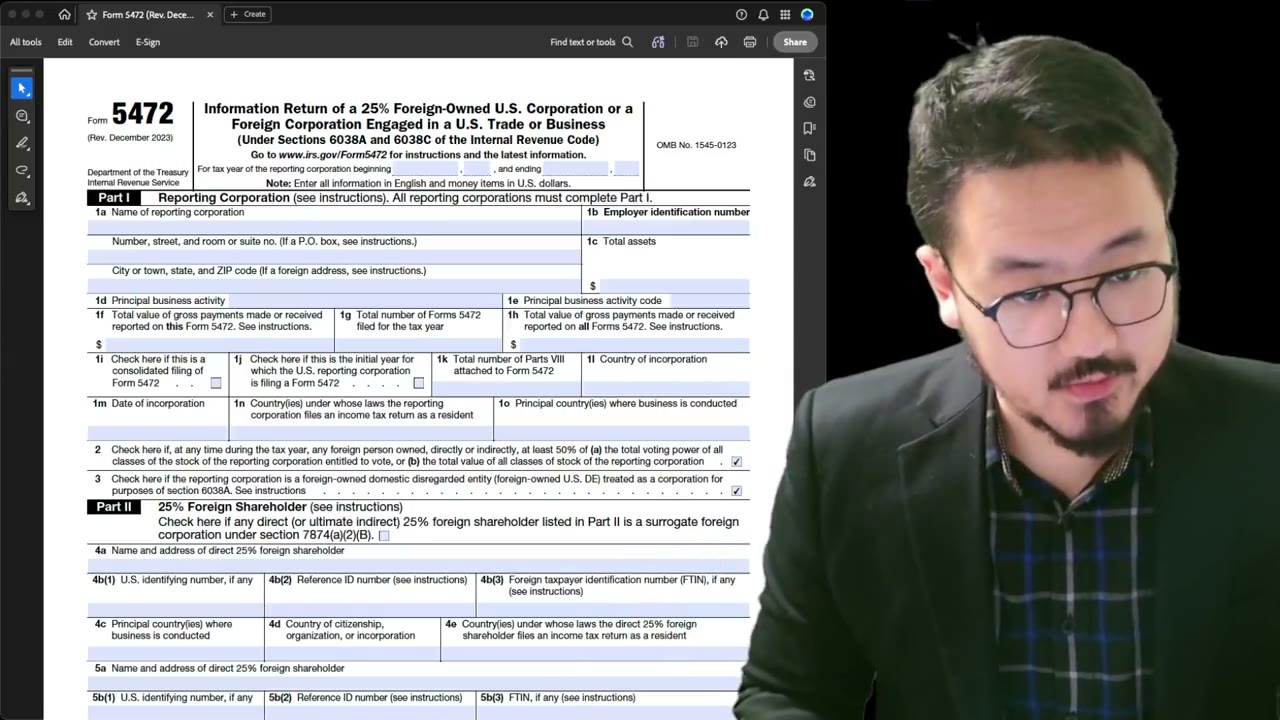
How Form 5472 Captures Parts IV, V, and VI Transactions
The current Form 5472 separates transaction reporting by part. Do not use an old line map or place every owner movement into Part V:
- Part IV: monetary transactions between a reporting corporation and the named related party, including sales, services, rents, royalties, interest, loans, and other amounts
- Part V: other reportable transactions of a foreign-owned U.S. disregarded entity, including formation, contributions, distributions, acquisitions, and dispositions not already reported in Part IV
- Part VI: nonmonetary and less-than-full-consideration transactions, described with a method used to determine fair market value
Prepare one workpaper per related party, in U.S. dollars, that maps each ledger family to the correct part and prevents double counting. Estimates may be used only within the instructions' limits and should have a retained method and source record.
- Identify the separate reporting corporation and the particular related party
- Separate cash, noncash, accrued, beginning/end balance, and formation/termination events
- Reconcile the workpaper to bank, capital, payable, loan, withholding, and financial-statement records
Our filer handles this automatically: When you use our Form 5472 filer, Part V is populated based on the transaction information you enter. No need to figure out which lines to use.
The Arm's Length Principle
The arm's length principle (IRC Section 482) requires that transactions between related parties be priced as if they occurred between unrelated parties in comparable circumstances.
Apply arm's-length pricing only after confirming there are separate controlled taxpayers and delineating what they actually exchanged:
- Services: benefit → activity class → cost base → best method → source → withholding → reporting
- Recharges: prove the underlying third-party cost and beneficiary; a hidden service or IP element can require more than pass-through treatment
- Loans: prove genuine debt and repayment capacity before benchmarking interest; an eligible controlled loan can use the regulatory 100%–130% AFR safe-haven range
- Royalties: identify exploitable IP rights and place of use before pricing, treaty, and chapter 3 withholding
- Tangible property: match the method to functions, risks, inventory terms, volumes, and available comparables
Scale documentation to risk, not to optimism. A small group may need only a concise contemporaneous file for routine transactions, but IP, repeated owner loans, U.S.-performed services, foreign-law restrictions, hybrids, withholding, or a mismatch between contract and conduct can require specialist work regardless of revenue.
Documentation Requirements
The IRS requires that you maintain records sufficient to establish the correctness of each reported transaction. Good documentation protects you in an audit and strengthens reasonable cause arguments if penalties are assessed.
Bank Statements
Monthly statements showing all transfers between the owner and LLC.
Wire Transfer Records
Confirmation documents for each international transfer.
Invoices and Receipts
For any expenses the owner pays on behalf of the LLC.
Loan Agreements
Written promissory notes for any loans between the owner and LLC.
Operating Agreement
Your LLC's operating agreement defining contribution and distribution terms.
Transaction Log
A simple spreadsheet tracking each transaction with date, amount, description, and category.
Examples of Proper Documentation
Example 1: Capital Contribution
Owner wires $10,000 from their personal bank to the LLC's U.S. bank account.
Example 2: Owner Pays for Software
Owner pays $1,200 for annual software subscription used by the LLC.
Example 3: Foreign-Parent Loan to Elected U.S. Corporation
A separate foreign parent advances $50,000 to a U.S. LLC that elected corporate treatment.
Penalties for Non-Compliance
Form 5472, income-tax pricing, withholding, and statute consequences are separate lanes:
- $25,000 initial Form 5472 penalty for a required form that is missing or substantially incomplete
- Continuation penalties: after the 90-day notice period, another $25,000 can apply for each 30-day period or fraction while the failure continues, with no statutory maximum stated in the instructions
- Record-keeping penalties for failure to maintain adequate documentation
- IRC Section 482 adjustments — the IRS can reallocate income between the owner and LLC if pricing is not at arm's length
- Sections 6662 and 6501(c)(8): valuation penalties and an extended assessment period can apply independently
- Withholding: U.S.-source services, royalties, interest, dividends, partnership ECTI, and owner returns follow their own collection and reporting regimes
Accurate Form 5472 reporting cannot substitute for a defensible pricing method, withholding, or the correct income-tax return—and a transfer-pricing memo cannot cure a missing Form 5472.
Not sure which method fits your deal?
The free method helper asks what your related-party transaction is — goods, a management fee, a royalty, or a loan — and points to the right §482 method, the safe harbor, and the documentation you need.
Open the Transfer-Pricing Method Helper →Picking a §482 Method at Small Scale
Every specified method under Treas. Reg. §1.482 starts from the same gate: the best-method rule. The method you use is whichever one gives the most reliable measure of an arm's-length result given your actual facts and the data you can get. For penalty defense, your choice is only "reasonable" if you concluded the selected method was the most reliable as applied and made a genuine effort to weigh the alternatives. That does not mean running every method to completion — a proportionate file just has to show why one method fit the facts and the others did not.
At one-person-LLC scale, four patterns cover almost everything:
Routine US distributor → CPM (operating-margin)
The comparable profits method (Treas. Reg. §1.482-5) is the workhorse when there are no clean internal comparables. It tests the least-complex party — here, a US LLC that warehouses, processes orders, handles customer service, and sells — on its operating profit relative to sales, with the foreign owner treated as the residual claimant. A thin, benchmarked operating margin is far more defensible than an improvised markup. It weakens fast if the US LLC owns valuable local intangibles or bears the entrepreneurial risk.
Limited-risk reseller → resale-price method
A tangible-goods method (§1.482-3) that tests the controlled purchase price by the gross margin a comparable independent reseller earns. It fits a US LLC that imports finished inventory from a foreign affiliate and resells it with limited functions, limited risk, and no US-created intangibles — and the goods are not physically altered before resale. It is not for pure services, royalties, or loans.
Contract manufacturer → cost-plus
Also a tangible-goods method (§1.482-3): an arm's-length price is production cost plus a comparable gross markup. Natural when the US LLC is a routine producer or contract manufacturer for a foreign affiliate and usable comparable markups exist. Cost-plus logic is a poor primary tool for valuable-IP royalties, which the intangible rules route elsewhere.
Both sides add nonroutine value → profit split
The profit split (§1.482-6) divides combined operating profit from the smallest identifiable activity. In its residual form, routine contributions get a market return first, then the leftover is split by the relative value of each side's nonroutine contributions. For solo LLCs this is the exception — reserve it for when the foreign owner contributes real brand or technology AND the US LLC makes its own demonstrable nonroutine contribution (meaningful US marketing intangibles, technology enhancement, shared strategic control).
Substance beats paper. Under §1.482-1, the IRS can look at actual conduct, disregard contract terms the parties do not follow, and impute terms where no written agreement exists. For a small LLC, owner emails, invoices, project logs, and the real flow of risks and benefits can carry as much weight as the intercompany agreement itself.
The Services Cost Method: Charge Admin at Cost
The Services Cost Method (SCM) under Treas. Reg. §1.482-9 is the single most useful simplification for routine support charges. When it applies, eligible services are priced at total services cost with no markup, SCM is treated as the best method, and the IRS is limited to adjusting the charge to the correctly computed total cost. For a foreign owner billing the US LLC for bookkeeping, payroll, or IT help-desk support, SCM often removes any need for a full markup study.
SCM eligibility has four moving parts, and all must hold:
- Covered service: either a specified covered service (Rev. Proc. 2007-13 lists payroll, AP/AR support, general admin, bookkeeping, accounting, tax-compliance support, recruiting, training, and IT support, among others) or a low-margin service whose median comparable markup on total cost is no more than 7%.
- Not an excluded activity: the exclusions are broader than founders expect — manufacturing, production, extraction, construction, reselling/distribution, R&D, engineering/scientific work, financial transactions (including guarantees), and insurance/reinsurance are all out.
- Passes the business-judgment rule: you must reasonably conclude the service does not contribute significantly to the group's key competitive advantages, core capabilities, or fundamental risks of success or failure.
- Adequate books and records: the cost build-up and allocations have to be documented.
The "management" trap.Routine office administration, bookkeeping, payroll support, tax compliance, and recruiting can ride SCM at cost. Strategic management, product strategy, key pricing decisions, brand stewardship, and IP-development oversight cannot — those are tied to competitive advantage and need another method. Do not bundle the two under one "management fee."
Some "management" is not chargeable at all.Under §1.482-9(l), a service must confer a benefit on the recipient. Duplicative activities generally do not. Activities whose only effect is to protect the renderer's own capital investment, or to meet legal or regulatory requirements specific to the renderer, are shareholder activities— not chargeable to the US LLC under any method. A foreign owner's investor-level oversight or parent-level governance cost should never land in a management charge. Genuine day-to-day operational support that actually benefits the LLC may be charged.
If SCM does not apply, the services rules step you up: a direct comparable fee (§1.482-9(c)), then cost-of-services-plus, then CPM for services, with profit split reserved for genuinely integrated high-value arrangements.
Owner Loans and Royalties
Related-party loans
For bona fide debt between separate controlled taxpayers, Treas. Reg. §1.482-2 asks what unrelated parties would charge on a comparable loan—looking at principal, term, security, the borrower's credit, and prevailing rates. This discussion does not turn an advance between a disregarded LLC and its owner into separate federal debt. For an eligible controlled loan between separate taxpayers, a practical regulatory anchor is the AFR safe-haven: a dollar loan rate is treated as arm's length if it sits at 100%–130% of the applicable federal rate (short-, mid-, or long-term AFR matched to the loan term; short-term AFR for demand loans). Charge too little and the floor applies; charge too much and the ceiling applies unless you prove a better market rate.
Thin capitalization is the bigger risk than the rate. §1.482-2 only reaches bona fide debt. A running owner balance with no note, no fixed maturity, no payment history, and no realistic expectation of repayment can be recharacterized as a capital contribution or a distribution even if the stated rate is inside the AFR band. If the instrument is not respected as debt, there may be no deductible interest at all. Keep a real note, maturity, principal schedule, and evidence of actual accruals and payments.
Even where debt is genuine and priced, sections 267(a)(3) and 267A can affect the timing or allowance of foreign-related deductions, chapter 3 can require withholding on U.S.-source interest, and IRC §163(j) can cap the business-interest deduction (generally business interest income plus 30% of adjusted taxable income), though the §448(c) small-business gross-receipts exemption can apply subject to its exclusions and aggregation rules. The order is: identify separate taxpayers; establish real debt; price it; then test accrual timing, withholding, hybrids, and deductibility.
Royalties and IP
The intangible rules (Treas. Reg. §1.482-4) are a separate, more demanding branch. The specified royalty methods are the comparable uncontrolled transaction (CUT) method, CPM, profit split, and unspecified methods — note that resale-price and cost-plus are not on the list. A CUT is strongest when the same or comparable IP is licensed externally; small LLCs often overlook an internal CUT, such as the foreign owner licensing the same trademark or software to another market.
Commensurate-with-income / periodic adjustments. IRC §482 requires that income from a transfer or license of intangibles be commensurate with the income the intangible actually produces. The regulations enforce this through periodic adjustments: the IRS can revisit the consideration in a later year to keep it commensurate — even if the original transfer year is closed. A royalty that looked fine when a brand was small can become indefensible once the US market takes off and the file never documented the projections and pricing logic.
The US brand build-out trap.When a US LLC funds and executes meaningful US marketing that enhances a foreign-owned trademark without contemporaneous compensation or a realistic expectation of future benefit, §1.482-4's examples let the IRS look past a simple owner-imposed royalty and ask who actually created the local value. A foreign-owned online store building US-market premium with its own spend cannot assume a flat royalty tells the whole story.
Penalties and the Documentation Defense
Separate from the $25,000 Form 5472 / §6038A penalties already covered, IRC §6662(e) and (h) impose accuracy-related penalties on the income-tax side: a 20% penalty for a substantial valuation misstatement, rising to 40% for a gross misstatement. There are two bases:
- Transactional: the claimed price is 200% or more, or 50% or less, of the correct §482 price (the 40% tier triggers at 400% / 25%).
- Net adjustment: the net §482 adjustment exceeds the lesser of $5M or 10% of gross receipts (the 40% tier at $20M or 20%).
The catch on the net-adjustment basis: §6662 says you get no reasonable-cause relief unless you meet the documentation requirements of Treas. Reg. §1.6662-6. That makes a contemporaneous file the heart of the defense, even at small scale. The principal documents must generally exist when the return is filed and be handed to the IRS within 30 days of request.
The 10 principal documents (§1.6662-6(d)(2)(iii)(B))
- Overview of the business and the economic and legal factors affecting pricing
- Organizational structure / org chart covering all related parties that matter under §482
- Any documentation the §482 regulations specifically require (e.g. an SCM intent statement)
- The selected method and why it was chosen, including whether its requirements were met
- The alternative methods considered and why they were rejected
- The controlled transactions and internal data analyzed, including terms of sale and cost build-ups
- The comparables used, how comparability was judged, and any adjustments
- The economic analysis and projections relied on
- Relevant data obtained after year-end but before filing
- A general index of the principal and background documents and the recordkeeping system
Proportionate is fine.For a one-person LLC this is not an economist's report — it is a low-cost annual file: a short method memo, a one-page related-party chart, written agreements (or a same-day memo of an oral arrangement), a transaction spreadsheet that ties each category to Form 5472 and the return, support for each amount, and a year-end true-up note. Add the SCM intent statement and cost allocations if you use SCM, a small CPM benchmark if you use CPM, or the note plus AFR support if you have a loan. That package satisfies the logic of §§482, 6662, and 1.6662-6 without paying for a full study every year. See the record-keeping for Form 5472 guide for the transaction-by-transaction mapping, then build the return in the step-by-step filer.
Primary sources
- IRC §482 — allocation among controlled parties; commensurate-with-income rule
- IRC §6662 — accuracy-related penalties (transactional and net-adjustment bases)
- IRC §163(j) — business-interest deduction limitation
- Treas. Reg. §§1.482-1, -2, -5, -9 — best-method rule, loans, CPM, and services/SCM
- Treas. Reg. §1.6662-6 — contemporaneous-documentation defense and the principal documents
- Rev. Proc. 2007-13 — specified covered services eligible for the SCM
Related Tools
File Form 5472
Our filer handles Part V transaction reporting automatically.
Transaction Categorizer
Categorize your related-party transactions for Form 5472.
Form 5472 Amendment Guide
Need to correct Part V transactions on a prior filing?
Penalty Calculator
Estimate potential penalties for non-compliance.
Let doola Handle Your Bookkeeping
Proper bookkeeping is the foundation of transfer pricing compliance. doola provides dedicated bookkeeping for foreign-owned LLCs — every transaction categorized and ready for Form 5472 reporting.
Explore doola BookkeepingFile Form 5472 with Part V Done Right
Our guided filer walks you through Part V transaction reporting step by step. Enter your transactions, review the generated form, sign, and submit it yourself.
Start Filing