Abroad Extension vs Form 4868 Guide for International Filers (2025-2026)

Filing deadline sequence
How the key federal filing dates line up across the year.
Know your form's due date
Each return has its own statutory deadline.
Extend if needed
An extension moves the filing date, not the payment date.
File the return
Submit by the (possibly extended) due date.
Retain proof of filing
Keep confirmation in case of later IRS questions.
Key Takeaways
- The automatic abroad extension to June 15 is separate from Form 4868.
- Form 4868 is generally for more time beyond the automatic two-month relief.
- Interest generally still runs from the regular April due date.
- The taxpayer should preserve the required statement and timely filing evidence.
The automatic abroad extension and Form 4868 are not the same deadline tool
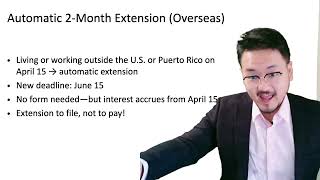
The IRS extensions FAQ says U.S. citizens and resident aliens living and working overseas on the due date receive an automatic two-month extension, generally to June 15 for calendar-year filers, if they attach the required statement to the return. The same FAQ also says Form 4868 is needed only if additional time is required beyond those two months.
That means many overseas founders already have more time without filing Form 4868. The mistake is assuming the June 15 relief and the October extension are one single mechanism.
June 15 relief still comes with interest exposure
The IRS abroad-extensions page says interest runs from the regular due date even if the taxpayer qualifies for the automatic two-month extension. So the filing deadline and the payment clock do not move together in the way many overseas taxpayers expect.
For founders with large balances due, that distinction matters far more than the paper deadline. A taxpayer can file on time for extension purposes and still pay meaningful interest because the tax was not settled by April 15.
Postmark and statement details matter when the taxpayer is outside the country
The IRS FAQ also says the return must be postmarked by June 15, 2026 for calendar-year 2025 returns to rely on the automatic two-month extension. The file should also include the statement showing the taxpayer is a person described in the relevant regulation.
In practice, the cleanest file keeps proof of mailing or e-filing timing along with the abroad statement rather than assuming the IRS will infer overseas status from the address alone.
Frequently Asked Questions
Do overseas taxpayers always need Form 4868 to get to June 15?
No. The IRS says qualifying taxpayers abroad generally receive an automatic two-month extension and need Form 4868 only for additional time beyond that.
Does the automatic abroad extension also extend time to pay tax?
Not generally. The IRS abroad-extensions guidance says interest runs from the regular due date if tax is paid later.
Does the June 15 deadline depend on receipt or postmark?
The IRS extensions FAQ says a qualifying return from abroad must be postmarked by June 15, 2026 for that filing cycle.
Listen on Spotify
Money & Tax Talk with Rippa — 5/5 rating
Need Help Filing?
Contact us with your situation and we'll point you to the right path
Never miss an IRS deadline
Get free email reminders for Form 5472, state annual reports, quarterly estimated tax, and OBBBA rule changes — built for foreign-owned LLC owners. No spam. Unsubscribe anytime.
We respect your privacy. No spam, ever.
Need to file your foreign-owned LLC return?
Skip the CPA bill. Our guided wizard builds your IRS-ready filing package, step by step.
Includes its walkthrough video pack
Start filing →
Ask the AI tools, free
Tax Return Drafter, Catch-Up Planner, Form Reviewer, IRS Notice Decoder — purpose-built AI tools, no signup needed.
Free tier · BYOK Anthropic/OpenAI for power use
Browse tools →
Starting your foreign-owned LLC?
Vetted partners we use ourselves: doola & Firstbase for formation, Mercury for banking, Alohi for IRS faxing.
No-fluff recommendations, no Northwest
See partners →
More on Tax Return Due Dates
Form 2350 FEIE Extension Guide
Form 2350 FEIE Extension Guide for U.S. Residents Abroad (2025-2026)
Form 7004 Extension Guide for Foreign-Owned LLCs
Form 7004 Extension Guide for Foreign-Owned LLCs (2025-2026)
Timely Filing Proof Guide for International Business Returns
How to Prove Form 5472 and Business Returns Were Filed on Time (2026-2027)
Form 1040-ES (NR) Estimated Tax Guide
Form 1040-ES NR Estimated Tax Guide for Nonresident Founders (2025-2026)
When Will the IRS Release 2026 Tax Forms? (Timeline for Form 5472 and Form 1120)
When Will the IRS Release 2026 Tax Forms? Form 5472 and 1120 Release Timeline
 3:28
3:28