Form 2350 FEIE Extension Guide for U.S. Residents Abroad (2025-2026)

Filing deadline sequence
How the key federal filing dates line up across the year.
Know your form's due date
Each return has its own statutory deadline.
Extend if needed
An extension moves the filing date, not the payment date.
File the return
Submit by the (possibly extended) due date.
Retain proof of filing
Keep confirmation in case of later IRS questions.
Key Takeaways
- Form 2350 is used when FEIE qualification will occur after the ordinary filing deadline.
- The automatic June 15 abroad rule and the Form 2350 extension are separate concepts.
- Form 2350 can extend filing to 30 days beyond the expected qualification date.
- The extension does not stop interest from running on tax owed.
Form 2350 exists for a narrow but important timing problem
The IRS extension page explains that Form 2350 is for taxpayers who expect to qualify for the foreign earned income exclusion or housing rules, but will not meet the bona fide residence or physical presence test by the normal filing deadline. This is different from the ordinary filing extension conversation because the issue is qualification timing, not just more time to organize papers.
For a founder who moved abroad late in the year, that distinction can be decisive. They may genuinely expect to qualify for Form 2555, but only after more days have passed in the foreign country.
The abroad extension and the Form 2350 extension are not the same thing
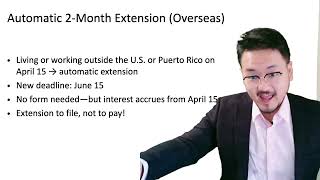
The IRS page says taxpayers abroad can generally have a June 15 due date if both their tax home and abode are outside the United States and Puerto Rico on the regular due date. Form 2350 is a separate request that can extend filing to 30 days beyond the date the taxpayer reasonably expects to qualify for the exclusion tests.
That means a taxpayer should not assume the automatic two-month rule fully solves a late-qualification problem. Sometimes the calendar still requires a Form 2350 filing to avoid choosing between an early return and a later amended return.
The extension is about filing time, not payment relief
The IRS page is explicit that Form 2350 does not extend the time to pay tax. Interest still runs from the regular due date, normally April 15, even when the taxpayer qualifies for the abroad extension or receives a Form 2350 extension.
That is why the payment estimate still matters. If the tests are ultimately not met, the taxpayer should file as soon as possible and settle the balance rather than treating the extension as a no-cost pause.
Frequently Asked Questions
When should Form 2350 be filed?
The IRS says it should be filed by the due date for the return, not after the taxpayer finally qualifies.
Does Form 2350 extend the time to pay tax?
No. The IRS states that it extends time to file, not time to pay.
What happens if I get the extension but never meet the FEIE tests?
The IRS says you should file as soon as possible and pay any tax due, with interest running from the regular due date.
Listen on Spotify
Money & Tax Talk with Rippa — 5/5 rating
Need Help Filing?
Contact us with your situation and we'll point you to the right path
Never miss an IRS deadline
Get free email reminders for Form 5472, state annual reports, quarterly estimated tax, and OBBBA rule changes — built for foreign-owned LLC owners. No spam. Unsubscribe anytime.
We respect your privacy. No spam, ever.
Need to file your foreign-owned LLC return?
Skip the CPA bill. Our guided wizard builds your IRS-ready filing package, step by step.
Includes its walkthrough video pack
Start filing →
Ask the AI tools, free
Tax Return Drafter, Catch-Up Planner, Form Reviewer, IRS Notice Decoder — purpose-built AI tools, no signup needed.
Free tier · BYOK Anthropic/OpenAI for power use
Browse tools →
Starting your foreign-owned LLC?
Vetted partners we use ourselves: doola & Firstbase for formation, Mercury for banking, Alohi for IRS faxing.
No-fluff recommendations, no Northwest
See partners →
More on Tax Return Due Dates
Abroad Extension vs Form 4868 Guide
Abroad Extension vs Form 4868 Guide for International Filers (2025-2026)
Form 7004 Extension Guide for Foreign-Owned LLCs
Form 7004 Extension Guide for Foreign-Owned LLCs (2025-2026)
Form 1040-ES (NR) Estimated Tax Guide
Form 1040-ES NR Estimated Tax Guide for Nonresident Founders (2025-2026)
When Will the IRS Release 2026 Tax Forms? (Timeline for Form 5472 and Form 1120)
When Will the IRS Release 2026 Tax Forms? Form 5472 and 1120 Release Timeline
Timely Filing Proof Guide for International Business Returns
How to Prove Form 5472 and Business Returns Were Filed on Time (2026-2027)
 3:28
3:28