Pro Forma 1120 + Form 5472: The Required Combo Filing for Foreign-Owned LLCs

Key Takeaways
- A wholly foreign-owned U.S. disregarded LLC generally files pro forma Form 1120 + Form 5472 for a year with reportable related-party transactions; zero income is not the test
- "Pro forma" means most of Form 1120 stays blank — only identification fields are filled in
- Form 5472 carries the actual reporting: owner identity, country, and every reportable transaction
- LLC formation (the initial capital contribution) counts as a reportable transaction, so first-year filings are not exempt
- The IRS penalty for non-filing is $25,000 per form per year — applied automatically when caught
What the Pro Forma 1120 + Form 5472 Combo Actually Is
For a wholly foreign-owned single-member U.S. LLC treated as a disregarded entity, a required Form 5472 is filed with a "pro forma" Form 1120 as its cover. The filing is generally required when the LLC had a transaction reportable in Form 5472 Part IV, V, or VI. Zero income, zero tax, or no U.S. business does not by itself remove the filing duty; formation, contributions, distributions, owner-paid costs, loans, and dissolution can be reportable. The current IRS instructions do provide an exception when none of those parts contains a reportable transaction.
Most foreign founders find this surprising. The LLC is disregarded for federal income-tax purposes, yet is treated as a separate reporting corporation for the limited section 6038A regime. The pro forma Form 1120 does not turn the LLC into a C corporation or calculate entity-level income tax; it is the filing vehicle to which Form 5472 is attached.
Why "Pro Forma" Means "Most of It Stays Blank"
The phrase "pro forma" is the key. It's a Latin term meaning "as a matter of form" — i.e., this isn't a real Form 1120 calculation of corporate tax. It's a procedural shell. The IRS instructions are explicit: a foreign-owned disregarded entity doesn't fill in the income, deductions, tax, or schedules sections. Almost the entire form stays blank.
What does get filled in: the identification block at the top (LLC name, EIN, address, state of incorporation), the tax year, and a small header annotation. The header annotation is critical — you write "Foreign-Owned U.S. DE" across the top of the form. That's the IRS's signal to the processing center that this isn't a real corporate return and shouldn't be routed through normal C-Corp examination.
The Real Reporting Happens on Form 5472
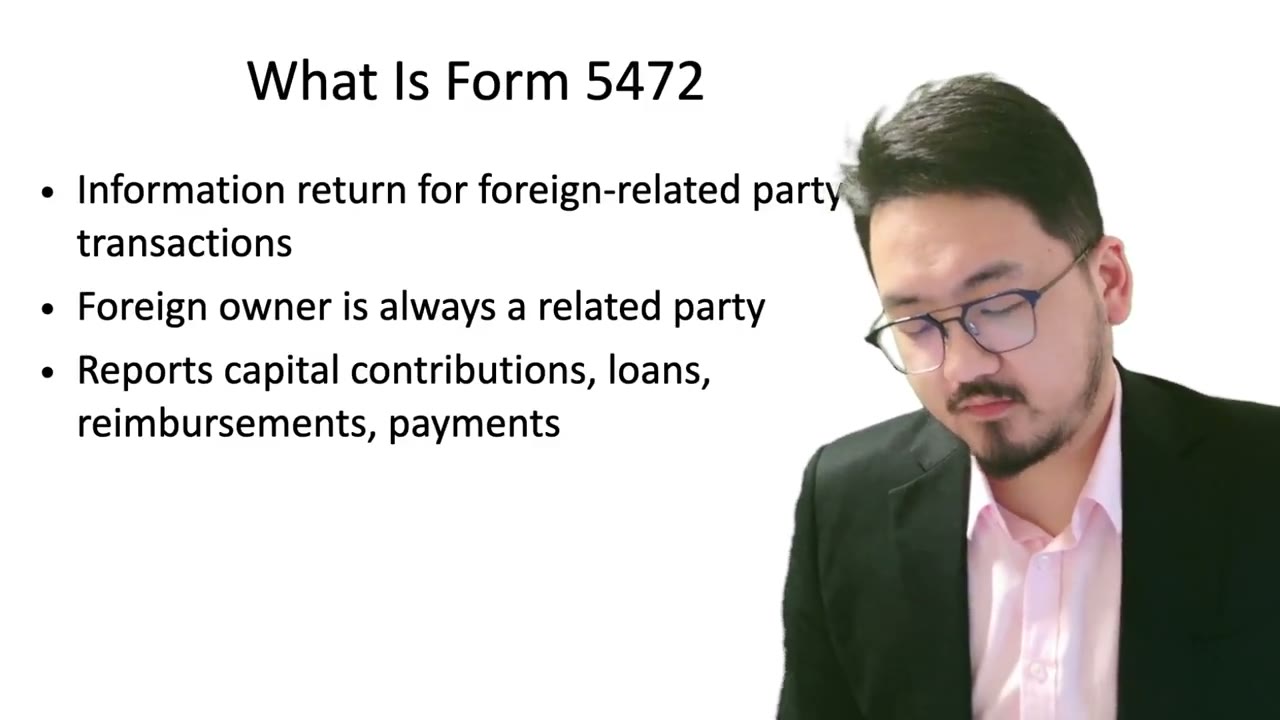
Form 5472 is where you actually report the substance: who the foreign owner is, what country they're a resident of, and every reportable transaction between the LLC and the foreign owner (or any related foreign party) during the year. Reportable transactions include capital contributions from the foreign owner, distributions paid to the foreign owner, loans between the LLC and the foreign owner, and any other money or property transfers.
The formation of the LLC itself counts as a reportable transaction — the founder's initial capital contribution. So even in the LLC's first year with no business activity, there's almost always at least one entry on Form 5472. This is why the "zero income" defense doesn't work: the filing requirement is triggered by ownership and transactions, not by net income.
Common Scenarios That Trigger This Filing
If a non-U.S. person wholly owns a U.S. single-member LLC that has not elected corporate treatment, the entity is generally disregarded and must test each year for Form 5472 reportable transactions. Common scenarios include a Delaware SaaS LLC funded by its German owner, a Wyoming freelance LLC whose Argentine owner pays expenses, or a New Mexico creator LLC that distributes Stripe proceeds to its Philippine owner.
Formation, capital, owner-paid expenses, reimbursements, loans, distributions, and dissolution can trigger the pro forma Form 1120 + Form 5472 package even when revenue is zero. The current IRS instructions provide an exception when no transactions are reportable in Parts IV, V, or VI. There is no income threshold or general small-entity exception to a required filing, and the initial penalty for a required form that is late or substantially incomplete is $25,000.
Frequently Asked Questions
If I had no income, do I still need to file the pro forma 1120 + Form 5472?
Yes. The filing requirement is triggered by being a foreign-owned U.S. disregarded entity, not by having income. The formation contribution alone counts as a reportable transaction.
Why do I have to file Form 1120 if my LLC is a disregarded entity?
It's procedural. Form 5472 needs to be attached to something, and the IRS designated Form 1120 as the cover return. You don't actually compute corporate tax — most of the form stays blank with "Foreign-Owned U.S. DE" written across the top.
Can I e-file this combination?
No. The IRS does not accept e-filing of the pro forma Form 1120 + Form 5472 combination for foreign-owned disregarded entities. You must paper-file or fax. ForeignLLCTax.com generates the IRS-ready PDF you can mail or fax.
IRS Form 5472 Instructions
Official IRS source on irs.gov
Listen on Spotify
Money & Tax Talk with Rippa — 5/5 rating
Never miss an IRS deadline
Get free email reminders for Form 5472, state annual reports, quarterly estimated tax, and OBBBA rule changes — built for foreign-owned LLC owners. No spam. Unsubscribe anytime.
We respect your privacy. No spam, ever.
Need to file your foreign-owned LLC return?
Skip the CPA bill. Our guided wizard builds your IRS-ready filing package, step by step.
Includes its walkthrough video pack
Start filing →
Ask the AI tools, free
Tax Return Drafter, Catch-Up Planner, Form Reviewer, IRS Notice Decoder — purpose-built AI tools, no signup needed.
Free tier · BYOK Anthropic/OpenAI for power use
Browse tools →
Starting your foreign-owned LLC?
Vetted partners we use ourselves: doola & Firstbase for formation, Mercury for banking, Alohi for IRS faxing.
No-fluff recommendations, no Northwest
See partners →
More on Form 5472 & Foreign-Owned LLCs
 2:20
2:20Pro Forma 1120 + Form 5472: What Counts as a Reportable Transaction with Your LLC
Form 5472 Explained — What It Is, Who Must File, and How It Works
Form 5472 Explained: Who Must File and What Is Reportable (2026-2027)
Separate Form 5472 for Each Related Party Guide
Separate Form 5472 for Each Related Party Guide (2025-2026)
Cloud Folder Records Guide for Related-Party Transactions
Cloud Folder Records Guide for Related-Party Transactions (2025-2026)
 1:04
1:04Why the IRS Requires Form 5472 for Foreign-Owned LLCs: Pro Forma 1120 Explained
 1:30
1:30