Foreign Corporation (1120-F) vs Foreign-Owned LLC (5472 + Pro-Forma 1120): Which US Tax Regime Applies
The audience's number-one confusion, settled: do you file Form 1120-F as a foreign corporation, or Form 5472 plus a pro forma 1120 as a foreign-owned disregarded LLC — and when do both apply? Plus branch profits tax, protective filing, treaty analysis, and the conversion trade-offs.
 Lipai WangIRS-registered tax professionalResearch Report
Disclaimer: This is independent research and educational analysis, compiled from the IRS instructions for Forms 1120-F and 5472, the Internal Revenue Code (sections 881, 882, 884, and 6038A), Treasury regulations, and public case law current to mid-2026. It is not legal or tax advice, and the choice between a foreign-corporation and a foreign-owned-LLC structure — and whether a US trade or business, treaty position, or branch profits tax applies — turns on intensely fact-specific questions. Anyone weighing a structure or a conversion should consult a qualified attorney or tax adviser before filing.
Key Takeaways
- These are two different regimes, not two names for one filing. Form 1120-F is the actual income tax return of a foreign corporation; the Form 5472 + pro forma 1120 package is an information report a foreign-owned US disregarded LLC files under section 6038A — it computes no income tax.
- The question is not which one you pick — it is which one your facts trigger. A foreign corporation owes 1120-F if it is engaged in a US trade or business, has effectively connected income, or has US-source income not fully satisfied by withholding. A disregarded single-member LLC owned by a foreign person files 5472 because the regulations treat it as a domestic corporation solely for information reporting.
- They can coexist. If a foreign corporation owns a US disregarded LLC, the LLC may file 5472 + pro forma 1120 under section 6038A while the corporation separately files its own Form 1120-F — the disregarded-entity rules do not erase the owner-level return.
- A foreign corporation operating directly as a US branch faces a second-level tax the LLC path never triggers: the section 884 branch profits tax, generally 30% (or a treaty rate for a qualified resident) on the dividend-equivalent amount — on top of the 21% net-basis tax on effectively connected income.
- Even at $0 US tax, a foreign corporation usually still files a protective Form 1120-F under Treas. Reg. 1.882-4 to preserve its deductions and credits — a missed return can forfeit them entirely.
1. Two regimes at a glance — and why people confuse them
The single most common point of confusion for cross-border founders is treating Form 1120-F and the Form 5472 + pro forma 1120 package as interchangeable. They are not. They answer different questions, sit on different parts of the Code, and produce different bills.
Form 1120-F is an income tax return. It is the return of the foreign corporation itself — a non-US entity that earns US income or operates in the United States. It computes and pays actual US tax, transmits treaty disclosures on Form 8833, and is where the branch profits tax under section 884 is calculated.
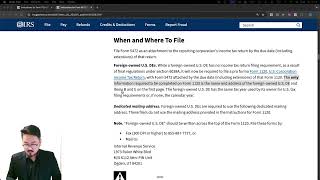
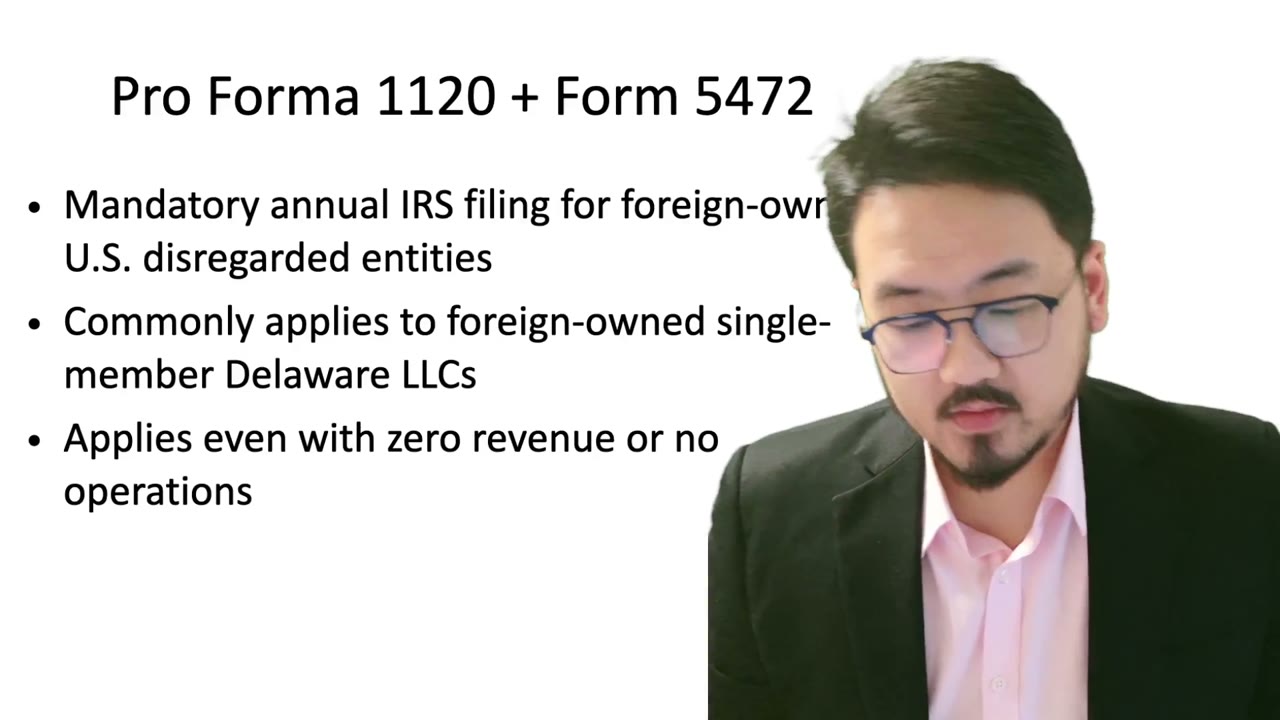
Form 5472 + pro forma 1120 is an information report. A US single-member LLC owned by a foreign person is generally disregarded for income tax purposes, but Treasury regulations treat it as a domestic corporation solely for the section 6038A information-reporting rules. That is why a foreign-owned disregarded LLC files a near-blank pro forma Form 1120 with Form 5472 attached to disclose reportable transactions with its foreign owner — but it is not paying entity-level income tax on that return.
So the threshold question is not which form you would rather file. It is a facts question: what is the legal entity (a foreign corporation, or a US LLC), and what is it doing in the United States. The rest of this guide walks the two trigger tests, the case where both fire at once, the two tax buckets, the branch-level second tax, protective filing, treaty/PE analysis, and the conversion trade-offs.
2. When a foreign corporation must file Form 1120-F
Engaged in a US trade or business, ECI, or under-satisfied US-source income
The IRS instructions cast the Form 1120-F net wider than most expect. A foreign corporation generally must file if, during the tax year, it was engaged in a trade or business in the United States — whether or not it had US-source income from that business, and whether or not that income is exempt under a treaty.
It must also file if it had income, gains, or losses treated as effectively connected with a US trade or business (ECI), or if it was not engaged in a US trade or business but had US-source income for which its US tax liability was not fully satisfied by chapter 3 withholding. The same return is used to claim refunds of over-withheld tax, to transmit a Form 8833 treaty-based position, and to compute the branch profits tax.
Two practical implications fall out of that wording. First, a treaty position does not remove the filing obligation — a corporation that concludes a treaty zeroes out its US tax is still expected to file (see protective filing in section 7). Second, even a corporation with only passive US-source income can land in 1120-F territory if its withholding did not fully cover the tax — for example, where the wrong rate was applied or a payment slipped through under-withheld.
- Engaged in a US trade or business during the year — file, even with no US-source income and even if a treaty exempts the income.
- Has effectively connected income, gains, or losses (ECI) — file and compute net-basis tax.
- Not engaged in a US trade or business, but has US-source income not fully covered by chapter 3 withholding — file to reconcile or claim a refund.
- Wants to claim a treaty position (Form 8833), claim a refund of over-withholding, or compute branch profits tax — the 1120-F is the vehicle.
3. The foreign-owned US disregarded LLC — a section 6038A information report
Briefly: Form 5472 + pro forma 1120 (covered in depth elsewhere)
The other path applies to a very different taxpayer: a US single-member LLC owned by a foreign person. Because the LLC is disregarded for income tax, it has no income tax return of its own — but section 6038A and its regulations treat it as a domestic corporation solely for information reporting, requiring it to file Form 5472 attached to a pro forma Form 1120 to disclose reportable transactions with its foreign owner and related parties.
This guide does not re-walk that mechanics — the package, the Ogden mailing/fax procedure, zero-activity edge cases, and the $25,000 penalty are already covered in our existing guides. The point to hold here is simply the contrast: the LLC filing is an information return that computes no income tax, while Form 1120-F is the income tax return of a foreign corporation. Mixing them up is the root of most of the confusion this guide exists to resolve.
- See: How to Submit Form 5472 — the full 5472 + pro forma 1120 mailing/fax procedure.
- See: Form 5472 Nuances — zero-activity LLCs, related-party loans, and edge cases.
- See: USTB Risk — when a foreign-owned LLC's activity rises to a US trade or business.
4. They can coexist — a foreign corporation that owns a US disregarded LLC
Here is the case the two-regime framing usually misses: the regimes are not mutually exclusive. If a foreign corporation owns a US disregarded LLC, both filings can be required at once.
At the LLC level, the disregarded LLC may have a Form 5472 + pro forma 1120 obligation under section 6038A, exactly as it would if any foreign person owned it. At the owner level, the foreign corporation may separately owe Form 1120-F — for instance, if it is engaged in a US trade or business through that LLC, or has US-source income not fully satisfied by withholding. The disregarded-entity rules collapse the LLC for income-tax purposes, but they do not eliminate the corporation's own Form 1120-F analysis.
In other words, the LLC's information report and the corporation's income tax return live on different rails and can both run. A foreign corporate owner who files only the 5472 package, assuming it has "handled" its US filing, can be sitting on an unfiled 1120-F — and, with it, the protective-filing and deduction-preservation risks discussed below.
5. The two tax buckets — section 881 gross-basis FDAP vs section 882 net-basis ECI
Once a foreign corporation is inside the 1120-F regime, the Code splits its US income into two buckets that are taxed in fundamentally different ways.
Section 881 — 30% gross-basis tax on FDAP. Certain US-source income that is not connected with a US business — broadly fixed or determinable annual or periodical income such as dividends, interest, rents, and royalties — is taxed at a flat 30% on the gross amount, with no deductions. This is normally collected through the chapter 3 withholding system and reported by the withholding agent on Form 1042-S, and a treaty can lower the 30% rate. On the return, this is the Section I computation, which the form tells you not to use for amounts already properly withheld and reported on Form 1042-S.
Section 882 — net-basis tax on ECI. Income that is effectively connected with a US trade or business is taxed on a net basis — gross ECI minus properly allocable deductions — at the same 21% corporate rate as a domestic corporation. This is the Section II computation, where allocated deductions (Schedule H) and allocated interest expense (Schedule I) come in and Schedule J computes the tax. Section 894 requires all of this to be applied with due regard to US treaty obligations.
The gulf between the two buckets — 30% of gross with no deductions versus 21% of net — is why the engaged-in-a-US-trade-or-business and effectively-connected questions are the most consequential determinations on the whole return.
6. Branch profits tax under section 884 — the big cost of operating as a direct branch
Section 884 is what makes operating a US business directly through a foreign corporation's branch economically different from operating it through a US subsidiary. Congress added it to approximate the second-level (shareholder) tax that would apply if the US business were run through a US corporation paying dividends to its foreign parent.
The mechanics are a second tax stacked on top of the section 882 net-basis tax. The branch profits tax is imposed on the corporation's dividend-equivalent amount, which equals the year's effectively connected earnings and profits, reduced by any increase in US net equity and increased by any decrease in US net equity. US net equity is, broadly, the branch's US assets minus its US liabilities — so reinvesting earnings into the US business (raising net equity) shrinks the dividend-equivalent amount, while pulling equity out (lowering it) enlarges it. Treasury Regulation 1.884-1 sets the rate at 30% of the dividend-equivalent amount, in addition to the section 882 tax. On the return this is the Section III computation.
A treaty can reduce or eliminate the branch profits tax, but only on section 884's terms: under section 884(e), a treaty helps only if it is an income tax treaty and the foreign corporation is a qualified resident of the treaty country. Where the treaty has no specific branch-profits article, the Code generally looks to the treaty's dividend rate for a wholly owned subsidiary paying its corporate parent. The form reflects this by applying 30% or a lower treaty rate if the corporation is a qualified resident or otherwise qualifies for treaty benefits.
- Branch profits tax applies to the dividend-equivalent amount — effectively connected E&P, adjusted for the change in US net equity.
- Statutory rate is 30%, on top of the 21% net-basis tax on ECI — a genuine second layer.
- A treaty cuts it only if it is an income tax treaty and the corporation is a qualified resident (section 884(e)).
- There is also a related branch-level tax on excess interest under section 884(f) — reported on the return, not collected by withholding.
7. Protective filing under Treas. Reg. 1.882-4 — why file even at $0 tax
A foreign corporation that concludes it owes no US tax — because a treaty exempts the income, or because its US activity does not rise to a US trade or business — still usually files a protective Form 1120-F. The reason is in Treasury Regulation 1.882-4: a foreign corporation gets deductions and credits against ECI only if it files a true and accurate return, and the regulation provides a specific protective-return mechanism to preserve that right if the no-tax determination later proves wrong.
The downside of skipping it is severe. The 1120-F instructions state in plain terms that a corporation that does not file a return can lose the right to take deductions and credits against effectively connected income — turning what should have been a net-basis tax into something closer to a tax on gross receipts if the IRS later finds ECI. A protective return is, in effect, a low-cost option premium that keeps the deduction door open.
This is also why "no permanent establishment" is not the same as "no filing." The instructions specifically direct a corporation that initially determines it has no US tax under a treaty — for example because its income is not attributable to a US permanent establishment — to file a protective return and attach Form 8833 where required. We treat the full protective-filing mechanics, deadlines, and the 18-month rule in a dedicated guide rather than repeating them here.
- See: Protective Filing of Form 1120-F — why and when to file protectively, deadlines, and the deduction-preservation rules.
8. Treaty + permanent-establishment analysis — and recent case law
Articles 5 and 7, Form 8833, and the cases that decide the close calls
Treaty analysis starts with section 894 and moves to the relevant treaty's business profits and permanent establishment articles — commonly Article 7 and Article 5. The Form 1120-F asks the questions directly: whether the corporation had a permanent establishment in the United States under a treaty, and whether it is taking a position that a treaty overrides the Code to reduce its tax — in which case Form 8833 is generally required under section 6114.
Recent case law shows how fact-driven these calls are. In YA Global Investments, LP, the Tax Court held the partnership was engaged in a US trade or business and rejected the argument that its US manager was an independent agent — emphasizing the manager's agency status, the retained control, and the manager's negotiation of hundreds of contracts, with the income then attributed through the US office. That case is a warning for foreign funds and corporations that use US managers, advisers, or affiliates to originate or negotiate deals: a dependent agent can create a US trade or business (and, by extension, a permanent establishment) even without a traditional office.
On the procedural side, the live authorities on late-filed returns are Swallows Holding, Ltd. v. Commissioner and Adams Challenge (UK) Ltd. v. Commissioner. The IRS continues to teach examiners that these cases are central to the loss of deductions and credits when a foreign corporation files its 1120-F late — Swallows upholding the regulatory timing standard for claiming deductions, and Adams Challenge reinforcing the consequences of delinquency. Together they are the reason protective filing is treated as a best practice rather than an afterthought.
- Item on the form: did the corporation have a US permanent establishment under a treaty? (Article 5/7 analysis.)
- Treaty-overrides-the-Code positions generally require Form 8833 (section 6114).
- YA Global — a dependent US agent/manager can create a US trade or business and ECI.
- Swallows Holding / Adams Challenge — late filing can forfeit the deductions and credits against ECI.
9. Conversion trade-offs and a decision summary
Disregarded LLC vs foreign-corp branch vs US C-corp
The structural choice is not merely administrative — it changes the core taxing regime and, critically, the second-level tax. Three common structures sit on a spectrum:
Disregarded US LLC owned by a foreign person. Income-tax-transparent to the owner; at the entity level it triggers the section 6038A information-reporting regime (Form 5472 + pro forma 1120). The owner's own US tax then depends on what the activity is and who owns the LLC — and, if the owner is itself a foreign corporation, can pull in a 1120-F (section 4).
Foreign corporation operating directly as a US branch. Moves the analysis into Form 1120-F, sections 881/882, treaty disclosure, and — the headline cost — the section 884 branch profits tax plus branch-level interest rules. It can simplify legal ownership, but it introduces that second layer on repatriated branch earnings.
US C-corporation owned by the foreign parent. Stays in the regular Form 1120 world (related-party transactions can still trigger Form 5472). Here the second-level tax is not branch profits tax but the more familiar dividend withholding when profits are actually distributed to the foreign parent — frequently reduced by treaty.
The decision in one line: for a passive or genuinely no-US-trade-or-business owner, the disregarded-LLC information-report path is usually the lighter touch (file 5472, watch the USTB line). Once there is a real US business, the choice becomes direct foreign-corp branch (1120-F + branch profits tax) versus US C-corp (1120 + dividend withholding) — and the right answer turns on modeling that second-level tax, the treaty's branch-profits and dividend rates, and the corporation's qualified-resident status, not on filing convenience. Because the stakes are entity-level and treaty-specific, model the economics before converting.
- Foreign-tax-credit note: a foreign corporation does not use Form 1116. It credits foreign taxes on its ECI under section 906 and reports them on Form 1118 (on Schedule J of the 1120-F) — Form 1116 is for individuals.
- A treaty position to reduce US tax generally requires Form 8833 disclosure (section 6114).
- Conversions can themselves be taxable events — model them economically with an adviser before acting.
The two regimes at a glance
| Feature | Foreign corporation (Form 1120-F) | Foreign-owned US disregarded LLC (Form 5472 + pro forma 1120) |
|---|---|---|
| What it is | An income tax return of the foreign corporation | An information report; the pro forma 1120 computes no income tax |
| Who files | A foreign corporation with a US trade or business, ECI, or under-satisfied US-source income | A US single-member LLC owned by a foreign person (disregarded for income tax) |
| Governing law | Sections 881, 882, 884; treaty articles 5/7 | Section 6038A information reporting |
| Income tax computed? | Yes — 30% gross-basis FDAP and/or 21% net-basis ECI | No — entity-level tax is not computed on this filing |
| Second-level tax | Branch profits tax (section 884) — 30% or treaty rate | None at the LLC level |
| Headline penalty exposure | Loss of deductions/credits if filed late (Treas. Reg. 1.882-4) | $25,000 per year for a missed/incomplete 5472 |
| Can they coexist? | Yes — a foreign corporation that owns a US disregarded LLC may file both | |
Related on ForeignLLCTax
Primary sources
- IRS — About Form 1120-F (U.S. Income Tax Return of a Foreign Corporation)
- IRS — Instructions for Form 1120-F
- IRS — About Form 5472
- IRS — Instructions for Form 5472
- IRS — About Form 8833 (Treaty-Based Return Position Disclosure)
- IRS — About Form 1118 (Foreign Tax Credit — Corporations)
- 26 U.S.C. § 881 — Tax on income of foreign corporations not connected with US business
- 26 U.S.C. § 882 — Tax on income of foreign corporations connected with US business
- 26 U.S.C. § 884 — Branch profits tax
- 26 U.S.C. § 6038A — Information with respect to certain foreign-owned corporations
- 26 CFR § 1.882-4 — Allowance of deductions and credits to foreign corporations