Pro Forma Form 1120: Do You Fill Every Section? (Foreign-Owned DE)

Key Takeaways
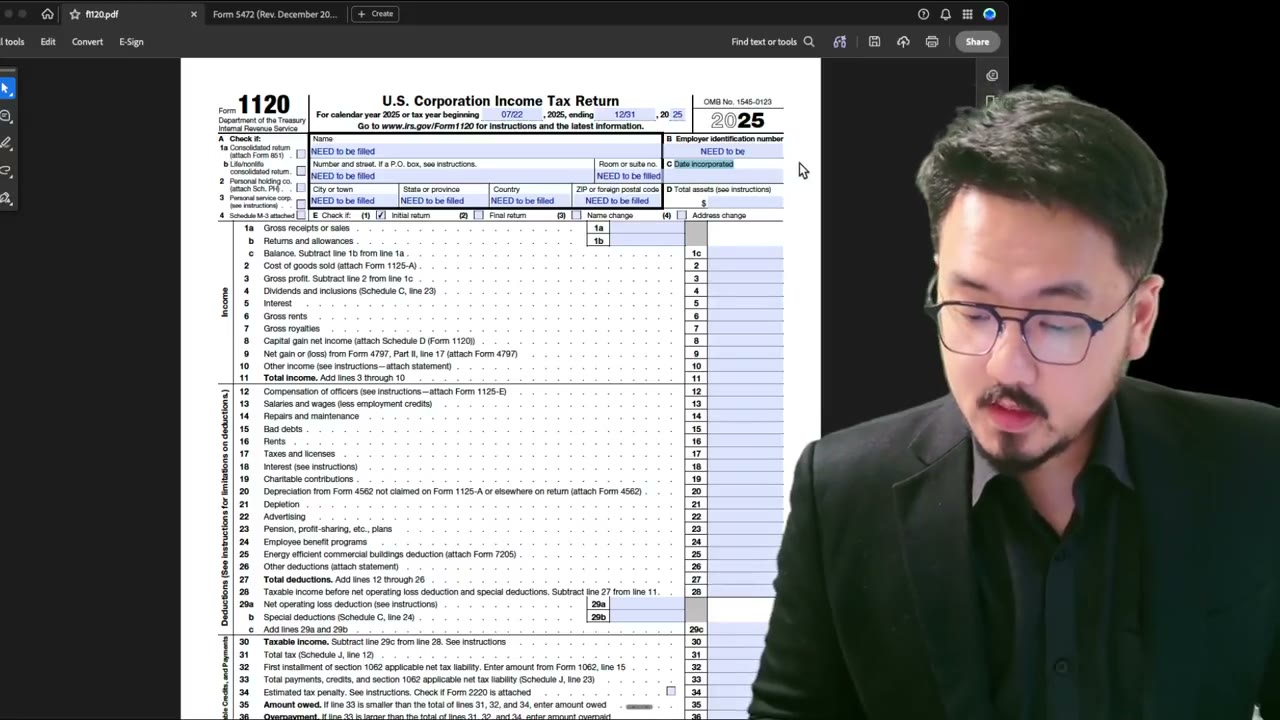
- Pro forma Form 1120 requires only name, address, EIN (Item B), and date incorporated (Item E)
- Income lines, balance sheet, Schedule M-1/M-2, and tax computation are left BLANK — not zero
- Filling extra fields is OK if accurate, but adds processing complexity for examiners
- Write "Foreign-owned U.S. DE" across the top so the pro forma isn't mistaken for a corporate return
- Spend your effort on Form 5472 (the substance), not on Form 1120 (the wrapper)
The Short Answer: No, You Don't
A foreign-owned U.S. disregarded entity filing Form 5472 with a pro forma Form 1120 does NOT need to fill every line on Form 1120. The pro forma is a wrapper — a cover sheet — not an income tax return. The Form 5472 instructions specifically authorize this minimal-fill approach.
The only Form 1120 fields you're required to complete are:
- Name and address of the foreign-owned U.S. disregarded entity (top of page 1) - Item B: Employer Identification Number (EIN) - Item E: Date incorporated
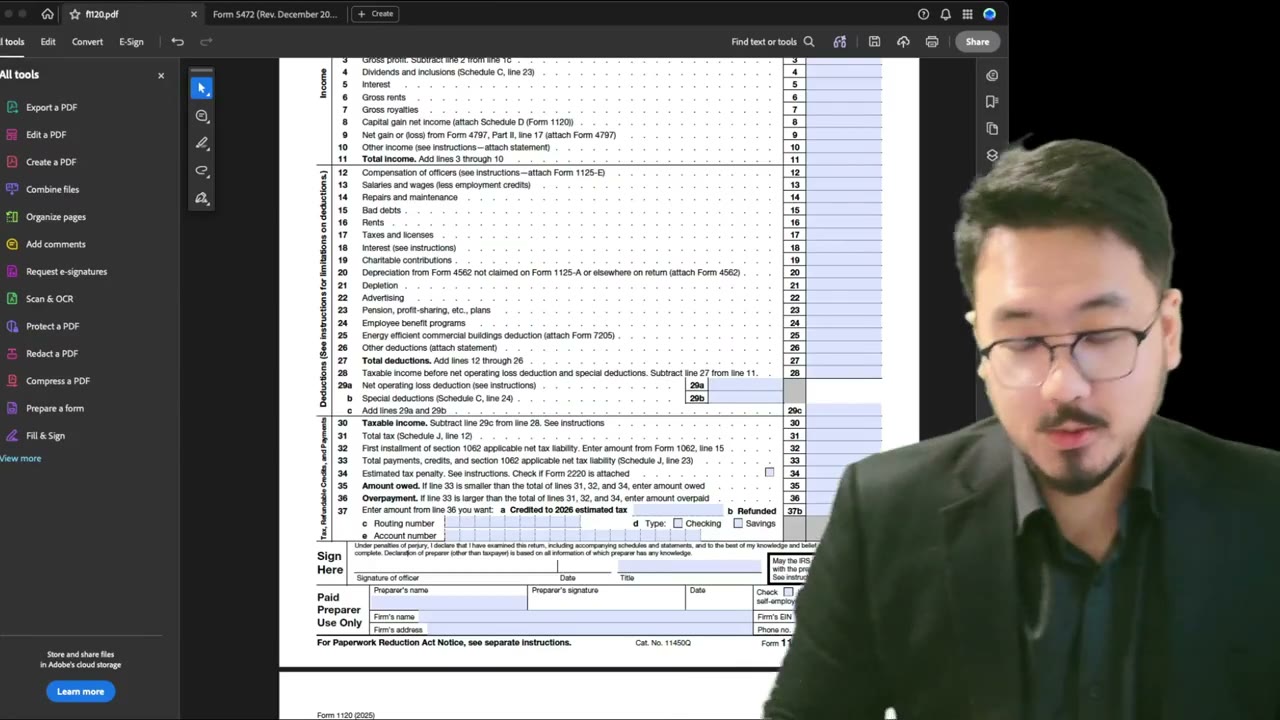
Everything else — income lines, deductions, balance sheet (Schedule L), Schedule M-1, Schedule M-2, tax computation, payments — is left blank or zero. The pro forma 1120 shows zero tax liability because there is no tax.
Why the Pro Forma Approach Exists
Form 5472 is an information return. It doesn't compute or report tax. The IRS infrastructure for processing returns is built around tax forms — and the tax form that goes with a corporation is Form 1120. So the IRS created a procedural workaround: foreign-owned disregarded entities attach their Form 5472 to a pro forma (placeholder) Form 1120 that serves only as a vehicle to deliver the 5472 into the IRS system.
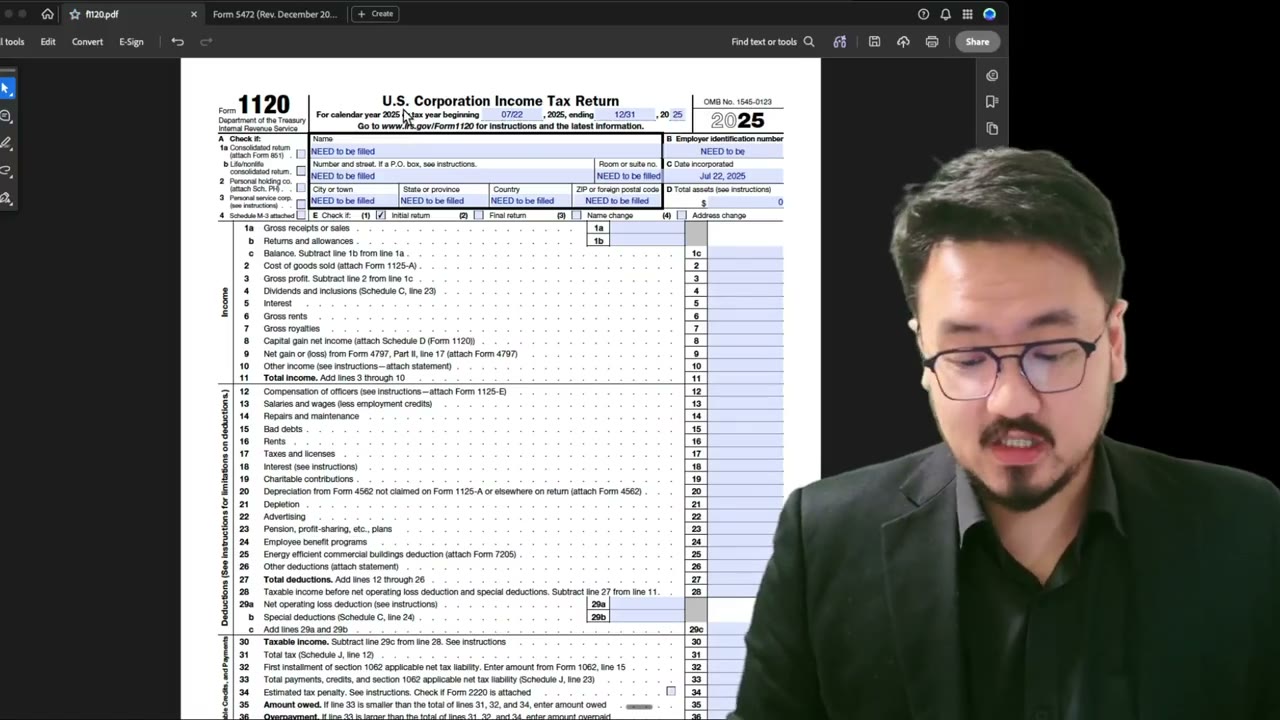
This is why you write "Foreign-owned U.S. DE" across the top of the pro forma 1120 — the marking tells IRS processing to treat it as a cover sheet, not a real corporate return. Without that marking, the 1120 with all its lines blank looks like a substantially incomplete corporate return and gets flagged for examination.
Common Gotchas When Filling the Pro Forma
Three traps catch first-time filers:
1. Filling income lines as zero. Resist the urge. Leaving income lines blank signals "pro forma — no income to report." Filling them with explicit zeros looks like "corporate return with zero income" — different signal, and one that occasionally triggers IRS correspondence asking for clarification.
2. Filling Schedule L (Balance Sheet). Don't. The pro forma doesn't need a balance sheet. Filling it incorrectly is worse than leaving it blank because mismatched figures invite scrutiny.
3. Filling tax year fields incorrectly. The tax year on Form 1120 must match the tax year on Form 5472. If you're a calendar-year filer, both show January 1 - December 31. If you're a short-year filer (first year, dissolution year, accounting period change), see our separate guide on short tax year mechanics.
What Practitioners Do Differently (and Why)
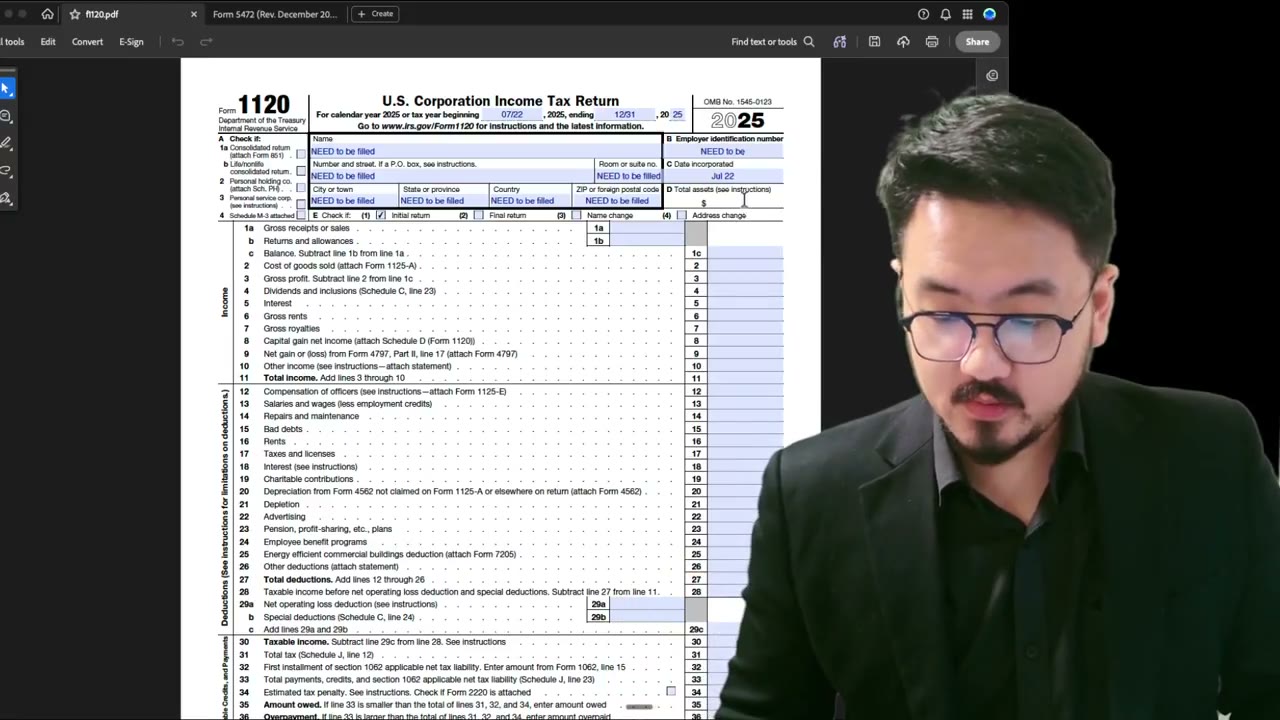
Some CPAs and tax preparers fill MORE fields on the pro forma than strictly required — Item C ("Total assets"), Item D ("Check applicable boxes"), etc. The IRS won't penalize you for providing more correct information than required.
The reasoning: more information looks more professional and less like a deficient filing. An examiner who pulls a sparse pro forma may have to spend extra cycles verifying that the blanks are intentional and not accidental. A pro forma with the optional fields filled (where the information is actually true) flows through processing faster.
The rule of thumb: if you know the value and it's accurate, fill it. If you don't know or it doesn't apply, leave it blank. Never fill with zero just to fill — zero is a substantive answer for some questions and creates noise.
Connection to Form 5472 Itself
Form 5472 has its own fill requirements — Part I (reporting corporation info), Part II (25% foreign shareholder info), Part III (related party info), Part IV/V/VI (reportable transactions). These ARE substantive — every applicable field must be completed accurately.
The pro forma 1120 is the wrapper; the Form 5472 is the substance. Spend your effort on getting Form 5472 right. The Form 1120 just needs name, address, EIN, and date incorporated — plus the "Foreign-owned U.S. DE" header marking across the top.
Frequently Asked Questions
Should I fill in zero on every income line?
No. Blank signals pro forma; zero signals 'corporate return with no income.' The IRS treats blank as 'not applicable' and zero as 'reported as zero' — different processing implications. Stick to blank unless the field is specifically required.
Do I need Schedule L (Balance Sheet)?
No. The pro forma doesn't require Schedule L. Filling it incorrectly is worse than leaving it blank — mismatched figures invite IRS scrutiny that a blank schedule wouldn't.
What if my CPA wants to fill all the fields?
It's their judgment call. Some practitioners prefer fuller filings for examiner-friendliness; others prefer the minimal pro forma approach. Both are compliant. Discuss the tradeoffs with your CPA — neither approach materially changes your §6038A exposure.
Does this apply to the partnership equivalent (Form 1065)?
No. Form 1065 isn't a pro forma — it's the actual partnership tax return. Foreign-owned multi-member LLCs file Form 1065 (with Schedule K-1s), not Form 5472 with a pro forma 1120. See /guides/form-1065 for the partnership filing rules.
IRS Form 1120 Instructions
Official IRS source on irs.gov
Listen on Spotify
Money & Tax Talk with Rippa — 5/5 rating
Never miss an IRS deadline
Get free email reminders for Form 5472, state annual reports, quarterly estimated tax, and OBBBA rule changes — built for foreign-owned LLC owners. No spam. Unsubscribe anytime.
We respect your privacy. No spam, ever.
Need to file Form 5472 + pro forma 1120?
Skip the CPA bill. Our guided wizard builds your IRS-ready filing package, step by step.
Includes its walkthrough video pack
Start filing →
Ask the AI tools, free
Tax Return Drafter, Catch-Up Planner, Form Reviewer, IRS Notice Decoder — purpose-built AI tools, no signup needed.
Free tier · BYOK Anthropic/OpenAI for power use
Browse tools →
Starting your foreign-owned LLC?
Vetted partners we use ourselves: doola & Firstbase for formation, Mercury for banking, Alohi for IRS faxing.
No-fluff recommendations, no Northwest
See partners →
More on Form 1120 Corporate Tax Return
Pro Forma Form 1120 for Foreign-Owned LLCs: What to Fill and What to Skip
Pro Forma Form 1120 for Foreign-Owned LLCs: What to Fill and What to Skip
Form 1120 Explained — What It Is, Who Files, and How It Works
Form 1120 Explained: What It Is, Who Files It, and How It Works (2025-2026)
 1:15
1:15Form 1120 Item C: Date Incorporated — Optional but Match Form 5472 Item 1m
 3:35
3:35Form 1120 Item D: Total Assets and Why You Must Fill It Despite Pro Forma Status
 3:25
3:25Form 1120: Adding the Required Foreign-owned U.S. DE Header (XFA Workarounds)
 9:10
9:10