Can You Use Your Registered Agent's Address on Form 1120? IRS Rules

Key Takeaways
- Form 1120 instructions explicitly prohibit using the registered agent address as the principal place of business
- The principal place of business for a foreign-owned LLC is where the founder actually operates — typically abroad
- Using the registered agent address is technically non-compliant, even though many practitioners do it
- The IRS-approved workaround is a C/O (Care Of) address — see Form 1120 instructions, Name and Address section
- The same rule applies to Form 5472 Part I, Line 1a — include C/O notation identically on both forms
What the Form 1120 Instructions Actually Say
Open the current IRS instructions for Form 1120 and you'll find an explicit prohibition under the "Name and Address" section: "Do not use the address of the registered agent for the state in which the corporation is incorporated." The instructions even provide an example — if your LLC is incorporated in Delaware or Nevada but operates from Little Rock, Arkansas, you must enter the Little Rock address, not the Delaware registered agent.
For a foreign-owned single-member LLC, the same rule applies on both Form 1120 (the pro forma cover sheet) and Form 5472 Part I, Line 1a (the reporting corporation's address). The IRS wants the principal place of business — where the LLC actually operates — not the address of a service company that just receives mail.
Why Foreign Owners Get Stuck Here
Most foreign LLC owners live abroad. The LLC has no U.S. office in the conventional sense. So what counts as the "principal place of business"?
The IRS answer is: wherever the management and operations actually happen. For a solo foreign founder who runs their LLC from a laptop in Berlin or Mumbai or São Paulo, that physical address — the founder's home or working address abroad — is the principal place of business.
This creates a real problem. Foreign mail delivery is unreliable. The IRS sends notices, CP-letters, and occasional refund checks by U.S. mail with no international forwarding. A notice sent to a Berlin home address may arrive weeks late or get lost entirely. Meanwhile, the registered agent is set up to receive mail reliably.
The Risk of Using the Registered Agent Address Anyway
Many foreign LLC owners use the registered agent address despite the prohibition. Their reasoning: the IRS rarely audits foreign-owned DEs, and a clean mail trail is worth more than strict compliance.
The risk: the IRS can challenge the address on examination. If your registered agent shows up as the principal address on Form 5472, an examiner familiar with the rule may flag it as a substantial deficiency — and a substantially incomplete Form 5472 can trigger the $25,000 §6038A penalty. It rarely happens, but it's not zero.
A second risk: the registered agent address looks suspicious in transfer-pricing audits or §6038A reviews. If the IRS believes the LLC has no real operational presence, the entire transaction structure with the foreign parent comes under scrutiny.
The IRS-Approved Workaround: C/O (Care Of) Address
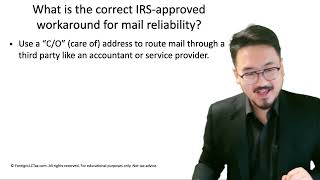
The Form 1120 instructions actually permit a Care Of address. Under "Name and Address," the IRS says: "If the corporation receives mail in care of a third party (such as an accountant or attorney), enter on the street address line 'C/O' followed by the third party's name and street address or P.O. box."
This is the right workaround. Format it as:
Street Address Line 1: C/O [Service Provider Name], [Their Street Address] City / State / ZIP: [Provider's location]
The LLC's principal address remains your actual operating address — but mail routes to the C/O. This is compliant with the Form 1120 instructions AND gives you reliable mail handling. See [Step 3 of our Address Strategy guide](/learn/the-irs-approved-care-of-c-o-address-workaround-for-form-1120) for line-by-line formatting.
What This Means for Form 5472
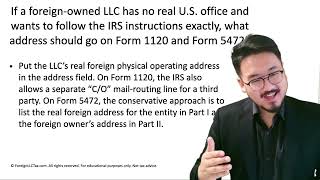
Form 5472 Part I, Line 1a mirrors Form 1120's address field — same rule applies. The principal place of business goes on Line 1a; the C/O workaround works the same way.
But here's a nuance: the Form 5472 instructions don't explicitly mention the C/O workaround. The Form 1120 instructions do. The IRS treats the C/O permission from Form 1120 as applicable to Form 5472 by extension (they're both signed under penalty of perjury, both governed by the same address rules), but a strict reading creates ambiguity. Most practitioners include the C/O notation identically on both forms — that's the safest path.
Frequently Asked Questions
Can I just use the registered agent address anyway?
It's technically non-compliant with the Form 1120 instructions. The risk on examination is low but not zero — and on §6038A review it can compound into a substantial-deficiency finding. The C/O workaround is a fully compliant alternative that solves the same mail-reliability problem.
What's the difference between 'principal place of business' and 'mailing address'?
Form 1120 only asks for the principal place of business (the address line). If you need to route mail differently, you use the C/O prefix on the principal address line. There isn't a separate 'mailing address' field on Form 1120 — the C/O notation is the IRS-approved way to do both at once.
If I use a U.S. mailbox service like iPostal1, does that count as the registered agent?
No, a mailbox service is not a registered agent. The Form 1120 prohibition is specifically about the registered agent's address — typically a commercial registered-agent service (Incfile, ZenBusiness, or the agent bundled with doola) in your state of formation. A separate U.S. mailbox service used as your principal address is also problematic (the IRS expects an actual operating address), but for different reasons.
What address goes on Form 5472 vs. Form 1120 if I use a C/O?
The same address. Both forms ask for the principal place of business. Use the C/O notation identically: Line 1 = 'C/O [Provider Name], [Provider Street]'; City/State/ZIP = provider's location. Don't try to put a different address on one form than the other — the IRS will treat the mismatch as a discrepancy.
IRS Form 1120 Instructions
Official IRS source on irs.gov
Listen on Spotify
Money & Tax Talk with Rippa — 5/5 rating
Never miss an IRS deadline
Get free email reminders for Form 5472, state annual reports, quarterly estimated tax, and OBBBA rule changes — built for foreign-owned LLC owners. No spam. Unsubscribe anytime.
We respect your privacy. No spam, ever.
Need to file Form 5472 + pro forma 1120?
Skip the CPA bill. Our guided wizard builds your IRS-ready filing package, step by step.
Includes its walkthrough video pack
Start filing →
Ask the AI tools, free
Tax Return Drafter, Catch-Up Planner, Form Reviewer, IRS Notice Decoder — purpose-built AI tools, no signup needed.
Free tier · BYOK Anthropic/OpenAI for power use
Browse tools →
Starting your foreign-owned LLC?
Vetted partners we use ourselves: doola & Firstbase for formation, Mercury for banking, Alohi for IRS faxing.
No-fluff recommendations, no Northwest
See partners →
More on Form 1120 Corporate Tax Return
 1:23
1:23Can the IRS Reissue a CP 575 Letter? What to Do If You Lost It
 2:25
2:25Can You Use a P.O. Box on Form 1120? IRS Address Rules for LLCs
 1:30
1:30Why Foreign LLC Owners Use Registered Agent Address (Risk Tradeoffs)
 4:33
4:33What Address Goes on Form 1120? Principal Office vs Mailing Address Explained
 1:45
1:45C/O (Care Of) Address on Form 1120 — The IRS-Approved Workaround
 2:15
2:15