Form 1120 Tax Year Dates: IRS Convention MM/DD/YYYY vs. Hybrid English + Numeric

Key Takeaways
- IRS convention is MM/DD/YYYY — two-digit month and day, four-digit year, separated by slashes
- Recommended hybrid: English month + numeric day + 4-digit year (e.g., "Jul 21, 2025") — clearest format
- Avoid ambiguous numeric dates (02/03/2025 — Feb 3 or Mar 2?) — write out the month
- ISO format (YYYY-MM-DD) is accepted but unusual for US tax filings — use sparingly
- Calendar-year LLCs always end December 31 — only the beginning date varies (Jan 1 for full year, formation date for short first year)
Numeric Date Formats: When You Want to Skip Month Names
Some filers prefer pure-numeric date formats because English isn't their first language, or because they're more comfortable with mathematical notation. You can use numeric formats — but with a catch.
The catch: "universal" numeric dates aren't actually universal. Different countries interpret the same string differently. "01/02/2025" is January 2 in the US (MM/DD/YYYY) and February 1 in most of Europe (DD/MM/YYYY). The IRS expects US convention, but if you're used to DD/MM/YYYY, you may default to the wrong order without realizing.
The IRS Convention: MM/DD/YYYY
US tax forms use MM/DD/YYYY format universally. Two-digit month, two-digit day, four-digit year, separated by slashes. Examples:
- 07/20/2025 = July 20, 2025 - 12/31/2025 = December 31, 2025 - 01/15/2026 = January 15, 2026
Use leading zeros: 07/20 not 7/20, 01/15 not 1/15. Tax accounting software typically formats output this way; if you're hand-entering, mirror the convention.
The Mixed Format: Month Name + Numeric Day + Year (Author's Preferred)
The video's recommended format: use English (or abbreviated English) for the month, numeric for the day, four-digit year. Examples:
- July 21, 2025 - Jul 21, 2025
This combines clarity (English month removes ambiguity) with brevity (numeric day is compact). The video author personally prefers this because it's the least likely to be misread by any processor.
Connected/No-Space Formats
Some date fields on Form 1120 are very small. If your handwriting needs to fit a long date in a tiny field, you can use connected formats like "Jul21,2025" or "7/21/25" with hyphens or slashes. The IRS processing system handles these but they're less common in printed/typed output.
For digital filing or tax software output, the system usually handles spacing automatically. For handwritten fill-in, prioritize legibility over compactness.
ISO Format (YYYY-MM-DD) — Tax-Pro Common, IRS-Tolerated
Some tax professionals use ISO 8601 format: 2025-07-21 (year-month-day with hyphens). This is the international standard and unambiguous in any country.
The IRS accepts ISO format but it's not the convention they use in their own forms. If you use ISO, the processing system reads it correctly — but it can look unusual to a reviewer who's used to MM/DD/YYYY. Use sparingly and only when you're sure your audience understands it.
The Important Lesson: Be Consistent and Be Obvious
The video's bottom line: be consistent within the filing, and be obvious about what you mean. If your start date is unambiguous ("July 1, 2025") and your end date is unambiguous ("December 31, 2025"), the IRS reads them correctly and moves on.
The trouble starts when one field is in one format and another is in a different format, OR when a date is genuinely ambiguous (like 02/03/2025 — February 3 or March 2?). Avoid both situations. Spell out months. Use full years. Be consistent. The 30 seconds you save with terse formatting isn't worth the weeks of delay if a processor flags the filing.
Ending Date for a Calendar Year LLC Is Always 12/31
If your tax year ends December 31 (which it does for any LLC on a calendar tax year — the vast majority of foreign-owned single-member LLCs), the ending date is always "December 31, [YYYY]" or "12/31/[YYYY]." This is the easy half of the date pair.
The beginning date is the variable half: - For a full calendar year: "January 1, [YYYY]" - For a short first tax year: your formation date - For a short final tax year: "January 1, [YYYY]" (with the ending = dissolution date)
Fill the relevant beginning date, pair it with December 31 (or your dissolution date), and the tax year fields are complete.
Frequently Asked Questions
If I'm filing handwritten and have small fields, what's the most compact format?
Connected numeric like "07/21/25" works if legibility is fine. But "Jul 21" is barely larger and is much less ambiguous — usually worth the extra character or two for the safety margin.
Does the IRS care if I use 25 vs. 2025 for the year?
Yes — use the full 4-digit year (2025). 2-digit years (25) can be misread by OCR systems and are generally discouraged on tax forms. The 4-digit format is the standard.
What if my software outputs a different format than I'd prefer?
Use the software output unless it's truly wrong. The IRS processes software-formatted forms constantly and accepts a wide range of variations. Hand-modifying the software output usually creates more inconsistency than it solves.
IRS Form 1120 Instructions
Official IRS source on irs.gov
Listen on Spotify
Money & Tax Talk with Rippa — 5/5 rating
Never miss an IRS deadline
Get free email reminders for Form 5472, state annual reports, quarterly estimated tax, and OBBBA rule changes — built for foreign-owned LLC owners. No spam. Unsubscribe anytime.
We respect your privacy. No spam, ever.
Need to file Form 5472 + pro forma 1120?
Skip the CPA bill. Our guided wizard builds your IRS-ready filing package, step by step.
Includes its walkthrough video pack
Start filing →
Ask the AI tools, free
Tax Return Drafter, Catch-Up Planner, Form Reviewer, IRS Notice Decoder — purpose-built AI tools, no signup needed.
Free tier · BYOK Anthropic/OpenAI for power use
Browse tools →
Starting your foreign-owned LLC?
Vetted partners we use ourselves: doola & Firstbase for formation, Mercury for banking, Alohi for IRS faxing.
No-fluff recommendations, no Northwest
See partners →
More on Form 1120 Corporate Tax Return
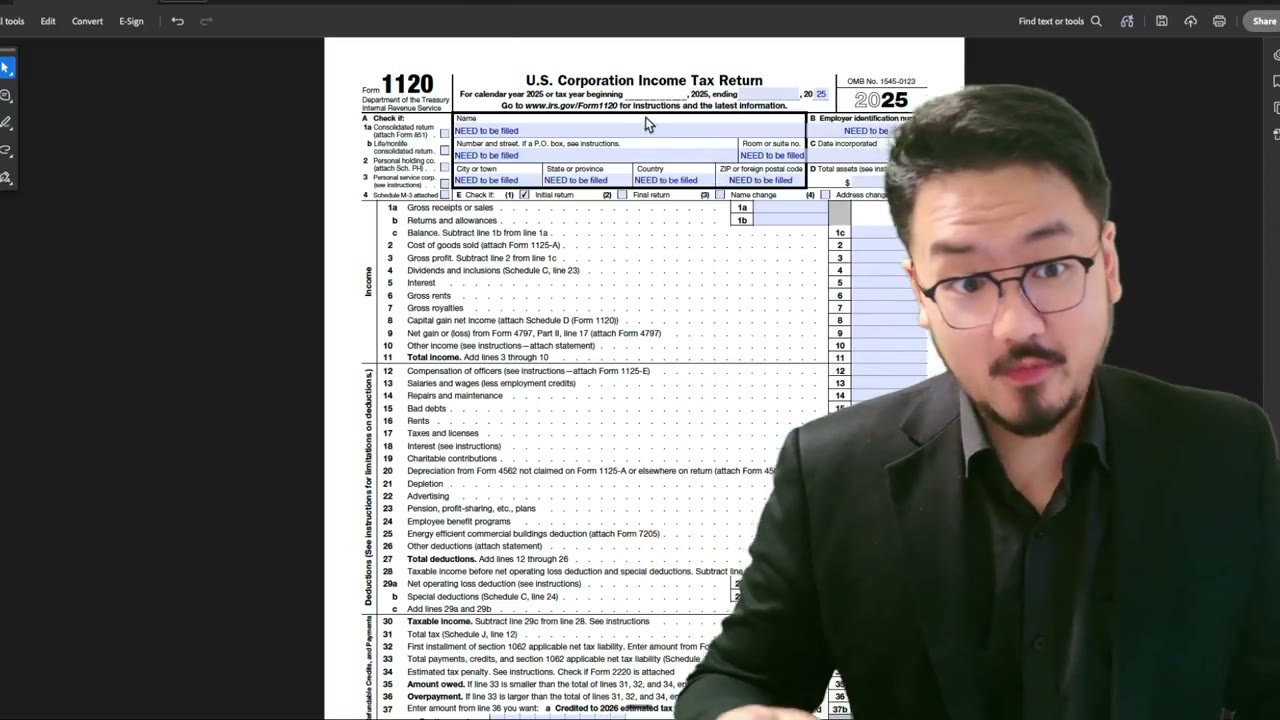 1:25
1:25Form 1120 Tax Year Dates: Full Month Name, MM/DD/YYYY, or Hybrid (and Avoid Ambiguous)
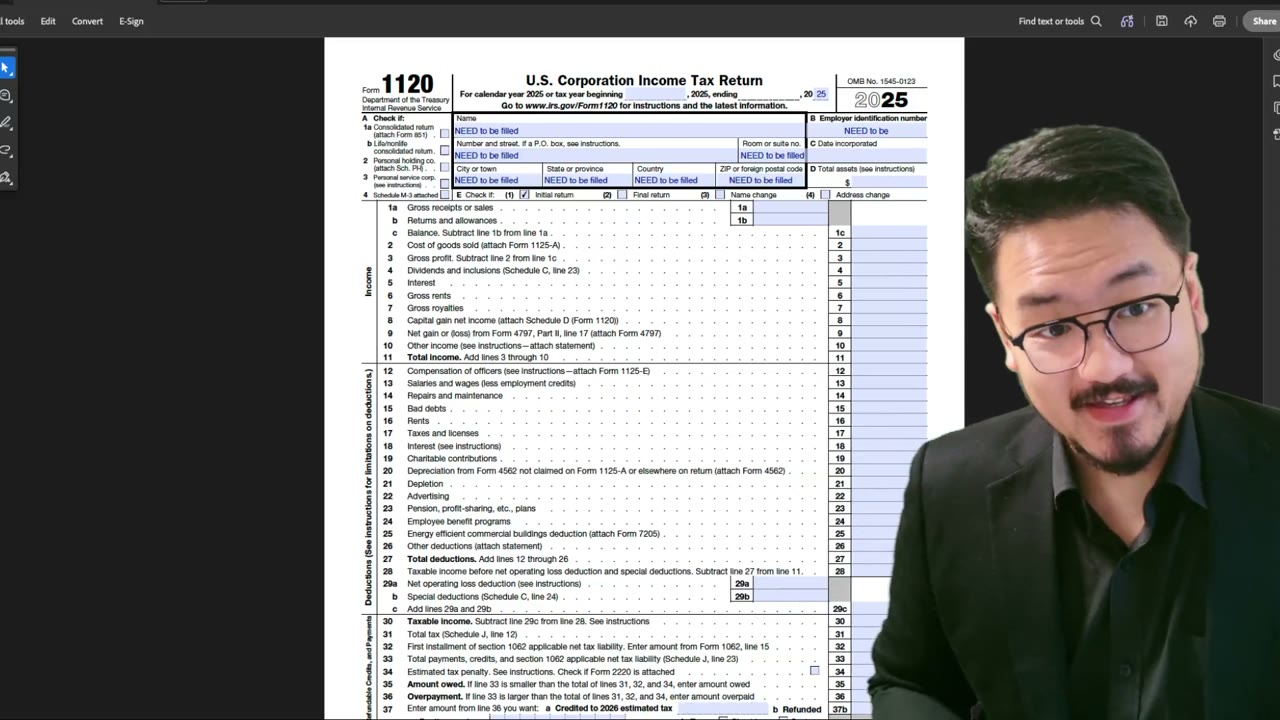 2:56
2:56Form 1120 Short Tax Year: How to Enter Beginning and Ending Dates (Foreign Owners)
 2:30
2:30Form 1120 Tax Year Demo: Beginning, Ending & Short-Year Filings
 1:14
1:14Form 1120 for Foreign-Owned LLCs: What You Need to Know (2025 Tax Year)
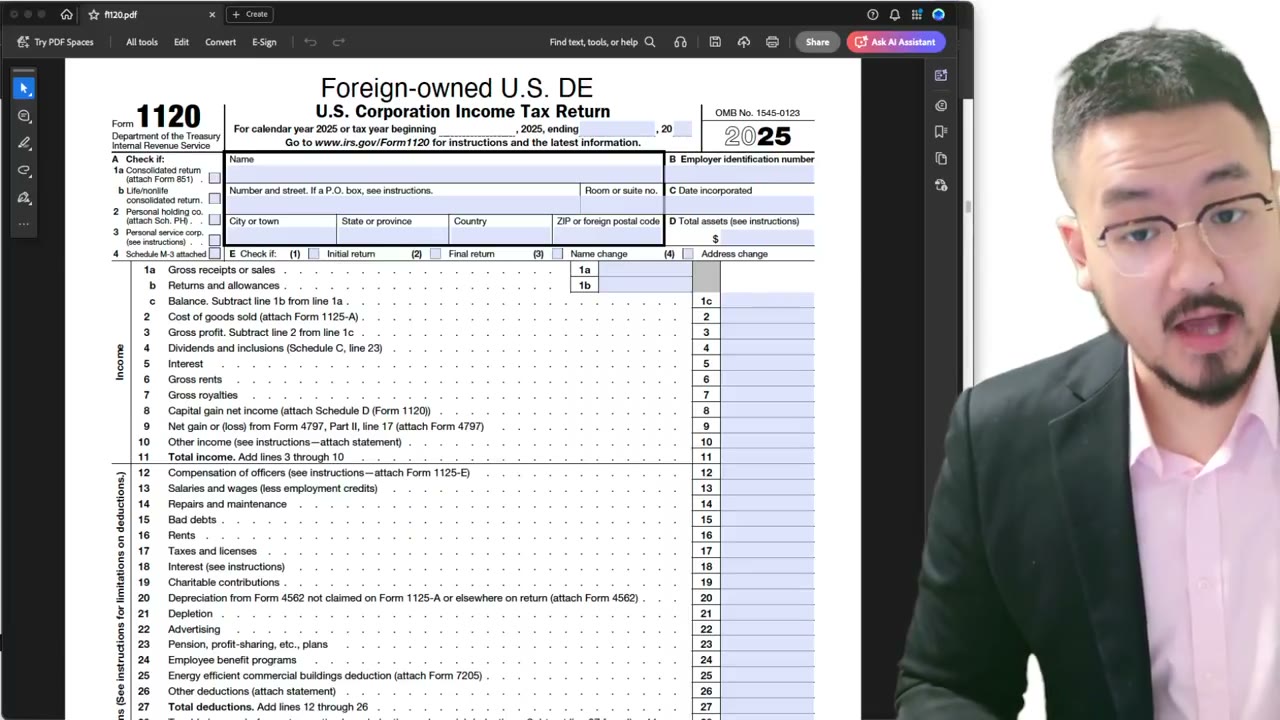 1:55
1:55Form 1120 Short Tax Year: How to Fill the Begin/End Dates and Initial Return Box
Form 1120 Explained — What It Is, Who Files, and How It Works