Forms 3520 & 3520-A: Foreign Trusts, Large Foreign Gifts, and the Founder Who Becomes a U.S. Person
The two forms report foreign trusts and large foreign gifts — not foreign companies. When a holdco chain still pulls a founder in, how section 6048 splits the filings, the five-year pre-immigration deemed-transfer rule, the penalty math, and the order of remediation.
 Lipai WangIRS-registered tax professionalResearch Report
Disclaimer: This is independent research and educational analysis, compiled from IRC sections 6048, 6677, 6039F, and 679, Treas. Reg. sections 1.679-5 and 1.679-3, Notice 97-34, the current Form 3520 and 3520-A instructions, and Rev. Proc. 2020-17, current to mid-2026. It is not legal or tax advice. Whether an arrangement is a trust, whether a U.S. beneficiary exists, and when residency starts are intensely fact-specific questions, and the penalty exposure is severe. Anyone with a trust in the chain or a large foreign gift — especially around an immigration date — should engage a qualified cross-border tax adviser before filing.
Key Takeaways
- Forms 3520 and 3520-A target foreign trusts and large foreign gifts — not foreign companies. A foreign operating LLC or holdco, standing alone, triggers neither form; a trust above it, an intermediary transfer, or section 679 attribution does.
- IRC section 6048 splits trust reporting into three buckets: reportable events (Part I), annual U.S.-owner reporting (Part II plus the trust's Form 3520-A, or the owner's substitute 3520-A), and distributions — including loans and uncompensated use of trust property (Part III).
- The five-year pre-immigration trap: a nonresident's transfer to a foreign trust within five years before the residency starting date is deemed made on day one of U.S. residency under section 679(a)(4) and Reg. section 1.679-5.
- Large foreign gifts go in Part IV: more than $100,000 aggregated from nonresident alien individuals or foreign estates, or more than $20,116 (2025) / $20,573 (2026) from foreign corporations or partnerships. Foreign-trust distributions belong in Part III, never Part IV.
- Penalties run the greater of $10,000 or 35% of the unreported amount (5% for owner reporting) under section 6677, plus 5% per month up to 25% for gifts under section 6039F — and section 6501(c)(8) holds the assessment statute open until the form is actually filed.
1. What Forms 3520 and 3520-A actually target
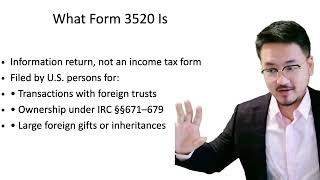
Start with scope, because it is the question founders most often get wrong. Forms 3520 and 3520-A exist to report foreign trusts and certain large foreign gifts or bequests — not foreign companies as such. IRS materials frame the threshold question the same way: before any filing analysis, decide whether the arrangement is actually a trust for U.S. tax purposes rather than a business entity. A foreign LLC or holding company that is merely an operating business sits outside the regime entirely.
The forms reach a founder's structure through a handful of specific doors: a foreign trust somewhere above the company chain (a family trust owning the holdco that owns the LLC), value routed through the company as an intermediary, deemed ownership under the grantor-trust rules of sections 671 through 679, or a reportable foreign gift. Under Treas. Reg. section 1.679-3, a transfer through an intermediary pursuant to a plan with a principal purpose of avoiding U.S. tax is treated as an indirect transfer by the U.S. person — the regulation treats the intermediary as that person's agent.
Two papering traps pull companies into the trust rules. First, a transfer to a related foreign trust in exchange for an obligation can still be a reportable Part I event — Notice 97-34 says a demand loan can never be a qualified obligation. Second, when a corporation or partnership makes a gratuitous transfer to a trust, the shareholders or partners are generally treated as the grantors unless the transfer served the entity's own business purpose. A foreign company's 'contribution' to a family trust can therefore land squarely on the founder personally.
The grantor/nongrantor split then decides who is taxed and which filings recur annually. A foreign trust is a grantor trust to the extent its assets are treated as owned by someone other than the trust under sections 671 through 679; any foreign trust not determined to be a grantor trust is a foreign nongrantor trust, a taxable entity in its own right. For founders, section 679 is usually the pivot: a U.S. person who directly or indirectly transfers property to a foreign trust that has a U.S. beneficiary is treated as owner of the portion attributable to that property.
2. The section 6048 three buckets — Parts I, II, and III
Events, owner reporting and the substitute 3520-A, distributions
Bucket one — reportable events (Part I). Section 6048(a) requires the 'responsible party' to report the creation of a foreign trust by a U.S. person, any direct or indirect transfer of money or property to a foreign trust, and certain deaths — a decedent treated as owner, or trust assets included in the gross estate. The fair-market-value transfer exception is narrow, and obligations issued by related trusts can defeat it.
Bucket two — U.S.-owner annual reporting (Part II plus Form 3520-A). Once a U.S. person is treated as owner of any portion of a foreign trust, Part II is due every year, even with no transactions. The trust itself must file Form 3520-A by the 15th day of the third month after its year-end, and the only extension is a Form 7004 filed under the trust's own EIN — extending the owner's income tax return does nothing for the 3520-A. If the trust will not file, the owner must attach a substitute Form 3520-A, with the owner and beneficiary statements, to the owner's Form 3520 to escape the section 6677 owner penalty.
The owner bucket carries a second mechanic founders miss: the U.S. agent. Under section 6048(b)(2), if the trust does not authorize a U.S. person as its limited agent for IRS record and testimony requests, the IRS may simply determine the owner's includible amounts itself. The authorization must be a binding agreement; the agent's name, address, and TIN go on Form 3520-A; it must remain in force while the statute of limitations is open; and if the relationship ends, the trust has 90 days to file an amended 3520-A.
Bucket three — distributions (Part III). Any U.S. person receiving a direct or indirect distribution from a foreign trust reports it in Part III — there is no dollar threshold. Certain loans from the trust and uncompensated use of trust property count as distributions. And without a Foreign Nongrantor Trust Beneficiary Statement or adequate records, section 6048(c)(2) defaults the distribution into accumulation-distribution treatment — throwback-style ordinary income plus an interest charge — which is routinely worse than the actual character of the money.
3. The five-year pre-immigration trap — section 679(a)(4)
Reg. section 1.679-5 and the deemed day-one transfer
This is the rule that converts old, fully offshore planning into a first-year U.S. filing problem. If a nonresident alien transfers property to a foreign trust and then has a U.S. residency starting date within five years, section 679(a)(4) and Treas. Reg. section 1.679-5 deem the transfer to occur on the residency starting date. The founder funded the trust years before any visa or green card — and still wakes up on day one of U.S. residency holding a deemed transfer to a foreign trust.
Concretely: a founder, then a nonresident, moves $2 million of private-company shares into a foreign family trust in 2023 and becomes a U.S. resident on July 1, 2026. If the trust has — or is deemed to have — a U.S. beneficiary, the founder owes a 2026 Part I filing for the deemed transfer and a 2026 Part II filing as U.S. owner, and the trust owes a 2026 Form 3520-A (or the founder attaches a substitute). The rule does not reopen the pre-immigration years; it concentrates the filings in year one.
The trigger is the U.S.-beneficiary test, and it is engineered to be hard to fail. A foreign trust is treated as having a U.S. beneficiary unless its terms completely bar current and terminal distributions to U.S. persons. Trustee discretion to distribute to anyone usually flunks the test unless the class is expressly limited to non-U.S. persons. Side letters and informal understandings count as trust terms. Beneficiary status is also attributed through entities — a controlled foreign corporation, a foreign partnership with a U.S. partner, or another foreign trust or estate with a U.S. beneficiary. Post-2010 loans to, or uncompensated property use by, a U.S. person create a U.S. beneficiary as well.
Funding more than five years before residency helps — section 679(c)(3) can keep that earlier transfer out of the deemed-ownership rule — but it does not end the analysis. Later distributions to the now-U.S. founder still trigger Part III, and the other grantor-trust rules (sections 673 through 678) run on their own facts. Anyone planning the move itself should pair this with our green-card tax transition guide, because the residency starting date under section 7701(b)(2)(A) is the hinge the entire five-year lookback swings on.
4. Large foreign gifts and bequests — Part IV
Thresholds, aggregation, recharacterization, and the Form 708 screen
Section 6039F governs gifts and bequests a U.S. person receives from non-U.S. persons. Operationally, the current Form 3520 instructions require Part IV when the year's receipts exceed $100,000 from nonresident alien individuals or foreign estates — aggregated across related donors — or exceed the inflation-adjusted threshold for foreign corporations and foreign partnerships: $20,116 for tax years beginning in 2025 and $20,573 for 2026. Once over the $100,000 line, each gift is reported, though gifts under $5,000 need not be separately itemized.
Aggregation is where family money trips founders. $75,000 from a nonresident parent plus $40,000 from a related nonresident relative in the same year crosses $100,000 — Part IV is required. $8,000 from a foreign corporation plus $15,000 from a related foreign individual crosses the corporate threshold through aggregation — each transfer becomes reportable. These are exactly the 'family support' and 'shareholder cleanup' wires that founders under-document.
Routing matters as much as size. A distribution from a foreign trust is not a 'foreign gift' — it belongs in Part III, with the beneficiary-statement machinery, not Part IV. Conversely, a distribution from a domestic trust treated as owned by a foreign person is reported in Part IV as a foreign gift. And a purported gift from a foreign corporation or partnership carries a second risk beyond the filing: the IRS can recharacterize it as income — dividend, compensation, a loan repayment — and section 6039F lets the IRS fix the income-tax consequences if the gift was never timely reported.
Two screens close out the gift analysis. If the donor is a covered expatriate, Form 708 may also be due — the section 2801 final regulations took effect January 14, 2025, and covered gifts and bequests are reported there, not merely on Form 3520. And where the transfer arrives at death from someone holding U.S.-situs assets, the estate-side analysis runs through our Form 706-NA estate-tax guide for nonresident decedents.
5. The penalty math — and the statute that never closes
Section 6677 sets the trust penalties. A missed Part I transfer or Part III distribution draws an initial penalty of the greater of $10,000 or 35% of the gross reportable amount. For section 6048(b) owner reporting — including Form 3520-A failures — the rate drops to 5%, measured against the year-end gross value of the trust portion treated as owned. If the failure continues more than 90 days after IRS notice, continuation penalties of $10,000 per 30-day period stack on top, capped in aggregate at the gross reportable amount.
Run the numbers. An unreported $300,000 trust distribution: greater of $10,000 or 35% — $105,000 of initial exposure. The deemed $2 million pre-immigration transfer from the example above: $700,000 of Part I exposure, plus 5% of the year-end owned-portion value on the owner-reporting leg. An unreported $150,000 gift from a nonresident parent: 5% per month under section 6039F, capped at 25% — a $37,500 maximum. 'Gross value' follows section 2512 gift-tax valuation principles, so keep contemporaneous support for a good-faith estimate even where no formal appraisal is required.
The quieter penalty is procedural. Under section 6501(c)(8), if a complete Form 3520 is not filed, the assessment period for tax connected to Parts I through III does not start running — it stays open until three years after the required information is finally reported. An unfiled 3520 is not a closed year that might get caught; it is a year that never closes. That alone is the business case for curing gaps quickly.
6. The relief landscape — reasonable cause, the 2024 pause, Rev. Proc. 2020-17
Reasonable cause under section 6677(d) is the main statutory valve, and it is narrower than founders assume. The instructions say outright that foreign secrecy laws, a foreign fiduciary's reluctance to disclose, and trust provisions that impede disclosure do not constitute reasonable cause. What works is a specific, documented narrative — what the filer knew, what advisers were asked, how the failure surfaced, what was done immediately after — signed under penalties of perjury with the declaration language the IRS's 2025 practice unit ties to Letter 3804.
The administrative posture shifted in late 2024. The IRS informed the Taxpayer Advocate Service in October 2024 that it would stop automatically assessing penalties on late-filed Form 3520 Part IV and on Form 3520-A where a reasonable-cause statement is attached, and that it would begin reviewing reasonable-cause statements before assessment for late-filed Parts I through III. That is a posture change, not a law change: sections 6677 and 6039F are untouched, and the penalties remain fully available the moment the IRS rejects the statement.
Rev. Proc. 2020-17 is the targeted carve-out: eligible individuals are exempt from section 6048 reporting for certain tax-favored foreign retirement and savings trusts, with a procedure to request abatement or refund of section 6677 penalties already assessed. It matters for immigrants whose 'foreign trust' is really a workplace pension or a government-sponsored savings plan — check it before building a full 3520/3520-A file around a pension account.
7. Remediation when already late — and the pre-immigration checklist
For a founder who is already late, sequence beats speed. First, reconstruct the chain and the timeline: immigration dates, trust-funding dates, amendments, side letters, powers of appointment, loans, guarantees, and any personal use of trust property. Second, fix the owner mechanics — obtain the trust's EIN, put a U.S.-agent authorization in place, and secure the Foreign Grantor Trust Owner Statement and any beneficiary statements.
Third, file complete delinquent returns promptly: if the trust missed Form 3520-A, prepare a substitute 3520-A and attach it to the Form 3520, as complete as the records allow. Fourth, reconcile the income-tax side — if prior returns treated trust items inconsistently with the 3520-A, file Form 8082. Fifth, attach the reasonable-cause statement under penalties of perjury with the supporting evidence: non-willfulness, efforts to obtain records, actual reporting of trust income. One procedural point worth knowing: when an examiner secures a delinquent 3520 or 3520-A during an exam, the IRM directs use of Form 13133 marked 'Do NOT Assess Failure to File Penalty.'
For the founder who is not yet a U.S. person, the checklist below costs a fraction of any remediation above. Run it before the residency starting date, not after:
- Map the chain — every trust, holding company, LLC, foundation, and informal family arrangement, regardless of local-law labels.
- Classify each vehicle — determine whether anything in the chain is a trust for U.S. tax purposes; the name on the deed does not decide.
- Run the five-year lookback — list every transfer to any foreign trust within five years of the expected residency starting date.
- Test U.S. beneficiaries the broad way — trustee discretion, side letters, and attribution through CFCs, foreign partnerships, and other trusts all count.
- Collect the paper — trust deed, amendments, financial statements, and the valuations that will support gross-value figures.
- Stand up the owner mechanics early — trust EIN, U.S.-agent authorization, and a Form 3520-A calendar (15th day of the third month; Form 7004 under the trust's EIN) before the first U.S. filing season.
The Form 3520 triggers at a glance
| Trigger | Where it goes | Threshold / condition | Initial penalty |
|---|---|---|---|
| Creation of / transfer to a foreign trust | Form 3520, Part I | Reportable event under § 6048(a); narrow FMV exception; demand loans are never qualified obligations | Greater of $10,000 or 35% of the gross reportable amount |
| U.S. owner of a foreign trust | Form 3520, Part II + Form 3520-A (or substitute) | Owner status under §§ 671–679 — annual, even with no transactions | Greater of $10,000 or 5% of year-end gross value of the owned portion |
| Distribution, loan, or use of trust property | Form 3520, Part III | Any direct or indirect distribution — no dollar threshold | Greater of $10,000 or 35% of the unreported distribution |
| Gift from NRA individual or foreign estate | Form 3520, Part IV | More than $100,000 for the year, related donors aggregated | 5% of the gift per month, capped at 25% |
| Purported gift from foreign corporation / partnership | Form 3520, Part IV | More than $20,116 (2025) / $20,573 (2026), related persons aggregated | 5% per month, capped at 25% — plus recharacterization risk |
Related on ForeignLLCTax
Primary sources
- Cornell LII — 26 U.S. Code § 6048 (information with respect to certain foreign trusts)
- Cornell LII — 26 U.S. Code § 6677 (failure to file information on foreign trusts)
- Cornell LII — 26 U.S. Code § 6039F (notice of large gifts received from foreign persons)
- Cornell LII — 26 U.S. Code § 679 (foreign trusts having one or more U.S. beneficiaries)
- Cornell LII — Treas. Reg. § 1.679-5 (pre-immigration trusts)
- Cornell LII — Treas. Reg. § 1.679-3 (transfers — indirect and constructive transfers)
- IRS — Notice 97-34, IRB 1997-25 (foreign trust and foreign gift reporting)
- IRS — Instructions for Form 3520
- IRS — Instructions for Form 3520-A
- IRS — Gifts from foreign person (Part IV thresholds)
- IRS — Foreign trust reporting requirements and tax consequences
- IRS — Rev. Proc. 2020-17 (tax-favored foreign trust exemption)