Form 1120 Tax Year Dates: Full Month Name, MM/DD/YYYY, or Hybrid (and Avoid Ambiguous)

Key Takeaways
- Use full month names ("July 20, 2025") or standard 3-letter abbreviations ("Jul 20, 2025") — never custom abbreviations
- If using pure numeric, always use MM/DD/YYYY with leading zeros and a 4-digit year
- Avoid ambiguous numeric dates like "1/12" or "11/12" — write out the month for clarity
- More information rarely hurts — when in doubt, expand format rather than abbreviate
- Use the same date format throughout the entire filing (consistency across Form 1120 and Form 5472)
Acceptable Date Formats for the Tax Year Fields
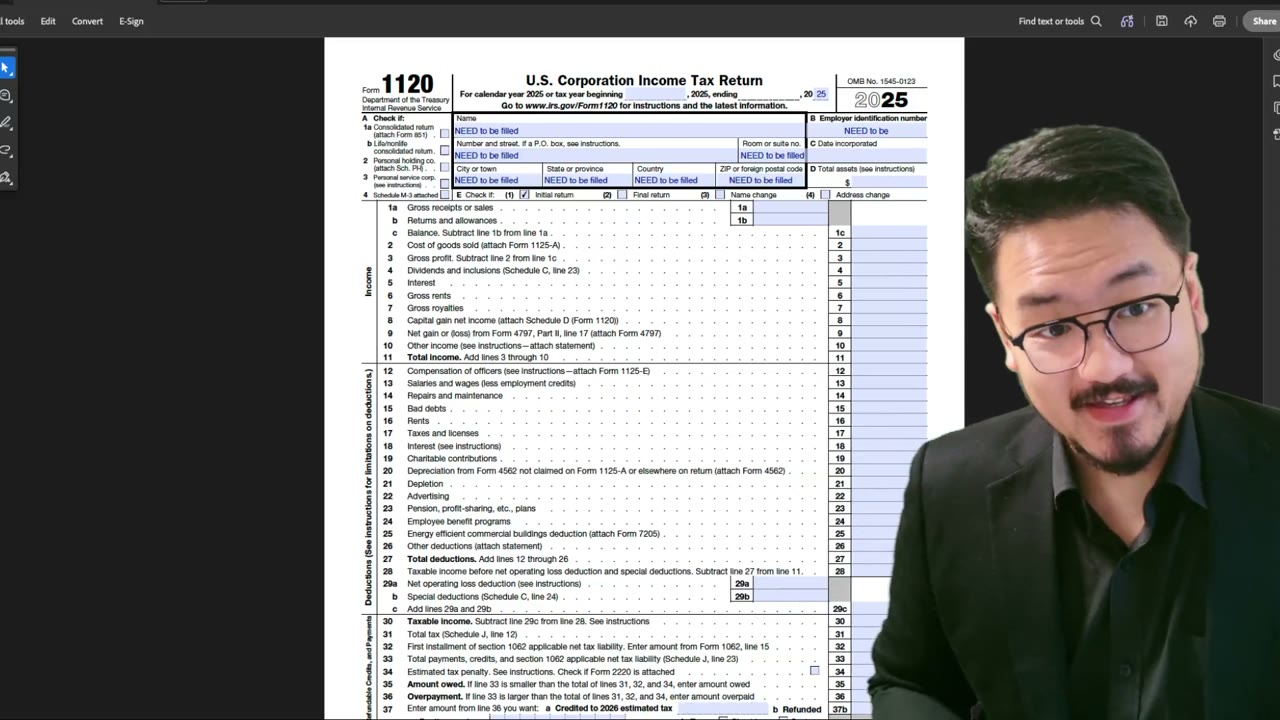
After establishing that Form 1120's tax-year fields need complete dates (not just month names), the next question is: which date formats actually work? The IRS doesn't publish strict format rules for these fields, but practice has converged on a few conventions that processing systems handle reliably.
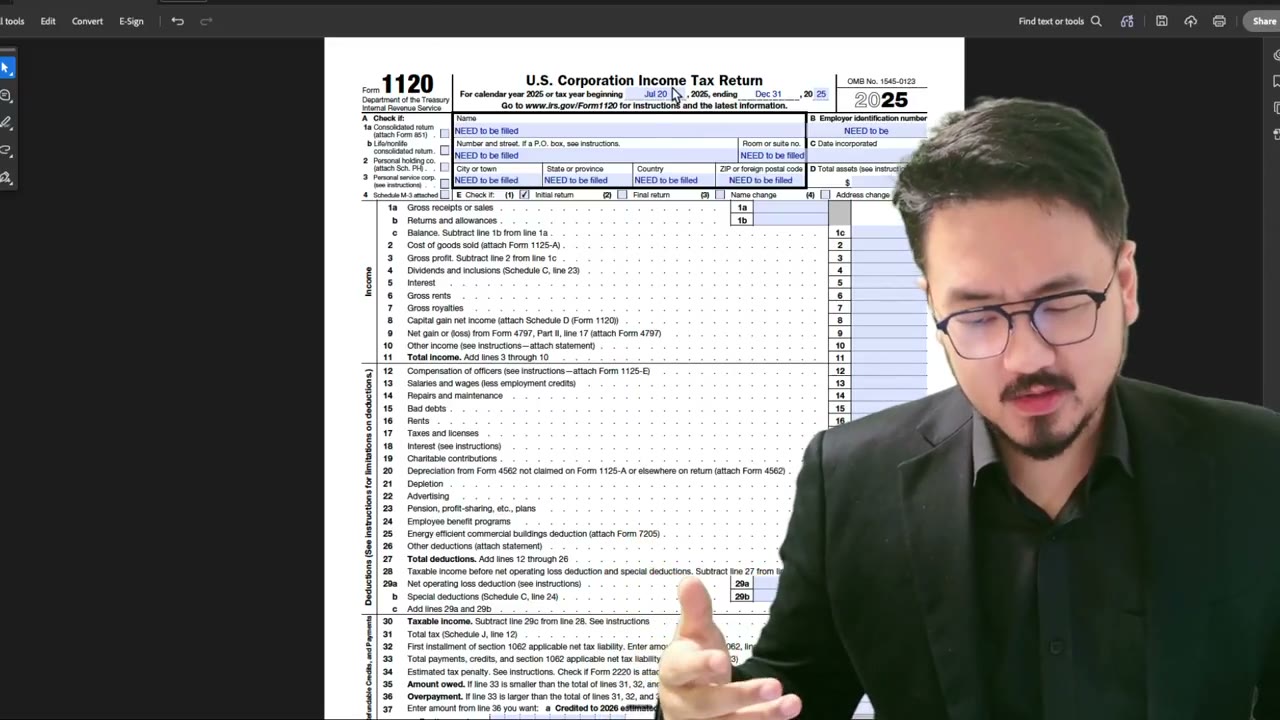
The video walks through correct examples. The point is: don't get fancy, don't abbreviate aggressively, and don't introduce formats that could be ambiguous.
Format 1: Full Month Name + Day + Year (Recommended)
The clearest format: write out the full month name, then the day, then the four-digit year. Example:
"July 20, 2025"
This is unambiguous in any country, any language. The IRS processing system has no trouble parsing it. The downside is that the form's date field may be small — "December" might not quite fit if the field is narrow.
Format 2: Abbreviated Month + Day + Year
If space is tight, use the standard 3-letter month abbreviation: Jan, Feb, Mar, Apr, May, Jun, Jul, Aug, Sep, Oct, Nov, Dec. Example:
"Jul 20, 2025"
Still unambiguous, fits more compactly. Use the IRS-standard 3-letter abbreviations, not custom variants ("Jly" or "Ju" — non-standard, can confuse OCR).
What to Avoid: Ambiguous Numeric Formats
The format you should NOT use: pure numeric dates that could be interpreted multiple ways. "1/12/2025" — is that January 12 or December 1? US convention says January 12; international convention (DD/MM/YYYY) says December 1. The IRS expects US convention, but the ambiguity creates risk if the form gets read by anyone unfamiliar with the convention.
If you must use a numeric format, ALWAYS use 2-digit months and 2-digit days with leading zeros: 07/20/2025, not 7/20/25. Even safer: include the full year (2025, not 25).
Special Case: Dates Like "11/12/2025"
Some dates are inherently ambiguous in numeric format. November 12 = 11/12/2025; December 11 = 12/11/2025. To a US processor, the first digit is the month. To an international processor, it's the day. The video author recommends avoiding pure-numeric formats for any date that could be misread.
The safest approach: use the month name (or abbreviation) plus day plus year. "Nov 12, 2025" is unambiguous regardless of who reads it. The peace of mind is worth the few extra characters.
Why More Information Doesn't Hurt
If you're worried about which format to use, the rule of thumb is: more information rarely hurts. "July 20, 2025" instead of "7/20/25" — slightly more text, much less ambiguity. The IRS doesn't penalize you for providing more information; they penalize you for providing wrong or ambiguous information.
This applies broadly: when in doubt, expand instead of abbreviate. Spell out the month. Use four-digit years. The extra characters are nothing compared to a delayed filing because someone couldn't parse your dates.
Be Consistent Within the Filing
Whatever format you pick, use the same format everywhere in the filing. Don't write "July 20, 2025" on Form 1120 and "7/20/25" on Form 5472 — even though both are valid, the inconsistency looks like a data entry error and may trigger review.
Pick one format, apply it to every date field on every form in the package, and the IRS gets a clean, internally consistent filing.
Frequently Asked Questions
Is the date format actually enforced by the IRS, or is it just convention?
Mostly convention, but the IRS processing system reads dates with automated OCR that's calibrated to common formats. Unusual formats may trigger manual review, which delays processing — even if they're technically valid.
Do I need to use the same format as my CPA software output?
If you're submitting whatever the software exports, use that. If you're hand-entering on top of the software's PDF, match the format the software used so the document looks consistent. Mixing handwritten formats with software-printed formats looks unprofessional and can trigger questions.
What format does IRS-published instructions use as examples?
IRS instructions usually use the full-month-name format (e.g., "For tax year beginning July 1, 2025, ending June 30, 2026"). This is the safest format to mirror because it matches the IRS's own writing conventions.
IRS Form 1120 Instructions
Official IRS source on irs.gov
Listen on Spotify
Money & Tax Talk with Rippa — 5/5 rating
Never miss an IRS deadline
Get free email reminders for Form 5472, state annual reports, quarterly estimated tax, and OBBBA rule changes — built for foreign-owned LLC owners. No spam. Unsubscribe anytime.
We respect your privacy. No spam, ever.
Need to file Form 5472 + pro forma 1120?
Skip the CPA bill. Our guided wizard builds your IRS-ready filing package, step by step.
Includes its walkthrough video pack
Start filing →
Ask the AI tools, free
Tax Return Drafter, Catch-Up Planner, Form Reviewer, IRS Notice Decoder — purpose-built AI tools, no signup needed.
Free tier · BYOK Anthropic/OpenAI for power use
Browse tools →
Starting your foreign-owned LLC?
Vetted partners we use ourselves: doola & Firstbase for formation, Mercury for banking, Alohi for IRS faxing.
No-fluff recommendations, no Northwest
See partners →
More on Form 1120 Corporate Tax Return
 5:05
5:05Form 1120 Tax Year Dates: IRS Convention MM/DD/YYYY vs. Hybrid English + Numeric
 2:56
2:56Form 1120 Short Tax Year: How to Enter Beginning and Ending Dates (Foreign Owners)
Form 1120 Personal Service Corporation Tax Year Guide
Form 1120 Personal Service Corporation Tax Year Guide (2025-2026)
 1:14
1:14Form 1120 for Foreign-Owned LLCs: What You Need to Know (2025 Tax Year)
 2:00
2:00What Is a Short Tax Year? Definition & Basics for Form 1120 Filers
 2:30
2:30