Form 1120 Short Tax Year: How to Enter Beginning and Ending Dates (Foreign Owners)

Key Takeaways
- Form 1120's tax-year fields require complete MM/DD/YYYY dates — not month names, not partial dates
- Form 1120 instructions are silent on the format; Form 7004 instructions explicitly require full beginning and ending dates
- The IRS processing center uses automated OCR — month-only entries get flagged for manual review
- For a short tax year, both the beginning and ending date need full day/month/year precision
- Foreign owners can't e-file the pro forma 1120 + Form 5472, so handwritten formatting matters more than usual
The Short Tax Year Field Is More Specific Than You Think
Near the top of Form 1120 there's a small section asking for the tax year — beginning date and ending date. For a regular calendar-year filer, this looks straightforward: write "01/01/2025" and "12/31/2025" and move on. But for a short tax year — common in the first year after LLC formation, the last year before dissolution, or any year with an accounting period change — this field becomes a stumbling block.
Many foreign owners filing the pro forma 1120 + Form 5472 by hand reach this field and pause. The IRS instructions for Form 1120 don't explicitly explain the short tax year format. There's no example shown. So people default to entering just the month name — "July" — and assume the IRS will infer the rest.
Why Month-Only Entries Fail
The IRS processing center isn't looking at the text "July" and inferring "July 1" or "July 31" — it's looking for a complete date in MM/DD/YYYY format. When the field doesn't parse correctly, the return gets flagged for manual review, which slows processing by weeks and sometimes triggers a correction letter asking you to resubmit.
This is purely a data-entry convention. The IRS uses automated OCR and form-recognition software at the processing centers, and those systems are calibrated to specific date formats. A month name alone isn't a date — it's a partial string the system can't act on without human intervention.
What the IRS Actually Wants: Reference Form 7004
The Form 1120 instructions are vague on this, but Form 7004 (Application for Automatic Extension of Time to File Certain Business Income Tax Returns) has the same field and explicit instructions: "Enter the calendar year (or short tax year) for which you are requesting an extension by entering the beginning and ending dates of the tax year." Form 7004 is unambiguous — full dates, both ends.
That same convention applies to Form 1120. So even though Form 1120's instructions don't spell it out, the answer is in Form 7004: enter the full beginning date (MM/DD/YYYY) and the full ending date (MM/DD/YYYY). Day, month, year — all three components on each side.
The Practical Example
Say your LLC was formed on July 15, 2025, and you're filing for the short tax year ending December 31, 2025. The correct entries are:
Beginning: 07/15/2025 Ending: 12/31/2025
Not "July" / "December." Not "7/15" / "12/31." Not "July 15" / "December 31" written out. The IRS form-processing software expects the numeric MM/DD/YYYY format with two-digit months and days, separated by slashes, with the four-digit year. Use leading zeros where needed (07 not 7, 09 not 9).
If you've already submitted with a wrong format and received a correction letter, the fix is to send a corrected return with the same numbers but in the proper format. No additional tax is owed — it's purely a data quality issue.
When You Need Tax Software vs. Filing by Hand
Foreign owners filing Form 1120 + Form 5472 cannot e-file the combination — the IRS does not support e-filing for foreign-owned disregarded entity returns. That means most foreign owners are filing by hand (paper or fax), and they're typing each field directly without the validation that consumer tax software (TurboTax, etc.) would provide.
Without software, small format mistakes like this are common. The way to avoid them is to follow the Form 7004 convention strictly: full MM/DD/YYYY on both date fields, even when the tax year is a normal calendar year. ForeignLLCTax.com's guided wizard handles this format automatically — you enter the dates in any reasonable input format and the generated PDF uses the IRS-correct convention.
Frequently Asked Questions
What format does the IRS want for the tax year fields?
MM/DD/YYYY with leading zeros, separated by slashes. For example: 07/15/2025, not 7/15/25 or July 15, 2025. Both the beginning and ending date need this format.
What if my LLC has a calendar-year tax year — do I still need to fill these fields?
Yes. Even for a normal calendar year, enter 01/01/2025 and 12/31/2025 in the beginning and ending fields. Leaving them blank can also trigger processing delays.
If I already submitted with the wrong format, what should I do?
Send a corrected return with the same numerical values but in proper MM/DD/YYYY format. Annotate "AMENDED" or attach a brief cover letter explaining the format correction. No additional tax is owed — this is purely a data quality fix.
IRS Form 1120 Instructions
Official IRS source on irs.gov
Listen on Spotify
Money & Tax Talk with Rippa — 5/5 rating
Never miss an IRS deadline
Get free email reminders for Form 5472, state annual reports, quarterly estimated tax, and OBBBA rule changes — built for foreign-owned LLC owners. No spam. Unsubscribe anytime.
We respect your privacy. No spam, ever.
Need to file Form 5472 + pro forma 1120?
Skip the CPA bill. Our guided wizard builds your IRS-ready filing package, step by step.
Includes its walkthrough video pack
Start filing →
Ask the AI tools, free
Tax Return Drafter, Catch-Up Planner, Form Reviewer, IRS Notice Decoder — purpose-built AI tools, no signup needed.
Free tier · BYOK Anthropic/OpenAI for power use
Browse tools →
Starting your foreign-owned LLC?
Vetted partners we use ourselves: doola & Firstbase for formation, Mercury for banking, Alohi for IRS faxing.
No-fluff recommendations, no Northwest
See partners →
More on Form 1120 Corporate Tax Return
 5:05
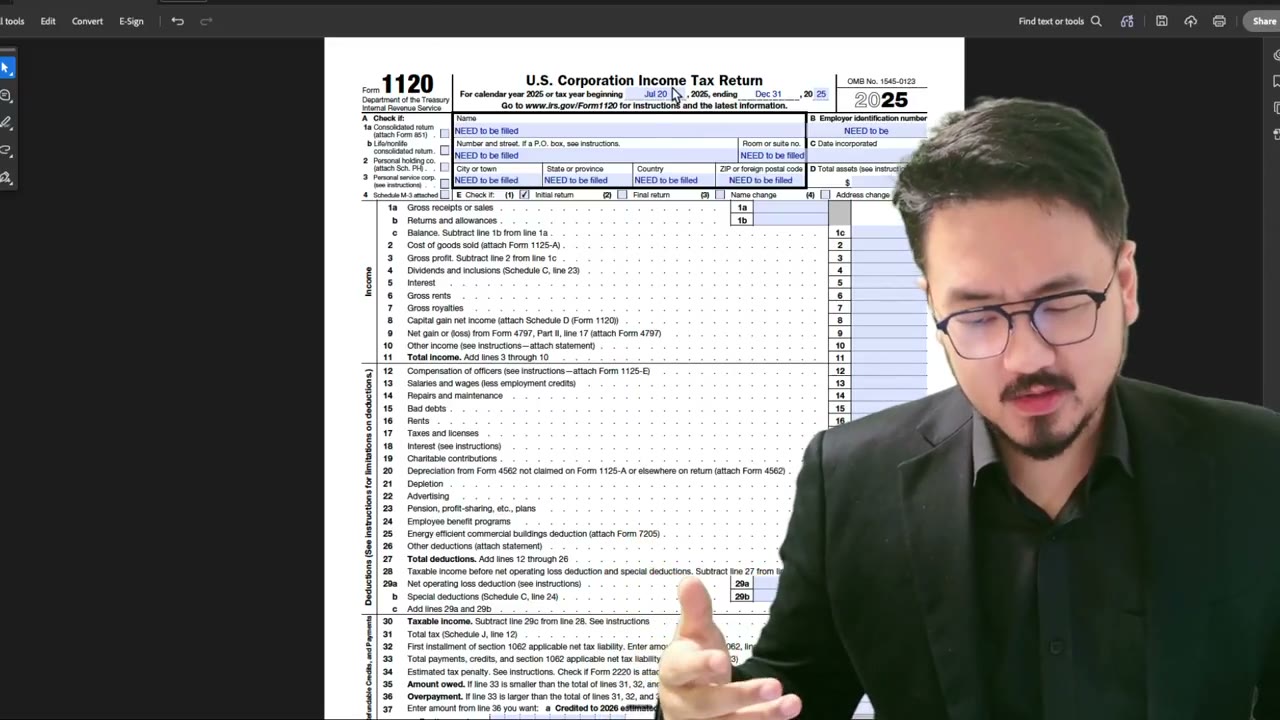
5:05Form 1120 Tax Year Dates: IRS Convention MM/DD/YYYY vs. Hybrid English + Numeric
 2:30
2:30Form 1120 Tax Year Demo: Beginning, Ending & Short-Year Filings
 1:55
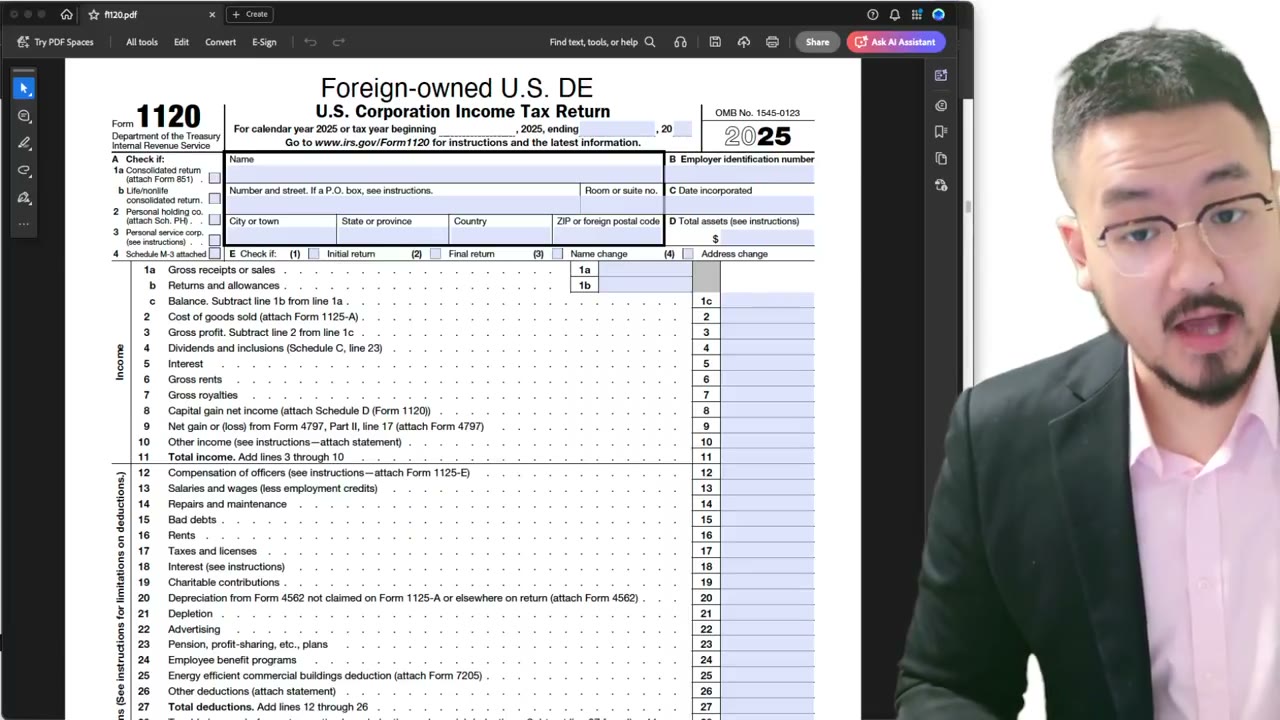
1:55Form 1120 Short Tax Year: How to Fill the Begin/End Dates and Initial Return Box
 1:25
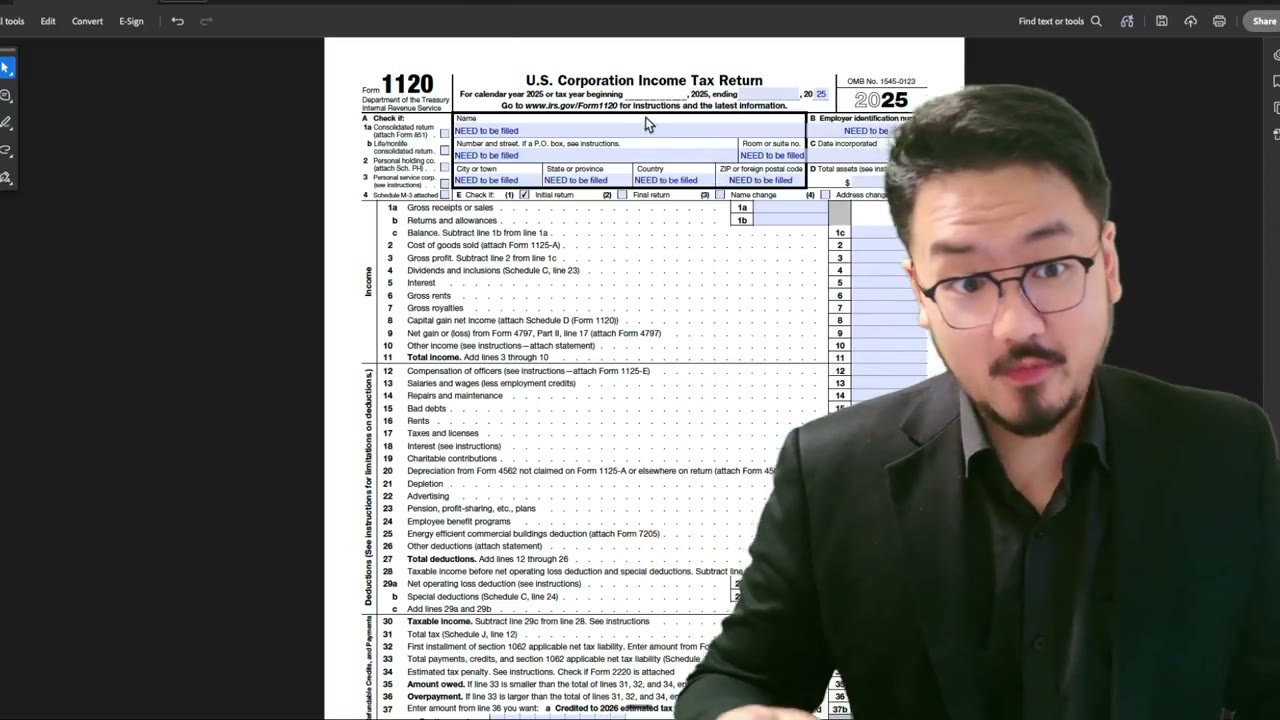
1:25Form 1120 Tax Year Dates: Full Month Name, MM/DD/YYYY, or Hybrid (and Avoid Ambiguous)
 1:28
1:28What Is the Name Field on Form 1120? How to Enter Your LLC Name Correctly
 2:25
2:25