Form 8857 Equitable Relief Factors Guide Under Rev. Proc. 2013-34 (2025-2026)

Innocent spouse relief path (Form 8857)
How a spouse requests relief from tax attributable to the other spouse.
Identify the joint liability
Understatement or unpaid tax from a jointly filed return.
Check the relief types
Innocent spouse, separation of liability, or equitable relief.
Prepare Form 8857
Explain the facts and why holding you liable would be unfair.
Submit and respond
File the request and answer IRS follow-up during review.
Key Takeaways
- Equitable relief is the broadest Form 8857 path when the other relief options do not fit.
- Its filing deadline is different from the two-year collection deadline that governs other relief types.
- Revenue Procedure 2013-34 controls the main facts-and-circumstances analysis.
- Abuse, financial control, hardship, and later compliance can materially change the outcome.
Equitable relief is the safety valve when the first two relief paths fail
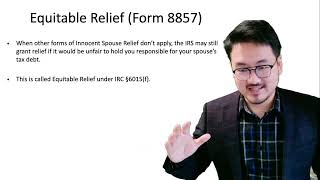
Publication 971 says equitable relief is available when the taxpayer does not qualify for innocent spouse relief, separation of liability relief, or community-property relief, but it would still be unfair to hold the taxpayer liable. The IRS points taxpayers to Revenue Procedure 2013-34 for the governing framework. That makes equitable relief the broadest and most fact-intensive Form 8857 lane.
In practice, many founder households end up here because the liability is an unpaid balance, the marriage is still legally intact, or the facts do not fit the stricter innocent-spouse tests.
Timing is different here and often more forgiving
Publication 971 says innocent spouse relief and separation of liability relief generally require Form 8857 within two years after the first IRS collection activity. For equitable relief, the timing depends on the kind of relief sought. For a balance due, the request generally must be filed within the collection period. For a credit or refund, the normal refund-claim timing rules apply.
That different timing rule is one of the biggest reasons taxpayers should not assume a missed two-year deadline ends the entire Form 8857 discussion.
Revenue Procedure 2013-34 turns the case into a facts-and-circumstances record
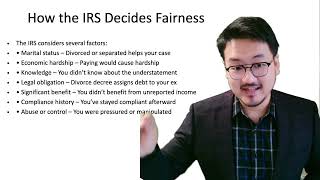
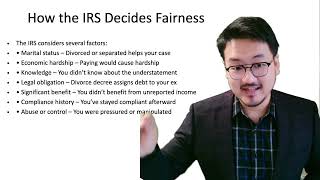
Revenue Procedure 2013-34 discusses streamlined determinations and then a broader facts-and-circumstances review, including marital status, economic hardship, knowledge or reason to know, legal obligation, significant benefit, later compliance, mental or physical health, and abuse or financial control. The revenue procedure also says abuse can push the analysis in favor of relief even when knowledge would otherwise weigh against the taxpayer.
That is why the best equitable-relief files are document-heavy and humanly specific rather than formulaic.
Frequently Asked Questions
Can I still ask for relief if I missed the two-year deadline for innocent spouse relief?
Potentially yes. Publication 971 says equitable relief follows different filing-timing rules tied to the collection period or refund-claim statutes.
What guidance does the IRS use for equitable relief factors?
The IRS points taxpayers to Revenue Procedure 2013-34 for the equitable-relief framework.
Does abuse matter even if I knew about the tax issue?
Yes. Revenue Procedure 2013-34 says abuse or financial control can cause the knowledge factor to weigh in favor of relief depending on the facts.
IRS Form 8857 Instructions
Official IRS source on irs.gov
Listen on Spotify
Money & Tax Talk with Rippa — 5/5 rating
Need Help Filing?
Contact us with your situation and we'll point you to the right path
Never miss an IRS deadline
Get free email reminders for Form 5472, state annual reports, quarterly estimated tax, and OBBBA rule changes — built for foreign-owned LLC owners. No spam. Unsubscribe anytime.
We respect your privacy. No spam, ever.
Need to file your foreign-owned LLC return?
Skip the CPA bill. Our guided wizard builds your IRS-ready filing package, step by step.
Includes its walkthrough video pack
Start filing →
Ask the AI tools, free
Tax Return Drafter, Catch-Up Planner, Form Reviewer, IRS Notice Decoder — purpose-built AI tools, no signup needed.
Free tier · BYOK Anthropic/OpenAI for power use
Browse tools →
Starting your foreign-owned LLC?
Vetted partners we use ourselves: doola & Firstbase for formation, Mercury for banking, Alohi for IRS faxing.
No-fluff recommendations, no Northwest
See partners →
More on Form 8857 Innocent Spouse Relief
Form 8857 Innocent Spouse Basics Guide
Form 8857 Innocent Spouse Basics Guide for Joint Returns (2025-2026)
Form 8857 Separation of Liability Guide
Form 8857 Separation of Liability Guide (2025-2026)
 7:32
7:32Form 8857: IRC Section 6015(f) Equitable Relief Explained (Part 2)
 7:32
7:32IRC 6015(f) Equitable Relief for Innocent Spouse (Part 2)
 6:18
6:18Form 8857: IRC Section 6015(f) Equitable Relief Explained (Part 1)
 5:44
5:44