Form 8857 Separation of Liability Guide (2025-2026)

Innocent spouse relief path (Form 8857)
How a spouse requests relief from tax attributable to the other spouse.
Identify the joint liability
Understatement or unpaid tax from a jointly filed return.
Check the relief types
Innocent spouse, separation of liability, or equitable relief.
Prepare Form 8857
Explain the facts and why holding you liable would be unfair.
Submit and respond
File the request and answer IRS follow-up during review.
Key Takeaways
- Separation of liability is available only in specific post-marriage or separate-household situations.
- It is aimed at joint-return understatement cases rather than every unpaid balance situation.
- The 12-month separate-household rule is a technical requirement, not a casual standard.
- Actual knowledge and improper asset transfers can defeat the request.
Separation of liability is narrower than most taxpayers expect
Publication 501 says separation of liability relief is available only to joint filers whose spouse has died, who are divorced, who are legally separated, or who have not lived together during the 12 months ending on the date the election is filed. Publication 971 repeats the same household and relationship gates in its decision framework. That means a taxpayer who is still informally connected to the spouse may be outside this relief lane even when the underlying facts feel unfair.
This is one reason Form 8857 analysis should begin with the relationship timeline, not the emotional timeline.
The relief is tied to understatement cases, not every unpaid balance problem
Publication 971's separation-of-liability flowchart asks whether the joint return contains an understated tax and then tests the relationship-status requirements. So this relief lane is not the universal answer for every unpaid joint balance. If the problem is an unpaid amount shown on the return rather than a deficiency rooted in erroneous items, equitable relief may become the more realistic path.
The distinction matters because taxpayers often frame every joint tax problem as 'separation' when the IRS uses a more technical classification.
Actual knowledge and fraudulent transfers can shut the door
Publication 971 says separation of liability relief will not be granted if the IRS proves the spouses transferred assets as part of a fraudulent scheme, if property was transferred to avoid tax, or if the requesting spouse had actual knowledge of the erroneous items that created the deficiency. So the case does not turn only on whether the couple stopped living together.
The supporting file should therefore address knowledge, transfers, and the precise date the spouses ceased sharing a household.
Frequently Asked Questions
Can I request separation of liability if I still live with my spouse?
Generally no, unless another qualifying relationship-status condition exists. Publication 501 and Publication 971 say the relief is limited to taxpayers who are divorced, legally separated, widowed, or outside the same household for the required period.
Does separation of liability apply to an unpaid balance shown on the return?
Not necessarily. Publication 971 focuses this relief on understatements, so unpaid-balance cases often need to be evaluated under equitable relief instead.
Why does actual knowledge matter?
Because Publication 971 says separation of liability can be denied if the requesting spouse had actual knowledge of the erroneous items that caused the deficiency.
IRS Form 8857 Instructions
Official IRS source on irs.gov
Listen on Spotify
Money & Tax Talk with Rippa — 5/5 rating
Need Help Filing?
Contact us with your situation and we'll point you to the right path
Never miss an IRS deadline
Get free email reminders for Form 5472, state annual reports, quarterly estimated tax, and OBBBA rule changes — built for foreign-owned LLC owners. No spam. Unsubscribe anytime.
We respect your privacy. No spam, ever.
Need to file your foreign-owned LLC return?
Skip the CPA bill. Our guided wizard builds your IRS-ready filing package, step by step.
Includes its walkthrough video pack
Start filing →
Ask the AI tools, free
Tax Return Drafter, Catch-Up Planner, Form Reviewer, IRS Notice Decoder — purpose-built AI tools, no signup needed.
Free tier · BYOK Anthropic/OpenAI for power use
Browse tools →
Starting your foreign-owned LLC?
Vetted partners we use ourselves: doola & Firstbase for formation, Mercury for banking, Alohi for IRS faxing.
No-fluff recommendations, no Northwest
See partners →
More on Form 8857 Innocent Spouse Relief
Form 8857 Innocent Spouse Basics Guide
Form 8857 Innocent Spouse Basics Guide for Joint Returns (2025-2026)
Form 8857 Equitable Relief Factors Guide
Form 8857 Equitable Relief Factors Guide Under Rev. Proc. 2013-34 (2025-2026)
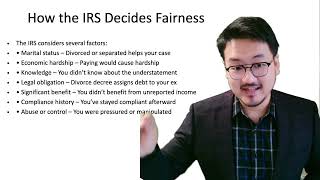 7:32
7:32Form 8857: IRC Section 6015(f) Equitable Relief Explained (Part 2)
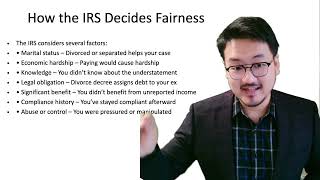 7:32
7:32IRC 6015(f) Equitable Relief for Innocent Spouse (Part 2)
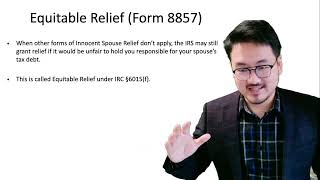 6:18
6:18Form 8857: IRC Section 6015(f) Equitable Relief Explained (Part 1)
 5:44
5:44