Form W-8BEN: Why Skipping It Triggers 24% Withholding on Your GLOBAL Revenue

Key Takeaways
- Without a W-8BEN, the platform applies backup withholding (typically 24%) to your GLOBAL revenue, not just U.S.-source
- Example: $100K global with only $2K U.S. → no W-8BEN means $24K withheld, not $600
- The W-8BEN's primary function is to declare foreign status so only U.S.-source income (at the treaty rate) is withheld
- File the form before your first payout — recovering over-withheld backup tax requires a 1040-NR or 1120-F filing
- The cost of filing is minutes; the cost of not filing scales with your global revenue, not your U.S. revenue
A Worked Example: $200 of U.S. Revenue, No W-8BEN
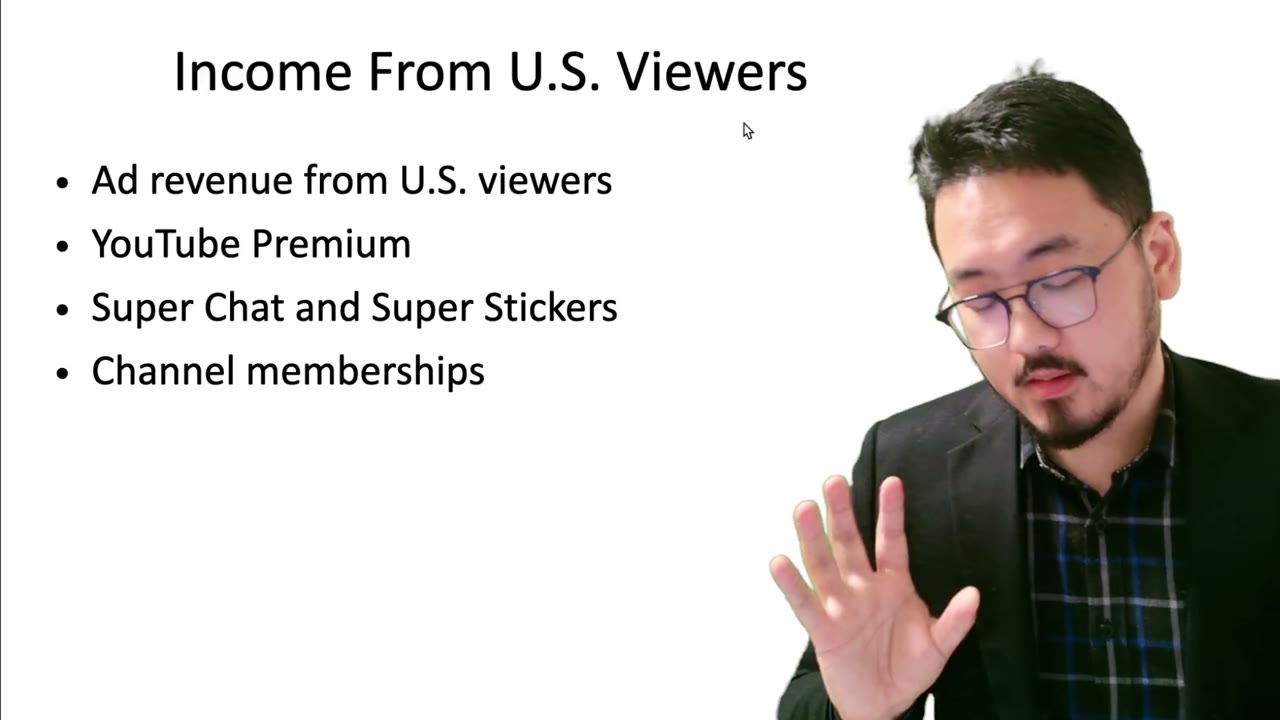
Open your YouTube Studio advanced dashboard, filter the revenue by geography, and select "United States." You see your U.S.-viewer revenue: say it's $200, or maybe $2,000 if your channel does well. That's the U.S.-source portion.
Without a W-8BEN, the platform applies the default withholding to that figure. At 30% on $200, you lose $60 before payout — you only receive $140. Submit a W-8BEN with a treaty claim, and the rate often drops to 10% or 0% — saving $40–$60 on this small example, scaling linearly as your channel grows.
That's the direct incentive: file the form, recover the difference between the default and treaty rate, every payout, forever.
The Punishment for Not Filing Is Worse Than 30% on U.S. Income
Here's the part that surprises creators. If you simply don't submit a W-8BEN, Google doesn't just apply 30% to your U.S. revenue and call it done. They apply 24% to your global revenue — because without proof of your foreign status, the platform's regulatory obligation is to treat you as a U.S. person who owes U.S. tax on worldwide income.
Unpacking the math: if your channel earns $100,000 globally (across every viewer country), with only $2,000 from U.S. viewers, you might think 30% on $2,000 ($600) is the worst case. It's not. Without a W-8BEN, you face 24% on the full $100,000 — $24,000 withheld.
Why "Backup Withholding" Hits the Global Number
The IRS rule the platforms follow is called backup withholding. Its logic: if a payer can't verify the recipient's tax status, the safe assumption (from the U.S. tax authority's perspective) is that the recipient is a U.S. person who hasn't given proper tax documentation, and U.S. persons are taxed on worldwide income. So the platform applies backup withholding to everything, not just the U.S.-source slice.
This is why creators with mostly non-U.S. audiences still need to file a W-8BEN. Even if your U.S. income is tiny, the backup withholding (if you don't file) attacks the global total. The form's job is to declare "I'm not a U.S. person — please apply withholding only to my U.S.-source income at the treaty rate."
The Asymmetry: $24,000 vs. $200
The math gap is enormous. With a filed W-8BEN claiming a treaty benefit, you might lose $0–$300 in U.S. withholding on $2,000 of U.S.-source income. Without a W-8BEN, you lose $24,000 on $100,000 of global income — even though only $2,000 came from the U.S.
This is the asymmetry the video drives home. Filing the form costs nothing (it's an in-product questionnaire, 5–10 minutes). Not filing can cost $24,000 a year on a mid-sized channel. The decision isn't between two close outcomes — it's between a small cost and a catastrophic one.
What to Do If You Forgot to File for Part of a Year
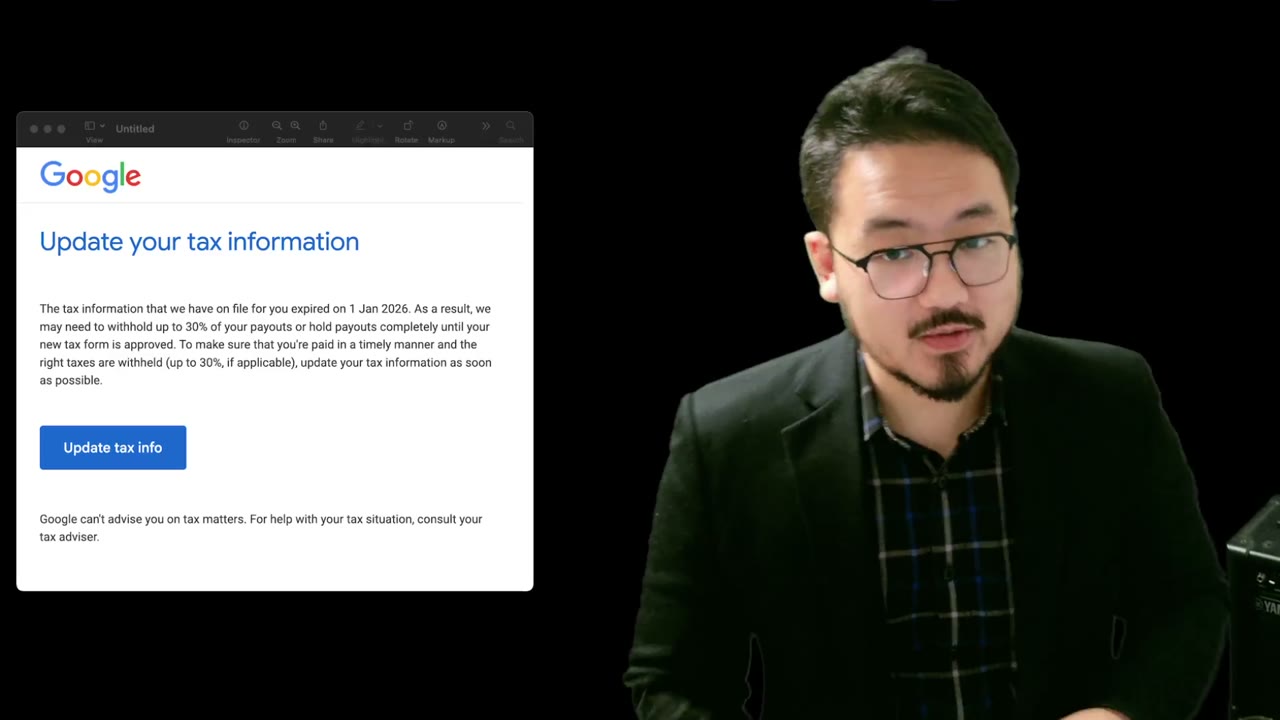
If you go a few months without a W-8BEN on file, Google has already started withholding at the punitive rate on whatever payouts went through. Once you file the W-8BEN, future payouts use the treaty rate — but you can't automatically recover the already-withheld backup amount through Google.
The recovery path is to file a U.S. tax return (Form 1040-NR for individuals, Form 1120-F for foreign corporations) for the tax year and claim a refund of the over-withholding. This is paperwork-heavy and slow, but the over-withheld amount is real and recoverable. The much easier path is to file the W-8BEN the moment you start monetizing — before any backup withholding happens.
Frequently Asked Questions
What's the difference between 30% and 24% withholding rates?
30% is the statutory non-resident withholding on U.S.-source income for non-U.S. persons. 24% is backup withholding applied when tax status can't be verified — and it hits your global revenue, not just U.S.-source. The 24% on global is usually much worse than 30% on U.S.-only.
Can I recover already-withheld backup tax after the fact?
Yes, by filing the appropriate U.S. tax return (Form 1040-NR or 1120-F) for the year and claiming a refund of over-withheld tax. It works, but it's paperwork — better to file the W-8BEN before any backup withholding happens.
Does this apply even if my U.S. income is tiny?
Yes — that's the trap. The backup withholding rate attacks your global revenue, so even a creator with 95% non-U.S. viewers gets hit on the full 100% if they don't submit the W-8BEN. The form is essentially mandatory for any non-U.S. creator monetizing through Google.
Never miss an IRS deadline
Get free email reminders for Form 5472, state annual reports, quarterly estimated tax, and OBBBA rule changes — built for foreign-owned LLC owners. No spam. Unsubscribe anytime.
We respect your privacy. No spam, ever.
Need to file your foreign-owned LLC return?
Skip the CPA bill. Our guided wizard builds your IRS-ready filing package, step by step.
Includes its walkthrough video pack
Start filing →
Ask the AI tools, free
Tax Return Drafter, Catch-Up Planner, Form Reviewer, IRS Notice Decoder — purpose-built AI tools, no signup needed.
Free tier · BYOK Anthropic/OpenAI for power use
Browse tools →
Starting your foreign-owned LLC?
Vetted partners we use ourselves: doola & Firstbase for formation, Mercury for banking, Alohi for IRS faxing.
No-fluff recommendations, no Northwest
See partners →
More on Foreign Income Reporting
 1:42
1:42Form W-8BEN: What Counts as US-Source Income for YouTube and AdSense Creators
Excess Withholding Refund Workflow Guide
Excess Withholding Refund Workflow Guide for Foreign Founders (2025-2026)
 3:27
3:27Form W-8BEN for YouTube and AdSense: Why Google Asks for Tax Information
Beneficial Owner and Disregarded Entity Rules on W-8 Forms
Beneficial Owner and Disregarded Entity Rules on W-8 Forms (2025-2026)
1042-S vs 1099 Guide for Foreign Founders
1042-S vs 1099 Guide for Foreign Founders (2025-2026)
How to Read Form 1042-S Boxes 1, 2, and 7