Creator Income Through a Foreign-Owned US LLC: AdSense, YouTube & Sponsorships
How a remote nonresident creator's revenue is sourced and taxed through a disregarded US LLC — the royalty-vs-services split, when remote work becomes ECI, Google/YouTube withholding and W-8BEN-E, reconciling 1042-S vs 1099-K, and treaty royalty rates by country.
 Lipai WangIRS-registered tax professionalResearch Report
Disclaimer: This is independent research and educational analysis, compiled from IRS source-rule guidance, IRC §§861-865 and §1441, Treas. Reg. §1.861-4/-5, the Form W-8BEN-E, 1042-S, and 5472 instructions, the tax treaty tables, and public platform tax documentation current to mid-2026. It is not legal or tax advice, and a creator's result turns on intensely fact-specific sourcing, residency, ECI, treaty, and hybrid-entity questions. Anyone monetizing through a foreign-owned US LLC — especially with any US travel, US production help, or a treaty claim — should consult a qualified tax adviser before filing or signing a W-8.
Key Takeaways
- Creator income splits into two source buckets: platform copyright monetization (YouTube Partner Program, channel memberships, Super Chat) is royalty income, while AdSense website ads, sponsorships, Patreon-style memberships, and most affiliate deals are services.
- Royalties are sourced by place of use (Treas. Reg. §1.861-5) — US-source to the extent of US-audience consumption; services are sourced by place of performance (§1.861-4 / §862), so a creator working abroad usually has foreign-source service income.
- US viewers alone do not create ECI. Effectively connected income needs US performance, a US office, or US personnel (§864(c)(4)(B); Reg. §1.864-5/-6); fully remote work normally is not ECI.
- Through a disregarded LLC the foreign owner is usually the Chapter 3 beneficial owner, so Google/YouTube withhold at the owner level — 30% statutory (or 24% backup), reduced by a valid treaty claim on a Form W-8BEN-E.
- There is no tactical FDAP-vs-ECI election: file W-8ECI only if the income is truly ECI. Reconcile 1042-S vs 1099-NEC/MISC vs 1099-K, and keep the LLC's baseline Form 5472 + pro forma 1120 current.
1. The two-bucket split — royalties vs services
Why the same creator has two tax characters in one year
Everything downstream — withholding, ECI, treaty rate, which information return shows up — follows from one question: is a given revenue stream a royalty or a payment for services? The source-rule regime in IRC §§861-865 answers it, and the two buckets are sourced by opposite tests. A royalty is sourced where the intangible is used (Treas. Reg. §1.861-5; the foreign-source mirror is §862). Compensation for services is sourced where the services are performed (§1.861-4), regardless of where the contract is signed, where the payer sits, or where the money lands.
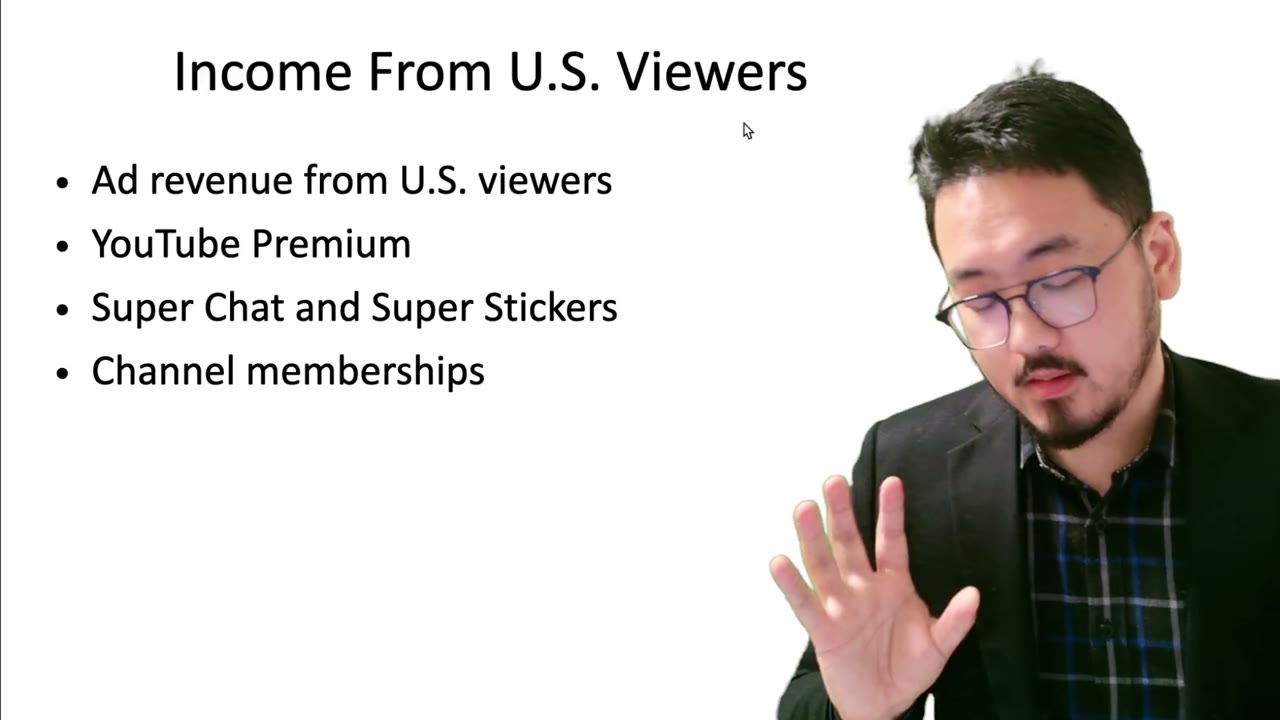
Platform monetization that licenses your copyrighted content is the royalty bucket. Google's own US-tax documentation files YouTube Partner Program earnings — ad revenue, YouTube Premium, channel memberships, Super Chat, Super Stickers, and Super Thanks — under 'Other Copyright Royalties.' Because a royalty keys off place of use, only the US-audience portion of those earnings is US-source, which is exactly what the platform withholds on for a non-US creator.
By contrast, website AdSense is classified as 'Services' in the same workflow, and under the source rules a creator performing that work abroad has foreign-source income. Sponsorships, affiliate commissions, Patreon-style membership access, and custom brand deals are also analyzed as services unless the contract separately pays for a genuine IP license. A mixed contract — say, producing a sponsored video and licensing the clips for reuse in US ad campaigns — may have to be split into its service and royalty pieces. That is an ordinary application of §§861-862, not an influencer-specific rule.
One trap on the royalty side: a deal labeled a 'sale' of a catalog or clip library is not automatically a sale. Under §865(d), an intangible sale follows the personal-property sourcing rule only to the extent the payments are not contingent on the intangible's productivity, use, or disposition. To the extent the consideration is contingent, the statute sources those payments as royalties — so a back-catalog or evergreen-library deal that pays on views or exploitation can still land in the US-source royalty bucket.
- Royalty bucket (place of use, §1.861-5): YPP ad revenue, YouTube Premium, channel memberships, Super Chat / Super Stickers / Super Thanks, and any explicit license of videos, music, footage, graphics, or trademarks.
- Services bucket (place of performance, §1.861-4): website AdSense, sponsorships and brand integrations, affiliate commissions, and Patreon-style membership access — when the work is performed abroad.
- Split if mixed: a contract that both pays for a deliverable and licenses IP for US use may carry income in both buckets.
- Contingent 'sales' (§865(d)): payments tied to future use, views, or monetization are sourced like royalties no matter what the contract calls them.
2. When remote creator work becomes ECI — and when it does not
Effectively connected income (ECI) starts upstream of sourcing, with whether the foreign person is engaged in a US trade or business at all. If a nonresident individual or foreign corporation is not engaged in a US trade or business for the year, then — subject to narrow exceptions — no income is effectively connected. IRS guidance is consistent: a foreign person generally needs a US trade or business to have ECI, and personal services performed in the United States are the classic way one arises.
For a creator who films, edits, streams, negotiates, and delivers everything from outside the United States, the service income is typically foreign-source under §862, and foreign-source income paid to a nonresident is generally outside Chapter 3 and Chapter 4 withholding and normally not reported on Form 1042-S. Crucially, that result does not flip just because the sponsors, members, subscribers, or viewers are American. US customers, by themselves, do not create ECI.
There is a narrower path by which even foreign-source royalty income can be pulled into ECI: under Treas. Reg. §1.864-5 and §1.864-6 (implementing §864(c)(4)(B)), certain foreign-source income — including foreign-source royalties — is effectively connected only if the taxpayer maintains a US office or other fixed place of business to which the income is attributable, and that office is a material factor in producing it (for intangibles, generally by actively arranging the license or performing significant incident services). A creator with no US office, no US employees, and no dependent US agent is unlikely to meet that bar.
The fact pattern shifts when real work happens in the US: flying in to film a sponsored campaign, recording a branded live stream while physically present, using a sustained US production team, or running a US studio that materially helps produce or license content. Then the services performed in the US become US-source, the activity can rise to a US trade or business, and US-source nonemployee compensation to a nonresident is reportable on Form 1042-S, generally at 30% absent treaty relief. The clean rule: US performance, US office functions, or US personnel can create ECI — US audience cannot. For the fully remote creator, the residual US exposure is usually not service ECI but US-source FDAP royalty on the US-viewer slice.
3. Google / YouTube withholding through a disregarded LLC
Who is the beneficial owner, and 24% vs 30%
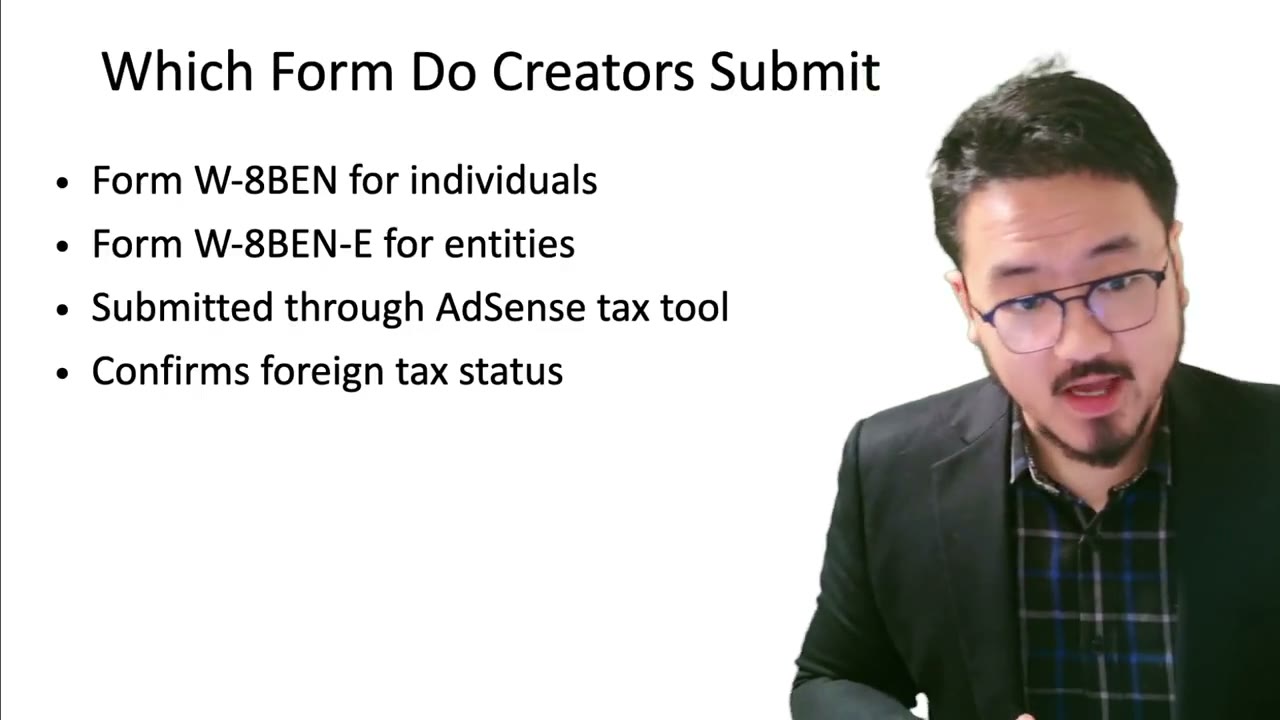
Platform documentation matters here because it shows how the rules are operationalized. Non-US individuals and entities generally submit a Form W-8BEN or W-8BEN-E; a payee claiming the income is effectively connected uses Form W-8ECI. Entity claimants taking a treaty rate must also satisfy the treaty's limitation-on-benefits (LOB) article. For YouTube, withholding applies only to the US-viewer portion of earnings when valid tax info is on file — the platform-level implementation of the royalty place-of-use rule.
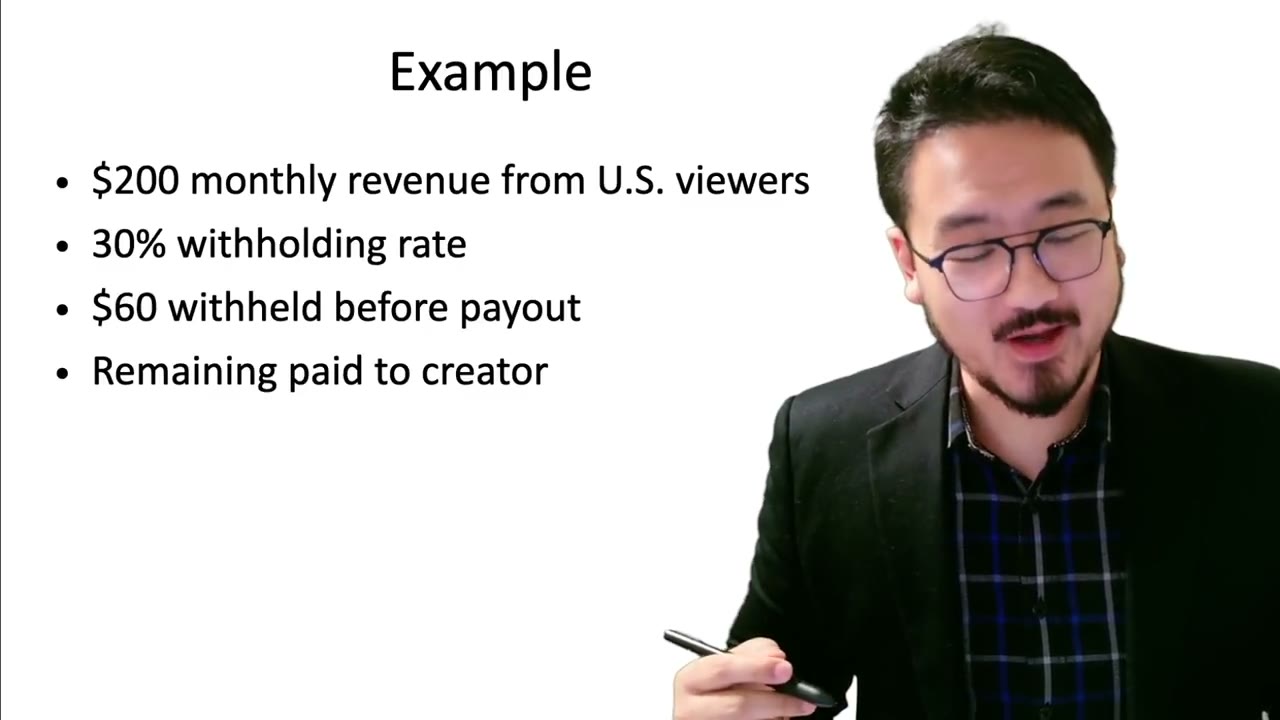
The 24% vs 30% distinction is routinely confused. 30% is Chapter 3 withholding (§1441) on US-source FDAP paid to a foreign person; a valid treaty claim can reduce it. 24% is backup withholding, which generally applies where the payee is presumed to be a US person or supplies invalid tax data. In practice, if no valid form is provided, an individual account can face 24% on worldwide earnings, while a business account with a payee outside the US can face 30% on US earnings — so missing or defective documentation, not the law's baseline, is what produces the worst outcomes.
For a foreign-owned US disregarded LLC, the withholding chain turns on who is the beneficial owner for Chapter 3 documentation. The Form 1042-S instructions say that when a withholding agent pays a disregarded entity that is not a treaty-claiming hybrid and holds a valid W-8BEN-E or W-8ECI from the foreign single owner, it issues the 1042-S in the name of the foreign single owner (using the owner's TIN where required). Only a disregarded entity that is itself a hybrid entity claiming treaty benefits becomes the recipient. So a plain-vanilla disregarded LLC usually does not block the owner-level Chapter 3 analysis — the foreign owner is the beneficial owner, and the treaty claim is made on the owner's W-8BEN-E.
4. No tactical 'FDAP vs ECI election'
A persistent myth is that filing W-8ECI is a switch a creator can flip to escape withholding. It is not. The W-8 instructions say to use W-8ECI only if the income is in fact effectively connected with a US trade or business, and they expressly say not to use it where the income is non-ECI for which the owner merely wants a reduced treaty rate — in that case the correct form is W-8BEN or W-8BEN-E.
W-8ECI is a representation that the identified income is ECI, and a withholding agent is entitled to rely on it as such. Signing one when the facts are not ECI does not create a favorable election; it creates a false statement and a likely return-filing obligation that does not actually exist. The honest sequence is: characterize the income under §§861-865 first, then pick the form the facts require. If the remote creator has no US trade or business, the income is FDAP/foreign-source, W-8BEN-E (with the treaty claim) is the form — not W-8ECI.
5. Information reporting — 1042-S vs 1099-NEC/MISC vs 1099-K
Three forms that answer three different statutory questions
The reporting forms are not interchangeable, and a creator LLC can legitimately receive more than one in the same year. Form 1042-S is the foreign-person / Chapter 3-4 form: it reports US-source income paid to a foreign person that is subject to withholding, and amounts reported on 1042-S must not be repeated on a 1099. If a payer first presumes a payee is US but documents it as foreign before filing, the IRS instructions say to report on 1042-S, not a 1099.
For calendar-year 2026 payments, the covered Form 1099-NEC/MISC threshold is generally $2,000; earlier payment years use their own threshold. These are domestic information returns. The same instructions flag the foreign overlay — payments to nonresident-alien performers belong on 1042-S — so payments to a properly documented foreign beneficial owner generally sit in the 1042 / 1042-S world rather than the ordinary 1099 world.
Form 1099-K is different again: it lives in the payment-settlement regime of §6050W. Payment-card and third-party-network payments that are reportable under both §6041/§6041A and §6050W are reported under §6050W — i.e., on 1099-K, not on 1099-NEC/MISC. A 1099-K reports gross amounts with no reduction for platform fees, refunds, or chargebacks, which is precisely why it cannot be read as taxable income on its own.
Reconciliation, then, is the real work. A foreign-owned disregarded LLC can receive a 1099-K from a processor while YouTube issues a 1042-S at the owner level on US-viewer royalties — the forms answer different questions and overlap. Keep one clean ledger that separates: gross card/marketplace receipts (1099-K), withholding statements (1042-S), any stray domestic 1099s, platform fees, refunds and chargebacks, foreign-source receipts, and owner contributions/distributions. The IRS itself says to use the 1099-K with your other records to arrive at correct taxable income.
6. What the LLC actually files — 5472 + pro forma 1120, then 1040-NR if needed
Independent of how the revenue is characterized, the disregarded LLC has a baseline entity-reporting duty. A foreign-owned US disregarded entity is treated as a corporation solely for the §6038A / Form 5472 regime and must file a pro forma Form 1120 with Form 5472 attached whenever it has a reportable transaction with a related party — by the due date including extensions (request more time on Form 7004). These filings cannot be e-filed.
What counts as a reportable transaction is broad. For a foreign-owned disregarded entity it includes not only ordinary monetary dealings but formation, dissolution, acquisition, disposition, contributions to the entity, and distributions from it — so many 'simple' owner-funding movements are themselves 5472 events. The penalties are severe and worth pricing in: $25,000 for a failure to file a complete and correct 5472 (and for failing to keep the required records), with a continuation penalty of another $25,000 per 30-day period after the cure window, and no maximum.
The 5472 + pro forma 1120 does not replace the owner's own income-tax return if one is otherwise required. For an individual owner that is Form 1040-NR (with Schedule NEC for income not effectively connected); for a foreign corporate owner it is Form 1120-F. The practical trigger for adding a 1040-NR is whether the owner has ECI to report, US-source FDAP that still needs return-level reporting or a refund/over-withholding claim (e.g., treaty rate not applied at source), or an unresolved treaty position. Recordkeeping is not optional — the entity must keep books sufficient to establish the correctness of the return and of every related-party transaction.
- Baseline: Form 5472 + pro forma Form 1120 for each year with a reportable transaction; paper filing only; Form 7004 for extensions.
- Reportable transactions include capital movements: owner contributions and distributions, plus formation/dissolution and acquisition/disposition.
- Add Form 1040-NR when the owner has ECI, US-source FDAP needing return reporting, an over-withholding/treaty refund claim, or a treaty position to disclose.
- Keep the ledger: statements behind every 1099-K, 1042-S, fee, refund, and owner transfer — the IRS expects records that substantiate the return.
7. Treaty royalty-rate patterns by creator country (and LOB)
Because most creator withholding pain sits in the royalty bucket, the treaty overlay is where a properly documented creator recovers the most. IRS treaty Table 1 covers income not effectively connected with a US trade or business and notes that, where the income is attributable to a US permanent establishment, a net-basis tax under the business-profits article applies instead of the reduced withholding rate. Rates always depend on the actual treaty text and protocols, and entity claimants must clear the treaty's limitation-on-benefits article.
For copyright royalties — the article that governs YPP US-viewer earnings — the current tables show a clear pattern. The rate is 0% for Canada, France, Germany, Ireland, Japan, the Netherlands, Spain, and the United Kingdom; 5% for Australia; 10% for South Korea; and 15% for India. A creator in a country with no in-force treaty reduction falls back to the statutory 30% ('Other Countries') rate. These are royalty-article rates and assume the creator is treaty-eligible and properly documented on a W-8BEN-E.
A worked contrast makes the mechanics concrete. A UK creator running a disregarded LLC, performing all work in London with no US staff or office, sees the YPP US-viewer slice as the only US-source royalty issue — and the UK copyright-royalty rate is 0% with a valid claim, while the remote sponsorships, Patreon access, affiliate links, and website AdSense are naturally foreign-source services. An India-based creator on identical facts has the same sourcing/ECI analysis but a 15% YouTube royalty rate on the US-audience portion (the figure platforms commonly use in their own examples). Either way the LLC still files 5472 + pro forma 1120, and owner contributions and distributions remain reportable.
Finally, recall the §865(d) catalog wrinkle from the first section: a creator who 'sells' a clip library or back-catalog for contingent consideration is sourced as if the payments were royalties. If that intangible is exploited in the US, the contingent piece can still draw treaty-rate (or, absent a treaty, 30%) withholding — a contract label does not change the source. Outcomes also shift if the LLC elected corporate taxation, the owner is a foreign corporation, the treaty country treats the LLC as fiscally transparent (a hybrid-entity question), or platform onboarding data causes a processor to presume a US payee — each of which warrants reading the specific treaty article and contract.
Royalty vs services at a glance
| Feature | Copyright royalty (YPP, memberships, Super Chat) | Services (AdSense, sponsorships, Patreon, affiliate) |
|---|---|---|
| Source test | Place of use — §1.861-5 (US-source on US-audience share) | Place of performance — §1.861-4 / §862 (foreign-source if performed abroad) |
| Typical US withholding | Chapter 3 FDAP, 30% on US-viewer slice (treaty may reduce) | Usually none if performed abroad (foreign-source) |
| Becomes ECI? | Only via US office (§864(c)(4)(B); Reg. §1.864-5/-6) | Only with US performance / US office / US personnel |
| Usual info return | Form 1042-S (owner level) | Often none for documented foreign owner; 1099-K from processors is gross |
Related on ForeignLLCTax
Primary sources
- IRC §§ 861-865 — source rules for income (services, royalties, sales of intangibles)
- IRC § 1441 — withholding of tax on nonresident aliens
- IRS — Source of Income (services where performed; royalties where used)
- Treas. Reg. § 1.861-4 — compensation for labor or personal services
- Treas. Reg. § 1.861-5 — rentals and royalties
- IRS — Effectively Connected Income (ECI)
- IRS — About Form W-8BEN-E (foreign entity beneficial owner)
- IRS — Instructions for Form 1042-S (recipient of a disregarded entity's payment)
- IRS — Instructions for Form 5472 ($25,000 penalty; reportable transactions)
- IRS — Tax Treaty Tables (Table 1, royalty rates by country)