Private Activity Bonds and AMT: What Investors Need to Know

Key Takeaways
- PAB interest is tax-exempt under regular tax but taxable under AMT
- Large PAB holdings can trigger significant AMT liability
- General obligation municipal bonds do not trigger AMT — PABs are the exception
- The AMT adjustment equals the full amount of PAB interest received
- Model the AMT impact before making large PAB investments
Private Activity Bonds and AMT
Private Activity Bonds (PABs) are municipal bonds issued to finance projects with private benefit — such as local airport expansions, affordable housing developments, or sports facilities. Interest from most municipal bonds is tax-exempt under the regular federal tax system. However, PAB interest is added back when calculating Alternative Minimum Taxable Income (AMTI).
How PABs Trigger AMT
Under the regular tax system, if you invest $1 million in PABs earning 5% interest ($50,000/year), that interest is tax-exempt and does not appear on your Form 1040 as taxable income. Under the AMT system, that same $50,000 is added back to your income for AMT calculation purposes.
This can create a significant AMT liability for investors with large PAB holdings. The higher your PAB interest income, the larger the AMT adjustment, potentially triggering AMT that exceeds your regular tax.
Planning Considerations
If you hold substantial PAB investments, monitor your AMT exposure annually. Consider diversifying into general obligation municipal bonds (which are exempt from both regular tax and AMT) rather than concentrating in PABs. Consult a tax advisor to model the AMT impact before making large PAB investments.
Frequently Asked Questions
Are all municipal bond interests subject to AMT?
No. Only interest from Private Activity Bonds (PABs) is subject to AMT adjustment. Interest from general obligation bonds and most other municipal bonds is exempt from both regular tax and AMT.
How do I know if my bonds are PABs?
Your broker or bond issuer should indicate whether the bond is a private activity bond. The information is typically disclosed in the bond offering documents and on your Form 1099-INT.
Never miss an IRS deadline
Get free email reminders for Form 5472, state annual reports, quarterly estimated tax, and OBBBA rule changes — built for foreign-owned LLC owners. No spam. Unsubscribe anytime.
We respect your privacy. No spam, ever.
Need to file your foreign-owned LLC return?
Skip the CPA bill. Our guided wizard builds your IRS-ready filing package, step by step.
Includes its walkthrough video pack
Start filing →
Ask the AI tools, free
Tax Return Drafter, Catch-Up Planner, Form Reviewer, IRS Notice Decoder — purpose-built AI tools, no signup needed.
Free tier · BYOK Anthropic/OpenAI for power use
Browse tools →
Starting your foreign-owned LLC?
Vetted partners we use ourselves: doola & Firstbase for formation, Mercury for banking, Alohi for IRS faxing.
No-fluff recommendations, no Northwest
See partners →
More on Alternative Minimum Tax (AMT)
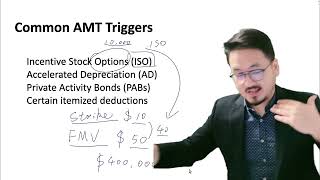 5:18
5:18ISO and AMT: How Incentive Stock Options Trigger AMT
 4:44
4:44Accelerated Depreciation and AMT: Common AMT Trigger
 4:22
4:22Alternative Minimum Tax (AMT) Explained Simply
 3:55
3:55Why the Alternative Minimum Tax Exists: A Brief History
 5:33
5:33AMT Credit Carryforward: Recovering Alternative Minimum Tax Paid
AMT Foreign Tax Credit and Form 8801 Guide